Extruded Shells With Integral Cooling Fins
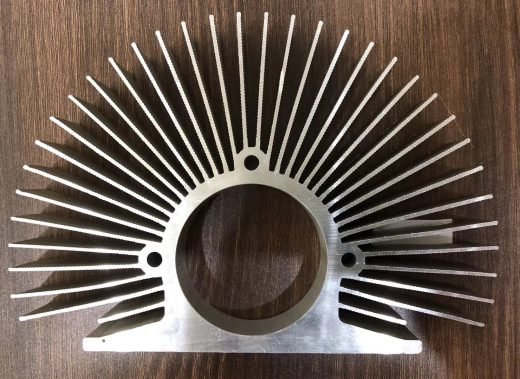
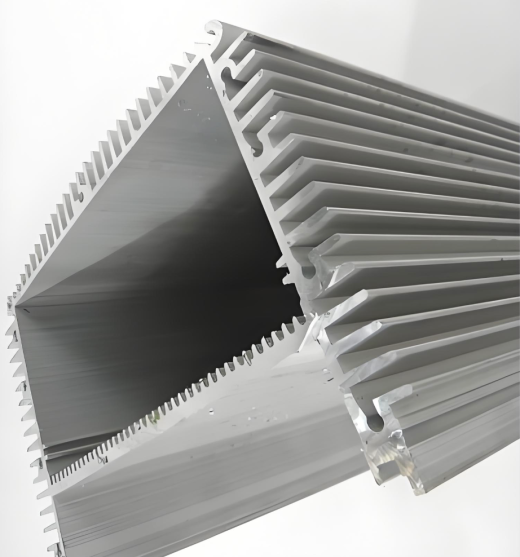
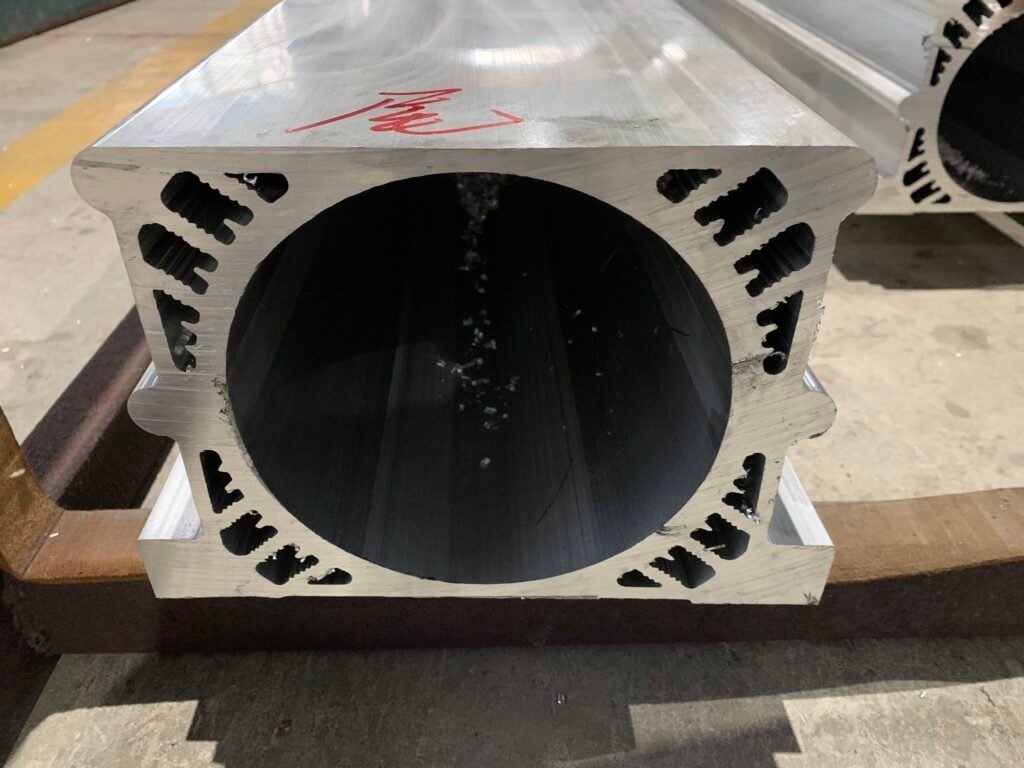
Die casting gives you complex shapes but charges long lead times and a tooling bill that makes small production runs unworkable. Off-the-shelf extruded tube leaves you bolting on separate heat sinks and machining every feature from solid. We take a third route: we extrude custom aluminum motor housings, round, square or fully custom in cross-section, with the cooling fins formed in the same pass. The housing is then machined so the inner bore and end faces meet the tolerances your rotor and end bells demand.
Fins That Perform, Not Just Look the Part
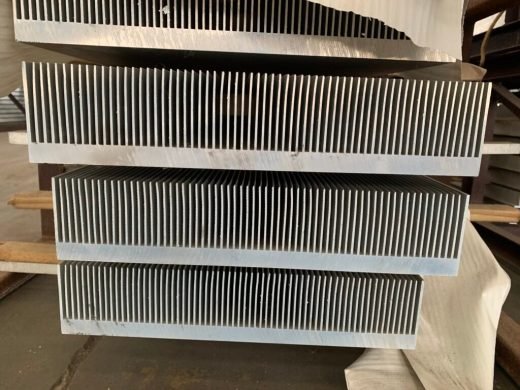
Tall, thin fins push against the physical limits of hot aluminum flowing through a die tongue. The die steel has to be thin enough to form the gap between fins and strong enough to survive extrusion pressure at around 500 °C. When the ratio of fin height to fin thickness exceeds roughly 15:1, standard die design and standard die steel stop holding up, and you get underfilled fins and broken tips.
We treat the thermal specification as a design input rather than an afterthought. Small changes to root radius, tip taper and wall transition can reduce die tongue stress by 20 to 30% while keeping the same total surface area, and we quantify those changes so your thermal engineer can verify them. When direct extrusion cannot reach the required fin geometry, we extrude a blank with thicker fins and skive them down on a CNC machine to a final thickness of 0.2 to 0.4 mm. Die tongues are cut from H13 or SKD61 hot-work steel, vacuum hardened and triple tempered, with tongue geometry checked every production shift.
Bores That Stay Round
A bore that is not round produces a motor that whines under load, with an air gap that varies around the circumference. The usual cause is wall thickness eccentricity: during cooling and straightening, the side with tall fins cools faster than the smooth side, setting up residual stress that releases unevenly when the bore is machined. We address it at three stages. The die is designed so the inner mandrel and outer die ring align precisely, and wall thickness eccentricity is monitored, holding wall variation within 5% of nominal on a typical housing. Every bar is tension-stretched after extrusion to 1 to 3% permanent elongation to pull out residual stress before machining, and for servo or spindle motors we can add a thermal stress-relief cycle. Finished housings are bored and spigot-faced in a single setup so concentricity between bearing seat and stator bore comes from the machining sequence rather than luck.
Cost: Extrusion Versus Die Casting
For tubular motor shells with external fins, extrusion tooling costs a fraction of die casting tooling and the die lead time is roughly half. We set the minimum order at 500 kg on a new die, which is enough for a serious pilot run or a small production batch: a typical motor housing weighs a few kilos per meter. The tooling fee is charged upfront and refunded in full once cumulative orders reach an agreed volume. Because we handle sawing, boring, spigot machining, drilling and tapping in-house, you qualify one supplier instead of two, with a single drawing and one batch of finished housings.
Alloy and Surface Finish Guide
6063-T5 is the standard for most motor housings. It extrudes well, anodizes evenly and handles the thermal and mechanical loads of servos, steppers and general industrial motors. 6061-T6 suits high-stress applications such as large EV motors, motors welded into a frame, or housings that double as structural members; it is roughly 50% stronger than 6063-T5 and takes welding without losing significant strength in the heat-affected zone.
Black anodizing is the industry standard for servo and stepper motors, boosting radiation heat transfer by 10 to 15% and providing good electrical insulation. Hard anodizing gives a thick, dense oxide layer with high dielectric strength for spindle motors. Natural anodizing is the cost-sensitive option, and powder coating fully encapsulates outdoor or marine-duty motors.
Tolerances and Delivery Options
Bore roundness is held to 0.05 mm as standard and to 0.02 mm with honing, with bore surface finish at Ra 1.6 µm or better on request. Spigot concentricity to bore is 0.03 mm, or 0.01 mm on request. Cut length is 0.10 mm, end face squareness 0.05 mm per 100 mm of diameter, and tapped holes are 6H class as standard.
We ship motor housings three ways. Extruded blanks are straightened and cut to rough length for customers who machine in-house, at the lowest cost. Pre-machined blanks are cut to finish length, rough-bored and faced square. Finished housings are fully machined with precision bored bore, cut spigot and register faces, drilled and tapped mounting holes, cable gland cross-holes and engraved serial numbers, cleaned and deburred. Lead time for a new die is 15 to 20 working days, plus 3 to 5 days for trial extrusion and sample machining.

 Industrial Aluminum