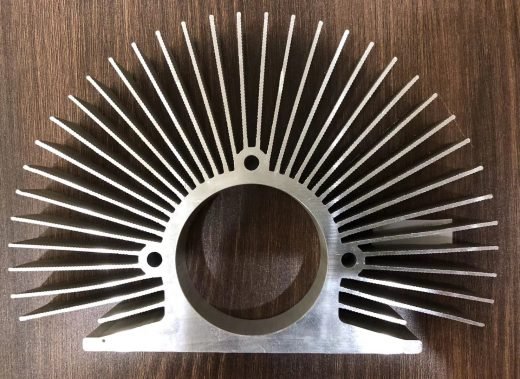
Custom Heat Sink Extrusions Engineered From Your Thermal Spec
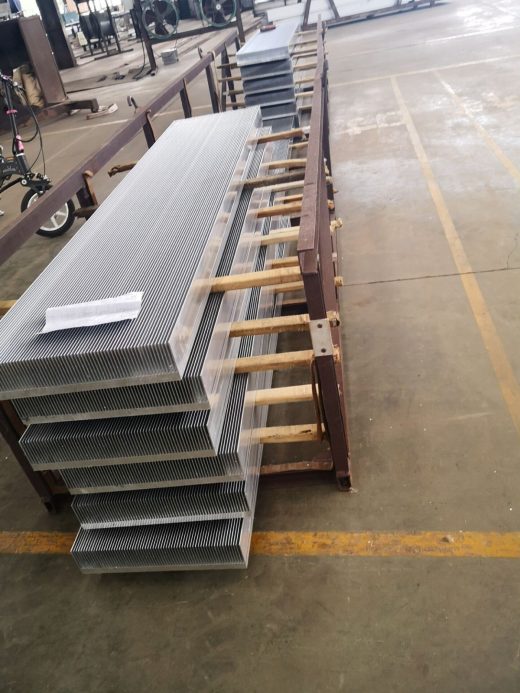
We extrude aluminum heat sink profiles to the exact cross-section your thermal design calls for. You can send a 3D drawing, a cross-section sketch, or simply the numbers: heat load in watts, ambient temperature, maximum junction temperature and cooling mode. Our die engineers evaluate fin height, fin-to-fin ratio, pitch, base thickness and tolerance against what is actually extrudable in 6063-T5 at production speed. If a feature will not fill properly, or the die tongue will not survive the run, we say so before anyone cuts steel, and we propose an alternative that delivers the same thermal performance.
Typical applications include LED street lights, high bay and flood luminaires, power inverters, UPS systems, variable frequency drives, CPU and GPU coolers, and EV onboard chargers.
Why 6063-T5 Is the Default Alloy
Pure aluminum conducts heat better, at roughly 230 W/m·K against about 200 W/m·K for 6063, but it is too soft. Extrude thin fins from 1050 or 1060 and they fold over coming out of the die, or bend the first time someone handles the part. 6063-T5 gives you about 85% of the thermal conductivity with enough mechanical strength to manufacture and use the component. That is the trade-off the industry has settled on, and it is our standard for heat sinks. 6061-T6 is available where the sink also acts as a structural member or has to be welded, and 6005A-T6 suits welded frame assemblies.
Fin Geometry: Real Capability, Not a Wish List
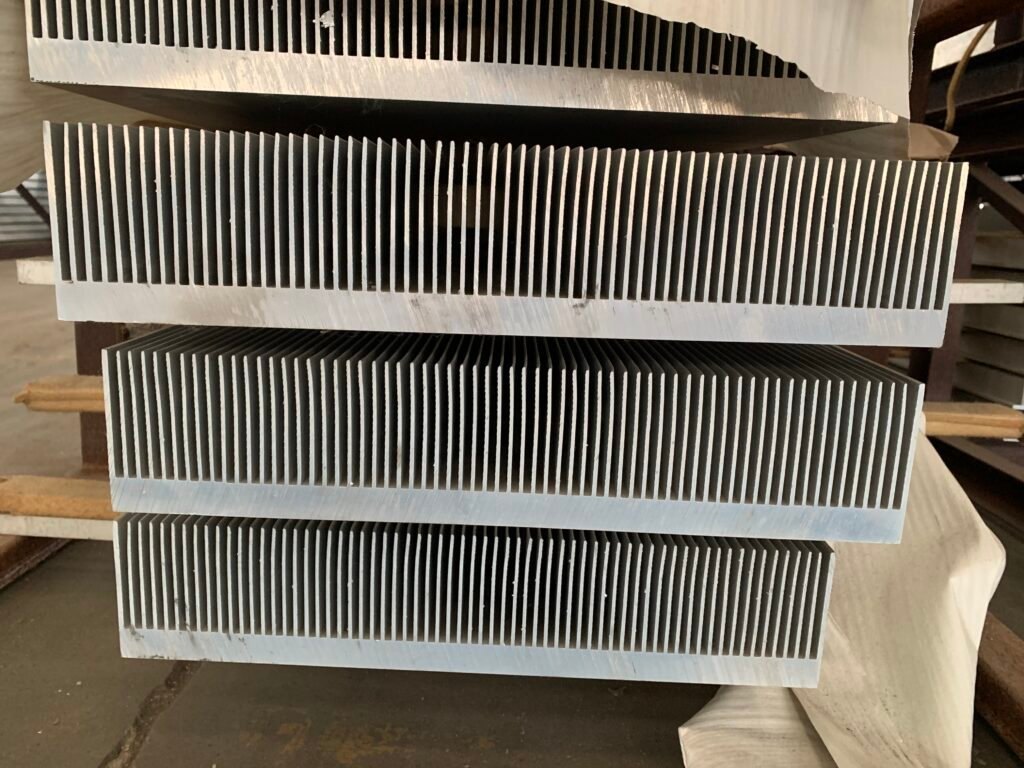
Fin density limits depend on fin height, not pitch alone. A fin under 10 mm tall can hold a tight 1.5 to 2 mm pitch. Push fin height to 50 mm and you need roughly 3 to 5 mm spacing, because the die steel that forms each gap needs enough material to survive extrusion pressure without cracking. Practical ranges: fin pitch from 2.5 mm standard with a 1.5 mm minimum; fin height up to 50 mm, and 80 mm with careful die design; fin tip thickness of 0.5 mm or more as-extruded; base thickness from 2 mm to 20 mm; profile width from 10 mm to 300 mm, with wider sections requiring a larger press. If your design sits outside these ranges, send the drawing anyway. Sometimes a small change to corner radii or fin taper is all it takes to bring it within extrudable limits.
Three Ways We Form Fins
Direct extrusion is the workhorse. Fins and base come out as one solid piece of aluminum, with no joint and no thermal interface resistance between fin and base. It suits fin heights under 50 mm and tip thickness above 0.5 mm, at the lowest cost and highest production speed.
CNC skiving covers what extrusion cannot. We extrude a blank with thicker fins and slice them down on a skiving machine to between 0.2 mm and 0.4 mm. This is how high-performance CPU coolers and server heat sinks are produced.
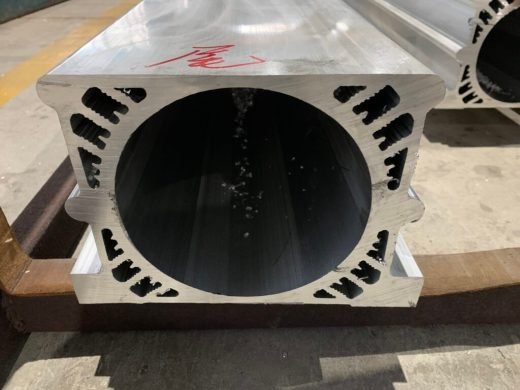
Bonded or inserted fins serve very large heat sinks, such as industrial drives, welding machines and traction inverters, where fin height exceeds what is practical in a single extrusion. Individual fins are bonded or mechanically pressed into a grooved base plate, giving large surface area without the die complexity and cost of a giant profile.
Surface Finish and Radiated Heat
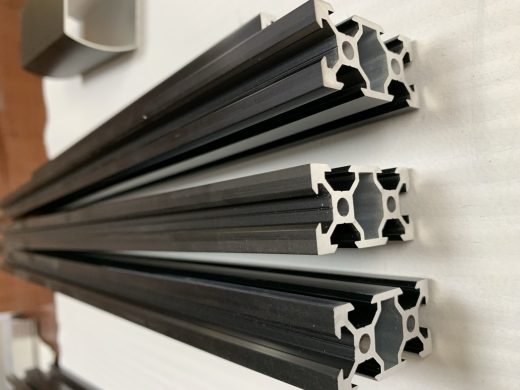
A heat sink both convects and radiates, and the radiation side is often overlooked. Mill finish has an emissivity of roughly 0.05 to 0.10, which is adequate for enclosed forced-air cooling. Black anodizing reaches about 0.85 to 0.90 and delivers a real, measurable 10 to 15% gain in natural convection; in forced air at high velocity the gap narrows to roughly 3 to 5%. Hard anodizing gives around 0.80 together with electrical isolation and a very durable surface. Sandblasted plus anodized exceeds 0.90. A simple rule: if the heat sink relies on natural convection, anodize it black. Anodizing is run in-house in black, natural silver, champagne and bronze.
Machining, Flatness and Heat Pipe Grooves
As-extruded mounting surfaces run about 0.2 mm per 100 mm of flatness, which is good enough for many applications. Power electronics customers usually need better, so we mill the base after extrusion and hold flatness to 0.05 mm or less across the mounting face, flat enough for a thin and uniform thermal interface layer. Secondary work in our own CNC shop includes cut-to-length at 0.1 mm, drilling and tapping from M2.5 to M6, deburring and cleaning so parts arrive ready to handle. We can also extrude a semi-circular or circular groove into the base to accept a heat pipe, in the common diameters of 6 mm, 8 mm and 10 mm, formed in the same pass as the profile.
Ordering
Minimum order is 300 kg for a new custom die. Heat sink profiles are light per meter, so that is usually a meaningful batch; prototyping from an existing die can run smaller. Standard length is 6 m cut to length from 100 mm, with up to 7 m extruded. Profiles are protected with in-line PE film and packed on pallets. Production runs under an ISO 9001:2015 quality system.

 Industrial Aluminum