Two Ways to Buy Aluminum Square Tube
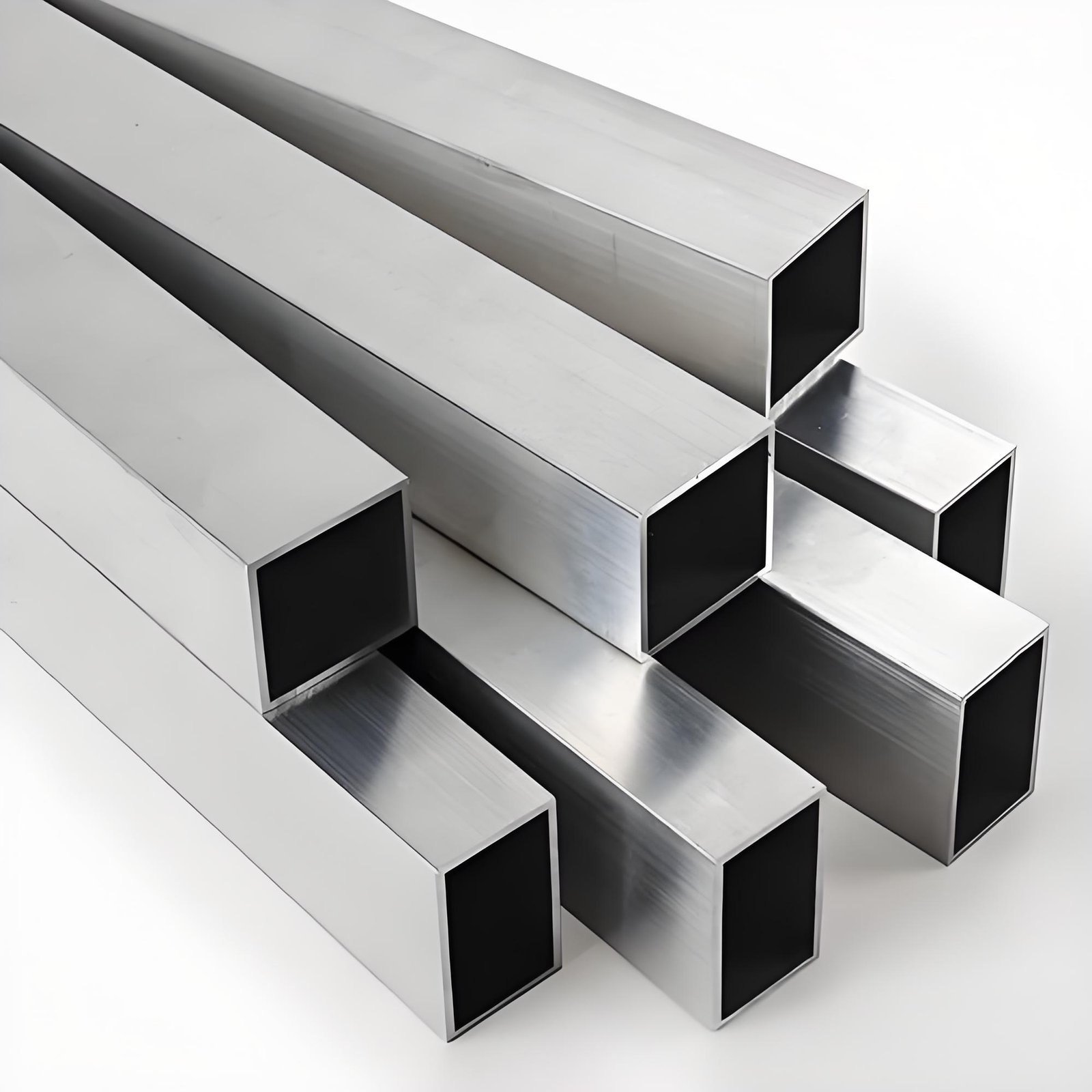
The first is a standard size. If your design calls for 50 x 50, 40 x 40, 80 x 40 or something similar, the die almost certainly exists already, which means no tooling charge: tell us the alloy, wall thickness, finish and cut length and the tube is produced against a live section. The second is a custom section. A specific corner radius, an unusual wall thickness or a size that sits off the catalog means a new die cut and extruded to your drawing. Either way the tube arrives cut to length, drilled or tapped where the design needs it, and labeled to match your bill of materials.
Standard stock tooling covers square sections from 20 x 20 mm to 100 x 100 mm and rectangular sections up to 150 x 50 mm, with wall thicknesses from 1.5 mm to 6.0 mm. Custom die lead time is typically 10 to 14 days.
Square Tube or Rectangular Tube?
The choice comes down to the direction the load acts in. Square tube is equal in both directions, so it is the right answer for vertical posts, columns and railing uprights where the force could arrive from any side. Rectangular tube puts more material into the tall direction, which is where bending resistance comes from. For a horizontal beam carrying weight across a span, an 80 x 40 section in the vertical orientation beats 50 x 50 on stiffness for roughly the same weight per meter. As a working rule: if the part stands upright and takes compression, square is usually right; if it spans horizontally and takes bending, rectangular is usually more efficient.
Load and Span: A Starting Point, Not a Certification
| Span | Light load (under 30 kg) | Medium load (30-100 kg) | Heavy load (over 100 kg or point load) |
|---|
| Up to 0.8 m | 30 x 30 x 2.0 mm | 40 x 40 x 2.5 mm | 50 x 50 x 3.0 mm |
| 0.8-1.5 m | 40 x 40 x 2.5 mm | 50 x 50 x 3.0 mm | 60 x 40 x 3.0 mm |
| 1.5-2.5 m | 50 x 50 x 3.0 mm | 60 x 40 x 3.5 mm | 80 x 40 x 4.0 mm |
| Over 2.5 m | Send us the details | 80 x 40 x 4.0 mm | Needs proper calculation |
This table assumes 6063-T5 with evenly distributed load and simple supports. There is no single answer without knowing whether the load is concentrated or distributed, whether the member is supported at both ends or cantilevered, and whether the duty is static or dynamic. Stepping up to 6061-T6 often allows a smaller section for the same load, because its yield strength is roughly 50 percent higher than 6063-T5. If failure could hurt someone, on a walkway, a raised platform or a vehicle structure, do not use a table: send the load case and we will check the section properly.
6063-T5 or 6061-T6?
| Property | 6063-T5 | 6061-T6 |
|---|
| Tensile strength | 160 MPa | 290 MPa |
| Yield strength | 110 MPa | 240 MPa |
| Anodized appearance | Clean, bright, even | Grayish, less uniform |
| Bending | Good | Poor without annealing |
| Welding | Acceptable, light loads | Excellent |
The short answer: decorative or lightly loaded work uses 6063-T5; structural, welded or safety-related work uses 6061-T6. Welding derates 6061-T6 by roughly 40 to 50 percent in the heat-affected zone, effectively dropping it to a T4 condition, so structural welded assemblies must either account for that in the calculations or be restored by post-weld solution treatment and aging. We also supply 6005-T5 for solar mounting and rail applications, since it is stronger than 6063-T5 and still extrudes at sensible speeds.
Bending Limits for Square Tube
Small sections bend easily and large sections do not. Sections up to about 40 x 40 mm bend reliably with standard tooling, while 50 x 50 mm and above usually need a generous radius and a wall thick enough to support the bend. A practical minimum bend radius for square tube is roughly three times the section size, measured to the centerline; tighter than that and the inside wall starts to cave. 6063 bends better than 6061, and 6061-T6 tends to crack on tight bends unless it is annealed first, which adds cost and time.
Why Two Quotes for the Same Tube Differ
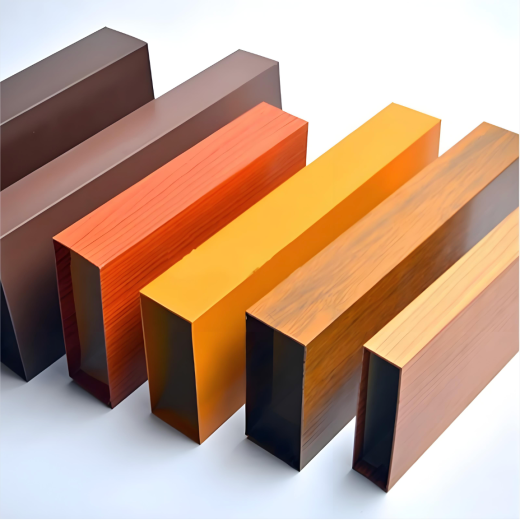
Identical dimensions on paper can be a different product in reality. A 50 x 50 x 3.0 mm tube may be produced at an actual wall of about 2.7 mm if the supplier runs to the loose end of the tolerance, which means less aluminum per meter. Billet quality shows up after anodizing, and straightening method shows up after cutting: tension-stretched tube stays straight where roll-straightened tube can spring back. Delivery condition is the last variable, since a raw bar costs less than a pre-cut, deburred piece until you add your own sawing and labor.
What We Do in the Factory
Billets are heated to 480-520 degrees Celsius and pushed through the die. 6063 runs fast; 6061 runs slower and wears tooling harder, which is part of why it costs more. Section dimensions are held to GB/T 5237.1 and checked every 50 bars. Every tube then passes through a tension stretcher at 1 to 3 percent past yield, which is what keeps a bar straight after it is cut into ten pieces. Cutting is done on precision saws to plus or minus 0.1 mm with square, burr-free ends, and cut lists can come straight from your BOM or drawing. CNC drilling is programmed from a single datum and holds hole position to plus or minus 0.15 mm, with tapping to 6H class from M3 to M12 and thread milling where the design calls for it. Rotary draw and roll bending handle curved sections after evaluation of radius, section and wall thickness.
Finishing is in-house: anodizing to AA10, AA15 or AA20 with nickel salt sealing, and powder coating in standard polyester, super-durable polyester or PVDF. Because machining and coating happen in the same building, a tube never leaves the site between operations. Packing puts a protective PE film on visible faces, foam separators between layers and waterproof stretch wrap over the bundle, then pallets or steel-reinforced crates for export, with labels on every piece for kit orders.
Every shipment includes an EN 10204 3.1 mill test certificate listing heat numbers, chemical composition and mechanical results including tensile strength, yield strength, elongation and Webster hardness. Third-party inspection by SGS, TUV or Bureau Veritas can be arranged before dispatch. Standard mill length is 6 m and minimum order quantity is 500 kg.

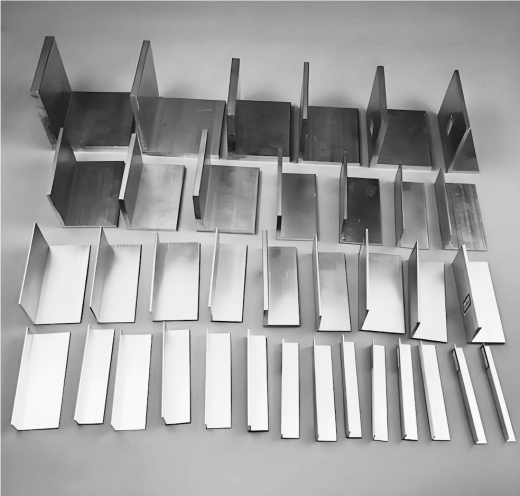 Standard Aluminum Shapes