Tube or Pipe? Specify the Right Product First
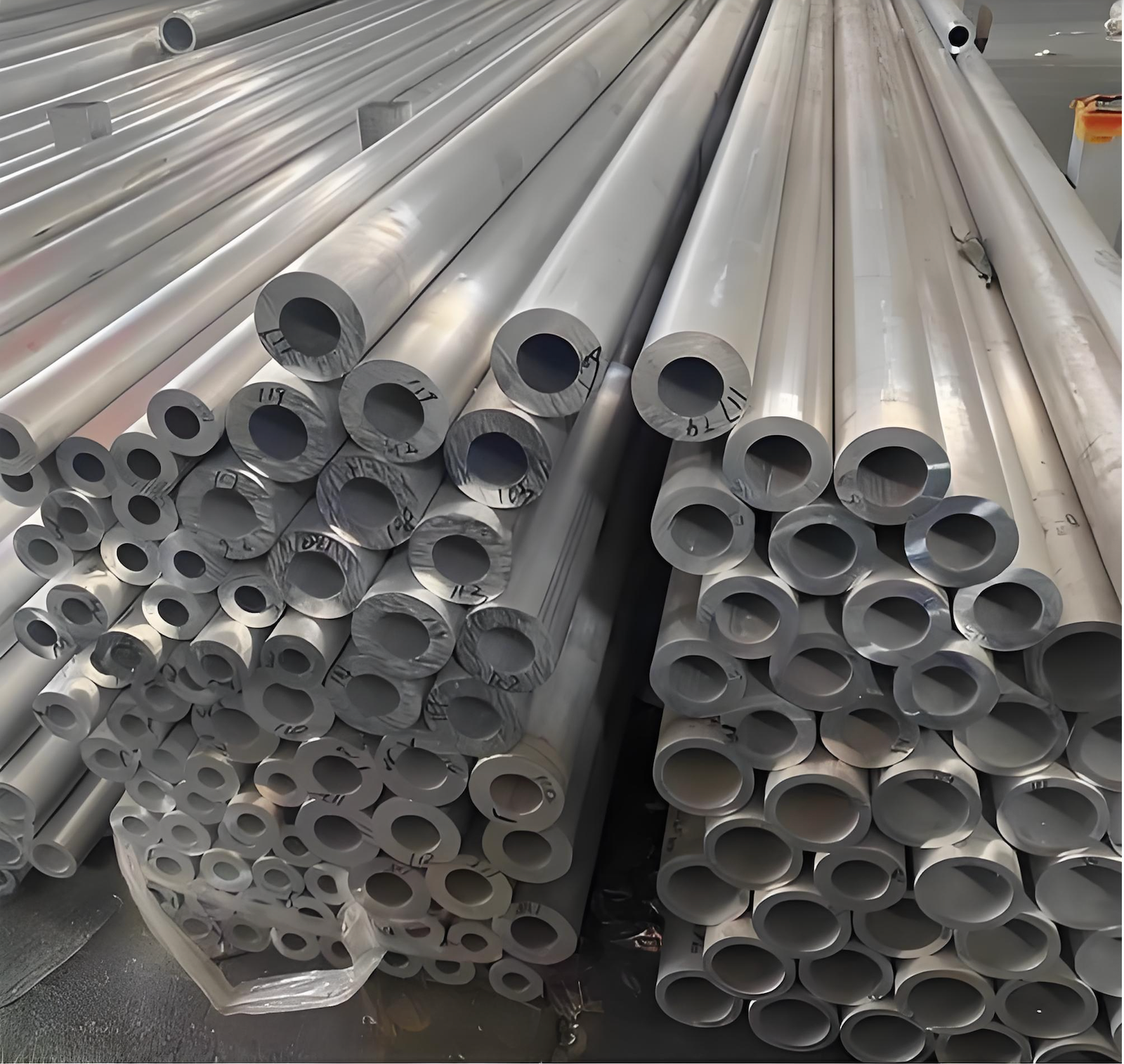
Both words describe a hollow cylinder, and confusing them costs a project weeks of fittings that will not seat. A tube is specified by its exact outside diameter and wall thickness, and its standards are ASTM B210, B221 and B345 for extruded tube. A pipe is specified by nominal pipe size and schedule, under ASTM B241 or B429, and it carries fluid and gas.
| Point | Tube | Pipe |
|---|
| Specified by | Exact OD plus wall thickness | Nominal pipe size plus schedule |
| Tolerance | Tighter, typically 10 percent on wall | Schedule based, looser on bore |
| Shape | Round, square, rectangular, oval, custom | Round only |
| Primary use | Structural, heat exchangers, precision frames, handrails | Fluid and gas transport, pressure piping |
The practical trap: a 2 inch pipe is actually 2.375 inch outside diameter. A tube ordered as 2.000 inch OD will not fit a 2 inch pipe flange. Send the standard with the request, ASTM B221 for tube or ASTM B241 for pipe, and the ambiguity disappears before the order is placed.
Three Manufacturing Routes and What Each One Gives You
- Seamless extruded tube. A heated billet is pressed through a die around a fixed or floating mandrel, so the metal welds to itself as it exits and leaves no longitudinal seam. Grain structure is uniform around the circumference, concentricity is excellent and pressure capability is the highest of the three. This is the route for hydraulic lines, high-pressure pneumatic tube, heat exchanger elements and critical structural members.
- Welded (ERW) tube. Strip is roll-formed into a cylinder and welded along the longitudinal seam, with the bead normally scarfed inside and out. It is the economical route, particularly above roughly 100 mm outside diameter. The weld seam is metallurgically distinct from the parent metal, so ERW is best kept to handrails, furniture, structural tube and low-pressure fluid lines.
- Drawn-over-mandrel (DOM) tube. Welded tube is cold-drawn over a mandrel, which work-hardens the wall, refines the grain and tightens dimensions substantially. The result is precision bore and outside diameter, a smoother surface and higher mechanical properties than the as-welded product. DOM is the specification for hydraulic and pneumatic cylinder tubing and precision shafts.
One rule governs the choice where forming is involved: if the tube will be bent, flared or swaged, specify seamless or DOM. The weld seam of ERW tube tends to crack or thin on the outside of a tight bend. If ERW is unavoidable, keep the seam on the neutral axis of the bend to reduce crack risk.
Alloy Selection by Duty
6061-T6 is the structural workhorse with a minimum yield of 240 MPa and tensile of 260 MPa; it welds and machines well and is the default for framing, handrails, machinery frames and transport equipment. Welding drops the heat-affected zone to roughly 60 to 70 percent of T6 strength, so welded assemblies need a design allowance. 6063-T5, at 110 MPa yield and 160 MPa tensile, extrudes cleanly and takes the brightest anodized finish, which suits visible architectural tube, irrigation, condensate lines and decorative trim.
7075-T6 is the strongest alloy in common commercial use, with yield around 503 MPa and tensile around 572 MPa, and it is reserved for weight-critical work such as motorsport and aerospace components. Its corrosion resistance is poor and it is not welded conventionally, so it is the wrong answer near salt water or in a welded assembly. 5052 and 5083 are non-heat-treatable marine alloys with excellent salt-water and chemical resistance, and 5083-H116 reaches about 215 MPa yield. 3003-O is the classic drawn tubing for refrigeration, air conditioning and low-pressure fluid transport: low strength, excellent formability, brazed into headers and bent into coils.
Pressure, Fatigue and Bend Limits
For thin-wall tube under internal pressure, use the hoop stress relationship P = (2 x S x t) / D, where S is allowable stress, t is nominal wall thickness and D is outside diameter. Take a 6061-T6 tube at 50 mm outside diameter with a 3 mm wall, a yield of 240 MPa and a safety factor of 4: the allowable working pressure works out at approximately 7.2 MPa, with burst at yield around 28.8 MPa. Use a safety factor of 3 to 4 for cyclic or uncertain service and a factor of 2 only for static, well-understood duty. Pressure piping also needs delivery against ASTM B241 rather than B221 alone.
Bending is the second check. A common rule for cold rotary draw bending is a minimum radius of about two times the outside diameter, and radii down to half the outside diameter require mandrel bending to stop the inside wall wrinkling or collapsing. Temper dominates formability: annealed O temper bends to roughly one times diameter and can be aged afterwards, T4 bends to about two times diameter, and T6 cracks at tight radii so it should not be taken below roughly three times diameter without a mandrel and likely pre-heating. Where cyclic loading is the design driver, 6061-T9, which is T6 cold-worked after aging, raises fatigue strength significantly at the cost of ductility; bend first and age to T9 afterwards.
Tolerances, Concentricity and Documents
Per ASTM B221 and EN 754-7, outside diameter is held to plus or minus 0.10 to 0.25 mm depending on size, wall thickness to plus or minus 10 percent of nominal, roundness to 1 percent of outside diameter or better, and straightness to 0.8 mm per 1,000 mm. Standard cuts hold plus or minus 1 to 5 mm and precision cuts plus or minus 0.1 to 0.5 mm. Concentricity is where tube differs most from angle or flat bar: seamless extruded tube holds around 5 percent wall variation around the circumference and DOM tube around 2 percent. For a press fit into a header or a precision boss, specify the concentricity you need rather than assuming the default is tight enough.
Every order ships with a mill test certificate to EN 10204 3.1 carrying measured mechanical properties, chemical composition and dimensional records, issued against ASTM B210, B221, B241 or EN 754 as the project requires. Finishes include mill finish, anodizing at AA10, AA15 or AA20 for visible handrails, powder coating at 60 micrometers and above, and PVDF for high-UV or coastal sites. Minimum order quantity is 500 kg, and standard bars are supplied in 6 m lengths in brown paper wrapping.

 Standard Aluminum Shapes