Extruded to Your Drawings for Outdoor Duty
Your crossbars sit under direct UV 365 days a year. Your tent frames get folded, rained on, yanked and shoved back into gear bags. When an anodized coating fades, a sliding mechanism jams, or a mounting hole misses by a millimeter, the end customer blames the brand, but the failure usually started at the extrusion press.
We extrude, machine and finish custom aluminum profiles engineered for automotive roof racks and outdoor camping systems. You supply CAD drawings or physical samples; we build the die, execute post-extrusion CNC machining, apply outdoor-grade surface treatments and ship finished components. We do not push close-enough standard catalog shapes.
Sun: UV-Stable Finishes, Not Dyed Black Anodizing
A roof rack crossbar in direct summer sun can reach 70 to 80 °C at the surface, and the UV exposure never stops. Organic dyes and cheap resins break down under that punishment: dyed black anodized profiles look sharp out of the box and turn reddish then grayish after two or three years, while a wrong powder chalks and loses gloss until a finger drawn across it comes away white.
We do not use indoor-grade powder on outdoor parts. For roof racks and tent frames we use super-durable polyester powder rated for 1000+ hours of xenon arc weathering, or PVDF fluorocarbon if the rack is permanently mounted and the owner expects it to look the same in year ten as on day one. For anodized finishes we go to AA15 or AA20 thickness rather than AA10, and seal with high-temperature nickel salt rather than a quick cold dip, because sealing is what stops the oxide pores absorbing moisture and contaminants.
Rain and Standing Water: Drainage Designed Into the Die
Rainwater itself is not the enemy; what it leaves behind is. Water pools in T-slot channels, inside tube ends and around bolt holes, dries, pools again, and each cycle deposits a trace of whatever was dissolved in it, including road salt, dust and pollution. Over months those traces concentrate and attack the anodized layer from inside the pores.
For profiles with closed cavities or upward-facing channels we can incorporate drainage slots or weep holes at the extrusion stage, positioned where water naturally collects. If your drawing already includes them we machine them precisely. If it does not and we spot a water trap, we flag it during die review and you decide whether to add drainage.
Thermal Cycling and Pretreatment
A 1.5 m roof rack crossbar expands by about 2 mm between a cold morning and a hot afternoon. The aluminum moves and the coating has to move with it. Anodizing is part of the aluminum and expands at the same rate, so it does not crack. Powder coating and PVDF rely on adhesion: if pretreatment was done properly the coating stretches with the metal, and if it was skipped or rushed the bond fails at the interface after enough cycles and the coating lifts in sheets.
Pretreatment, whether chrome or chrome-free passivation before anodizing or powder coating, is where we do not cut corners. It costs a few cents per kilo and time in the line, and it stops filiform corrosion, the thin white worms that creep under a coating from a tiny scratch.
Tolerance Problems Behind "Cheap-Feeling" Racks
Read enough owner reviews and the same complaints repeat, and they are manufacturing problems rather than design problems.
- A crossbar adjuster that needs kicking into position. A telescopic or sliding mechanism needs a controlled gap between inner and outer profiles. You cannot hit a consistent 0.2 mm clearance if tube dimensions wander by 0.3 mm across a batch, so we CNC machine the sliding surfaces after extrusion and hold the clearance your drawing specifies. If it does not specify, we ask.
- Mounting holes that do not line up. We drill every hole on a CNC machining center from a single datum per part, with position tolerance of 0.15 mm across the batch. For a system where crossbar, rail and foot bracket must bolt together, all parts are machined in the same production window using the same reference setup, and we spot-check assembly before packing.
- Crossbars that are not parallel. A crossbar that left the plant with a 3 mm bow never mounts flat. We tension-straighten every profile after extrusion and hold straightness to 0.5 mm per meter or better. Where the drawing specifies a designed arc for aerodynamic or load reasons, we straighten to that arc rather than to a flat line.
What We Make and How We Finish It
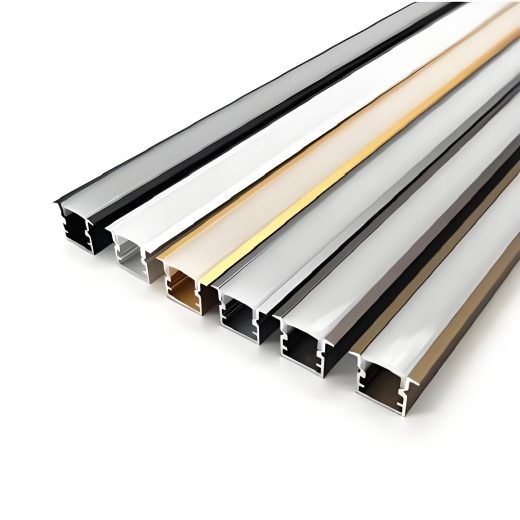
Roof rack crossbars are typically aerodynamic oval, rectangular or T-slot top sections in 6061-T6 or 6063-T6. Roof rails and side rails are curved or straight profiles, raised or flush mount. T-slot mounting tracks for accessory attachment run in 6063-T5. Foot bases and clamps are shaped blocks and clamping jaws in 6061-T6. Tent frame poles are round, oval or rectangular tubes in 6063-T5 or 7005-T6, telescopic pole sets pair an inner and outer tube with machined locking collars, and hinge extrusions form pivot bodies and folding joints.
Finishes include AA15 anodized with nickel sealing for roof rails and metallic-look tent poles, AA20 for premium racks and marine tent frames, super-durable polyester powder in full RAL colors for colored crossbars and tent frames, PVDF fluorocarbon for permanently mounted racks and overlanding systems, and electrophoretic coating for hidden structural parts and internal tubes. All finishing is done in-house, and every profile for one order passes through the same tank or booth on the same shift, so roof rails match crossbars and foot covers.
We also rotary-draw and roll-bend tubes to your specified radius, ream pin holes to H8 tolerance and press stainless bushings where wear matters, and ship pre-machined parts cut, drilled, tapped and labeled so your team bolts or pins the assembly together. Minimum order is 500 kg on a new die, or 200 kg from an existing die.

 Industrial Aluminum