
Why Batch Two Never Quite Matches Batch One

Same colour, two batches, a line you can see on the wall. What actually moves in anodising, powder coating and wood grain, and what to write into the order.
Two batches of the same colour, made three months apart, rarely read as the same colour on a wall. The joint between them becomes a line you can see from the car park, and by then nobody is arguing about the ink or the powder. They are arguing about whose fault it is.
The three finishes we run in our own plant fail in different places, and the controls sit in different rooms. Anodising is a transparent film over a metal that varies. Powder is an opaque film whose colour is the film. Wood grain is a printed ink that sinks into that film and takes its tone from the base coat underneath.
What does ΔE 1.5 actually cover?
GB/T 5237.4-2017 asks for ΔE*ab ≤ 1.5 against the agreed sample, and ≤ 1.5 between profiles within one delivery batch, measured instrumentally per GB/T 11186.2 and 11186.3. Qualicoat approval is measured against the certified RAL card under D65 and the 10° observer, specular reflection included, with limits that depend on the colour (these are ΔE*ab values; ΔE2000 readings run lower and are not interchangeable): 2.0 is common, some greys sit at 1.0 to 1.4, and the widest entries reach 6.0 and 8.0 on a few yellows. Matt and textured finishes get a corrective factor of 1.3.
Both schemes answer a narrow question. GB/T 5237.4 compares a part to a sample and to its own delivery batch. Qualicoat compares a powder to a RAL card. Neither bounds the difference between the batch delivered in March and the batch delivered in June, which is the difference a project manager sees. The arithmetic is unforgiving: two powder lots can each sit 1.9 away from the card on opposite sides, pass approval, and land 3.8 apart from each other. That gap is where most colour disputes live.
Why does anodising shift between batches?
The oxide film is ten to fifteen microns of transparent alumina with no colour of its own. We run that film in AA10 and AA15 on anodised window and door profiles and on curtain wall extrusions. What you see is the alloy underneath, filtered through pore structure and film thickness. The same dye bath produces different shades from different billets.
Chemistry sets the tone before anything enters the tank. Silicon above roughly 1%, where it is not in solid solution, gives a cloudy grey cast. Copper above about 0.2% produces a speckled brown, and copper-bearing alloys anodise unevenly because the Al₂Cu particles do not convert at the same rate as the matrix. Manganese and chromium show at 0.1% as a yellow cast; magnesium above 5% dulls the film; zinc is forgiving up to about 2%.
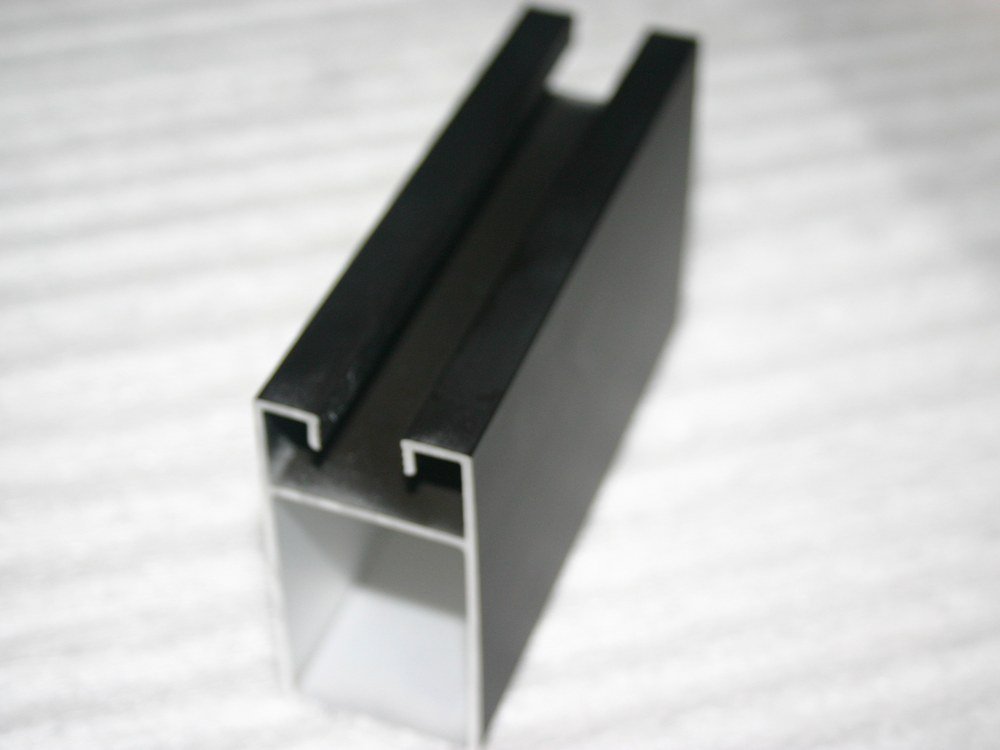
Two billets carrying the same 6063 designation do not necessarily carry the same silicon-to-iron ratio, and recycled content moves it further. A supplier switch mid-project will show on the wall and will look like the anodiser's fault.
Extrusion feeds into the same result. Quench rate changes how much Mg₂Si stays in solution, which changes how the surface etches and how deep the matte runs. Die lines, chatter and belt marks do not disappear under a transparent film; they read as streaks of a different colour because the film follows the surface.
Inside the line, the parameters with the tightest tolerances matter most. Bath temperature is held to about ±1 °C — run hotter and the film grows more porous, takes more dye, comes out darker. Acid concentration and dissolved aluminium drift over a shift. Current density changes dye uptake at a fixed film thickness, and current is never spread perfectly evenly across a rack, so a long profile can colour slightly lighter where contact and geometry give it more current.
Film class is a colour variable as much as a durability one. AA10 and AA15 do not look the same in champagne or bronze, because the light path through the film differs. Moving a project between classes without telling anyone is a colour change.
Then colouring. Organic dyes depend on concentration, pH, temperature, time and water quality. Electrolytic colouring with tin deposits metal at the base of the pores: roughly 200 mg/m² for a light bronze, around 2,000 mg/m² for black, with about 7 to 8 microns of tin needed for a true black. Both routes are sensitive to pore uniformity and to the barrier layer, so variation in the anodising step arrives at the colour tank as variation in shade.
Sealing closes the pores and shifts the shade slightly — different seal chemistries move the colour a little green or yellow, and sealing below pH 5 leads to colour deterioration that shows up later, not at despatch. Sealing quality is measurable: the nitric-acid pre-dip phosphochromic test holds mass loss to 30 mg/dm² or less.
GB/T 5237.4 judges colour against an agreed sample, and that is the control we run: the board the customer signed off, held as a physical reference rather than a RAL number on a purchase order. Every production batch is compared against that board before packing — anodised tones in daylight at about a metre, powder against the same board, wood grain against its own approved sample. The board is kept indoors, away from sunlight and away from salt air and damp; under those conditions it holds its colour for years, which is what makes it usable as a reference across a long project. It belongs to the project rather than to the plant, and each comparison is recorded against the carton batch number. A batch that reads differently at that distance is held and re-checked before it goes into the crate.
The one-metre rule exists because ΔE on a transparent film over brushed or sand-blasted metal correlates poorly with what a person sees at distance. GB/T 5237.4's three-metre viewing distance belongs to surface defects, not to colour matching; the two are separate checks and should be quoted separately. On bronze, black and gold we judge in daylight at about one metre against that board. If the difference is not visible there, it is normal process behaviour. If it is, the batch is out of control and the records will show where.
Where does powder coating lose colour?
The film is opaque, so it carries the whole result. Four things move it. The same variables apply to powder coated window and door profiles, where a project usually runs to several hundred kilos per section.
Powder lot first. Pigment dispersion shifts slightly from lot to lot, and every supplier works to its own tolerance against the RAL card. Two lots can both be inside their specification and still differ visibly when they meet on the same elevation. A project should reserve its powder in one lot at the start rather than reordering as the site consumes it.
Film thickness second. GB/T 5237.4 asks for at least 40 microns locally on decorative faces, averaging 60 to 120. Light colours are the sensitive ones: a film that runs 60 microns on one elevation and 80 on the next reads as two shades in white, and hardly at all in anthracite. Thickness also varies by geometry — inside corners and returns always run thinner.
Cure third, and this is the one most often measured in the wrong place. What matters is the metal temperature of the part, not the oven air. A heavy section and a thin one on the same line at the same speed do not reach cure temperature together. Overbake is the common failure: a line stop, a re-run, or a heavy extrusion left in too long will yellow whites and shift blues and greens, permanently. Under-cure is quieter — the colour looks close, the film is soft, and adhesion fails months later.
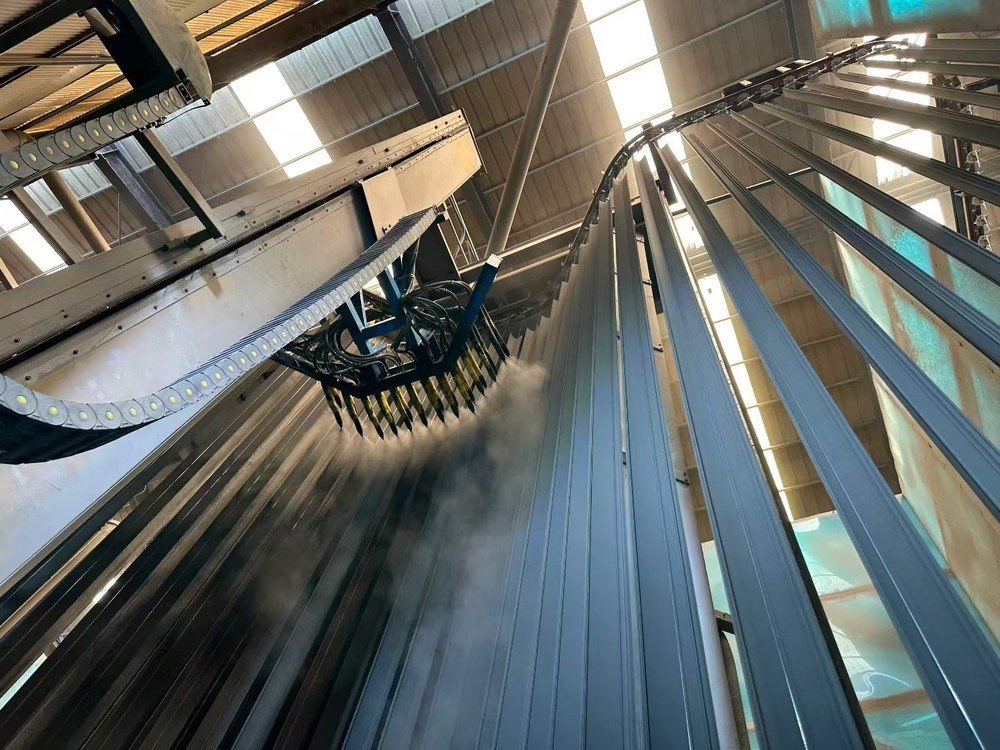
Metallic and mica finishes add a fourth. Effect pigment has to sit at a consistent orientation, and orientation responds to gun voltage, distance, part angle and grounding. Reclaim is where most plants drift: overspray does not come back with the same flake-to-binder ratio, so a reclaim percentage that suits a solid colour will move a metallic. Bonded metallics are more stable than dry blends; project work should run on fresh powder. A single-angle reading can also agree on a metallic while the flop does not, which is why these finishes still get judged by eye at two or three angles.
Underneath sits the substrate. Powder covers the base metal, which is exactly why some suppliers run secondary billet at the minus side of the tolerance and let the coating hide it. Shade and adhesion both suffer, usually after the material has left the plant.
Why wood grain drifts three times
Wood grain is a fully cured base powder coat with a printed film pressed onto it under heat and vacuum. The ink sublimates and moves tens of microns into the coating — published figures range from about 20 to 60, depending on base film and cycle — so the grain lives inside the film rather than on top of it. The base coat is part of the final colour, not a primer hidden underneath.
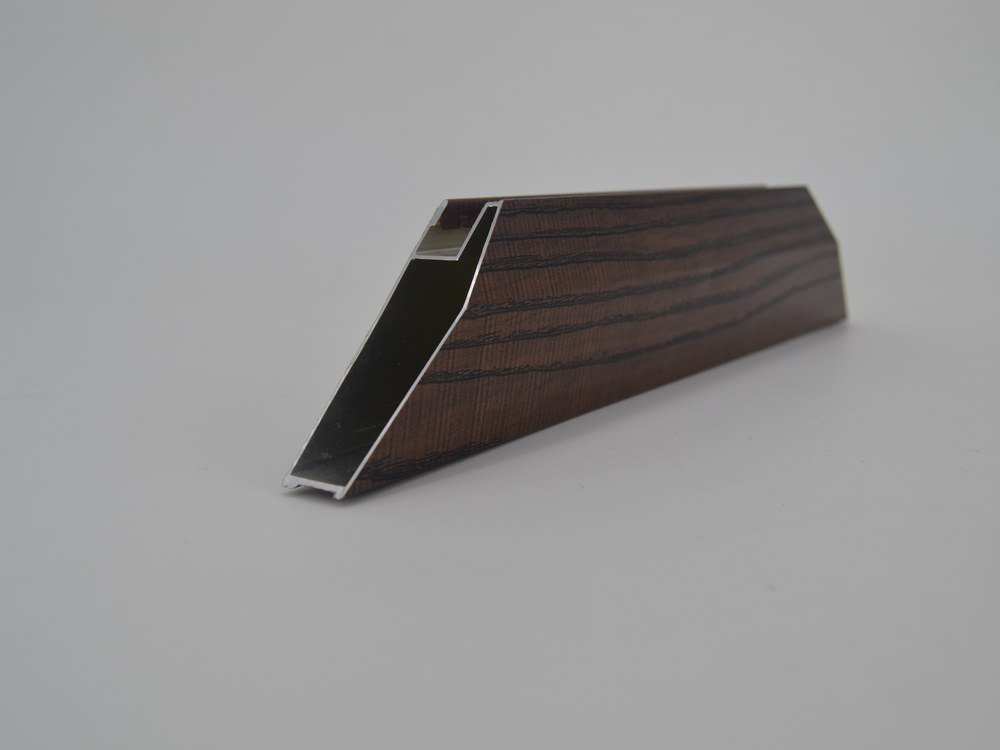
That is why one change can move everything: the base coat sets tone and gloss, and a different base powder lot shifts the whole result even with identical transfer film. A wood grain order should fix base colour and film together, as one package.
The film varies by printing lot and it is perishable. Rolls stored above about 20 °C lose ink volatiles and transfer lighter. The vacuum window usually sits between 175 and 200 °C for 12 to 18 minutes, though published practice ranges from 7 to 25 minutes depending on section and film, with the bag pulled to roughly −0.09 to −0.1 MPa and held a few minutes to check for leaks. Below the window the grain is pale and weakly bonded; above it the ink spreads, line definition goes, and past about 195 °C with a long dwell the film sticks and the surface can lighten instead of darken.
Geometry decides whether heat and vacuum arrive evenly. Grooves, returns and hollow chambers are where the bag bridges, the vacuum leaks at the ends and the grain comes out patchy. Oven position matters: the difference between the front and the centre of a transfer oven is enough to change shade on one load. Cooling is the step that gets rushed — peeling while the part is still hot smears the ink, and that cannot be corrected afterwards.
The pattern is separate from all of this. A printed roll repeats, so the grain will not align from one batch to the next, and no process change will make it. That is not a colour difference and should not be judged by the colour rule: the approved sample governs, and the order should say so. For exterior use the film and ink decide how long the tone holds. A standard interior film on a south facade will fade; a warranted exterior film costs more. That belongs in the specification, before price.
What should go into the order?
- One approved board per colour and finish, signed by both sides and stored indoors; it is the reference for the life of the project.
- The method: ΔE*ab, D65, 10° observer, specular included, 60° gloss, plus the instrument and who reads it. Name a referee laboratory.
- The batch policy: one billet lot, one powder or film lot, a single campaign, tonnage sequenced.
- The site rule: anodised dark tones at about one metre in daylight against the board; powder against the board, with instrument readings where the order names them; wood grain against its approved sample, pattern repeat excluded.
- Batch, colour code, finish and date on every carton, records kept for the warranty period.
- The two things that void the result — substituting material mid-project, and re-coating without a new approved sample.
Colour is settled long before the first profile enters the tank or the booth. What most projects miss is the one line nobody writes down: how many campaigns the order will take, and where the seam between them will fall.
*References: GB/T 5237.4-2017 §4.6.3 (colour difference), GB/T 5237.2-2017 (anodised sealing and colour by agreed sample), GB/T 11186.2/11186.3 (instrumental measurement), Qualicoat Specifications 2024 Appendix A8 (ΔE limits by RAL colour). Transfer windows quoted from published converter practice; the exact window is set per film, base powder and section.*
Frequently asked questions
Why do two batches of the same colour look different? add
What colour difference is acceptable on anodised profiles? add
Can wood grain match exactly from one batch to the next? add
Customer cases and reviews
No reviews yet — be the first to review Why Batch Two Never Quite Matches Batch One.
Write a review
Reviews are read by our team before they appear here, usually within one working day. We publish what customers write; we only remove spam and abuse.
Keep reading

What Anodising and Powder Coating Do to Extrusion Tolerances
Dies are cut under nominal size, then finishing changes the wall again: anodising takes metal away, powder adds it. What that means for the…
Read article arrow_forward
Europe Can't Make Its Own Aluminium Anymore — What 2026–2030 Looks Like for B2B Buyers
Europe's primary aluminium self-sufficiency has fallen below 13%, the Middle East conflict has knocked out 2.3 Mt of supply, and the…
Read article arrow_forward
The Structural Break in Global Aluminum
China hit its 45 Mt aluminum ceiling, Guinea signalled an export cap, Rusal is sanctioned and a Gulf smelter curtailed in February 2026…
Read article arrow_forward