
Why Aluminum Extrusion Quotes Differ

Two quotes for the same drawing rarely agree. Where the difference sits — billet basis, delivered wall, finish class, scope — and how to judge anodized and coated quality before you pay.
Two quotes for the same drawing rarely agree. The gap sits in the billet basis behind the price, the wall actually delivered — 0.8 mm is the floor here, a groove is held to ±0.1 mm — the finish class, AA10 against AA15, and what the quotation leaves out: die, machining, packing, documents. We quote FOB Shenzhen or Guangzhou against a stated billet date, 500 kg minimum per profile.
Most buyers compare the number at the bottom. The useful comparison is the four items in the table below, because each one is a decision the supplier made before quoting — and each one shows up later, in assembly or in a claim.
| Where the money moves | What the cheaper quote does | What it costs you later |
|---|---|---|
| Billet basis | Prices against an older date or a lower regional basis | The number moves at order confirmation |
| Wall and tolerance | Runs the lower half of the permitted tolerance | Grooves and hinge screws suffer first |
| Finish specification | AA10 instead of AA15, 60 µm instead of 80 µm | Colour drifts, edges wear through |
| Scope | Leaves out die, machining, packing or documents | The invoice at shipment is the real price |
What moves the price before the metal is cut?
Aluminum is priced in two layers: the billet and the conversion. The billet follows a published market — LME plus a regional premium — and in China several bases are published side by side: Nanhai Lingtong, Shanghai SMM and Changjiang. They are not the same number on the same day, and each mill prices off the one its region settles on.
Guangdong converters, including this plant, quote mostly against Nanhai Lingtong, which is the highest of the three. That is the plain reason a Foshan quotation runs above a quotation from an inland province for an identical section: the input is dearer, not the margin. Foshan is also where extrusion started in China, and the whole chain — die shop, presses, anodizing, powder line, machining — still sits inside a short radius, worked by people who have run these lines for decades. The premium buys process control, not a logo.
Above the billet, three variables move the conversion charge:
- Alloy. 6063 is the volume grade and the cheapest to extrude; 6061 and 6082 run slower and cost more; 6463 costs more again because it is made for bright anodizing. The differences in strength and finish are set out in our 6063 versus 6061 comparison.
- Temper. T6 adds a heat-treatment step over T5 and is quoted above it; T4 is used where the part is formed after extrusion.
- Order size. A container and a few tonnes are two different quotes, and often two different packing methods. Setup, die amortisation and finishing batch charges do not shrink with the order.
Wall thickness belongs on this list too. A 0.8 mm wall runs slower through the press, wears the die faster and rejects more often than a 2 mm wall, so the conversion charge per kilogram rises even though each metre weighs less.
Why does a lower price often mean a thinner wall?
Dimensional tolerances are bands, not single values. GB/T 5237 high precision defines a permitted range for every dimension, and a supplier can sit anywhere inside it. A quote built on the bottom of the band is a legitimate quote — and a lighter profile.
The failure mode is predictable. A groove specified to take an 18 mm panel is held to ±0.1 mm at this plant; a groove that arrives 0.2 mm off will not accept the panel after anodizing, or lets it rattle once it is in. Neither shows on the drawing. Around a hinge, two or three threads in a 0.9 mm wall will pull out after a season of use, while the same hinge in a 1.4 mm wall holds. The sections most exposed to this are the cabinet and wardrobe profiles covered in furniture and cabinet profiles.
You can check this without a laboratory: measure the same dimension at four points around one section, then repeat on three sections from different bundles. A single thin reading may be a burr; a systematic shortfall across twelve readings is the specification the supplier actually ran.
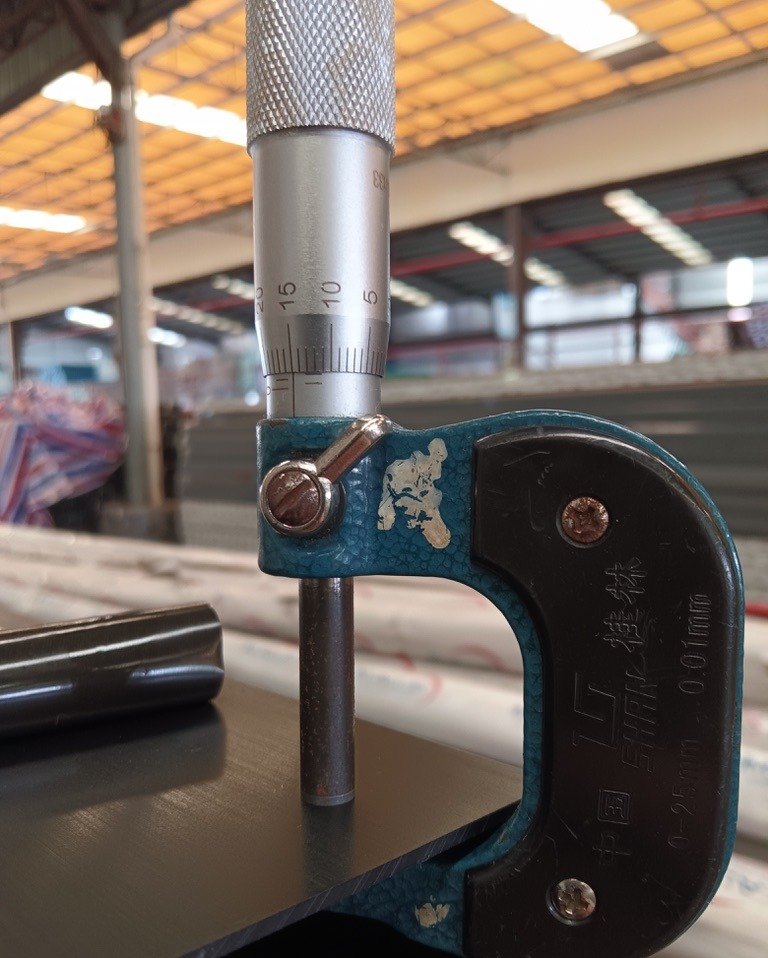
Thin walls are a capability here, not a discount. The floor is 0.8 mm, and on sections up to a 540 mm circumscribed circle the wall is set by what the part has to do — screw purchase, groove stiffness, dent resistance — not by what makes the quote look better.
Where does the finish change both price and risk?
Anodizing is sold by class. AA10 puts about 10 µm on each face, AA15 about 15 µm, and the second costs more because the line runs slower. On a vertical face that nobody touches, AA10 is the sensible buy. On a door edge, a handle return or a hospital corridor, 15 µm is what keeps the metal from wearing through at the contact point.
| Finish | Nominal build | Where it is the right buy |
|---|---|---|
| Anodized AA10 | about 10 µm per face | Indoor faces, little handling |
| Anodized AA15 | about 15 µm per face | Handles, door edges, humid or coastal air |
| Powder coat | 60–80 µm | Colour range, hiding fine die lines |
Colour is a separate axis. Silver — sandblasted, alkali-etched, glass bead or steel shot, coarse to fine — is the most forgiving. Champagne, bronze, black and gold are progressively harder, and the darker the tone, the harder the batch-to-batch match becomes. That is metallurgy and bath chemistry, not sales talk: dye concentration, bath temperature and the alloy batch all move the final shade.
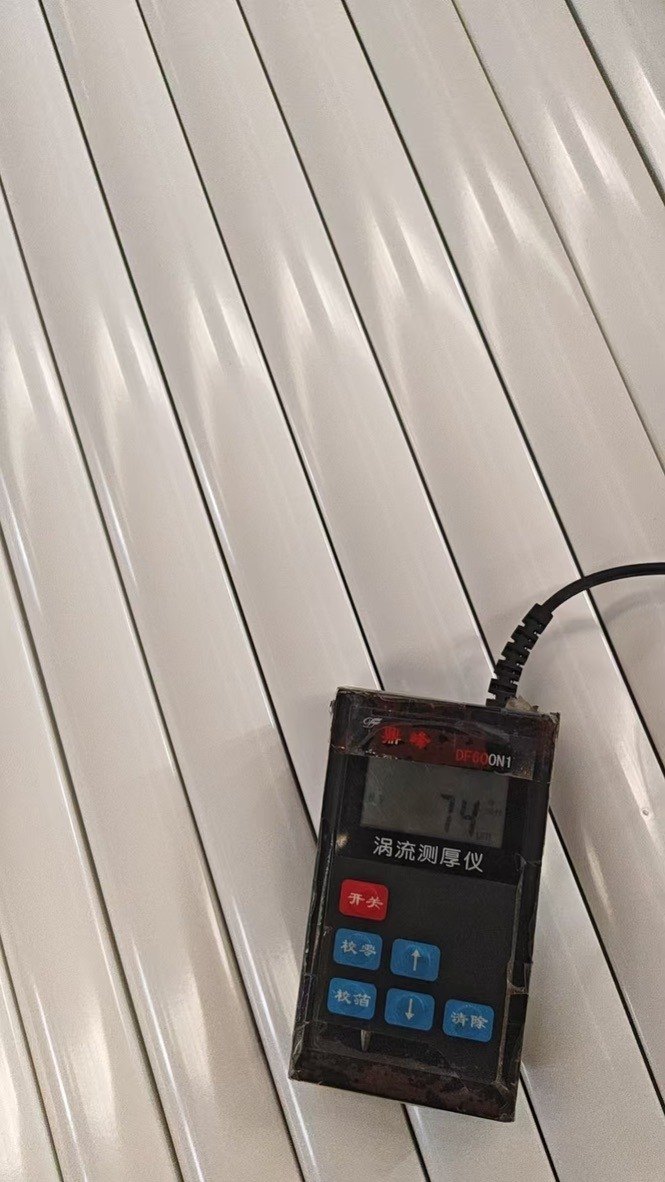
Powder coating builds far more film, typically 60–80 µm. It buys colour range and hiding power, and it costs you fit: a 70 µm coat closes an 18 mm groove by about 0.14 mm, while AA15 anodizing closes the same groove by about 0.03 mm. Decide the fit after finishing, not before.
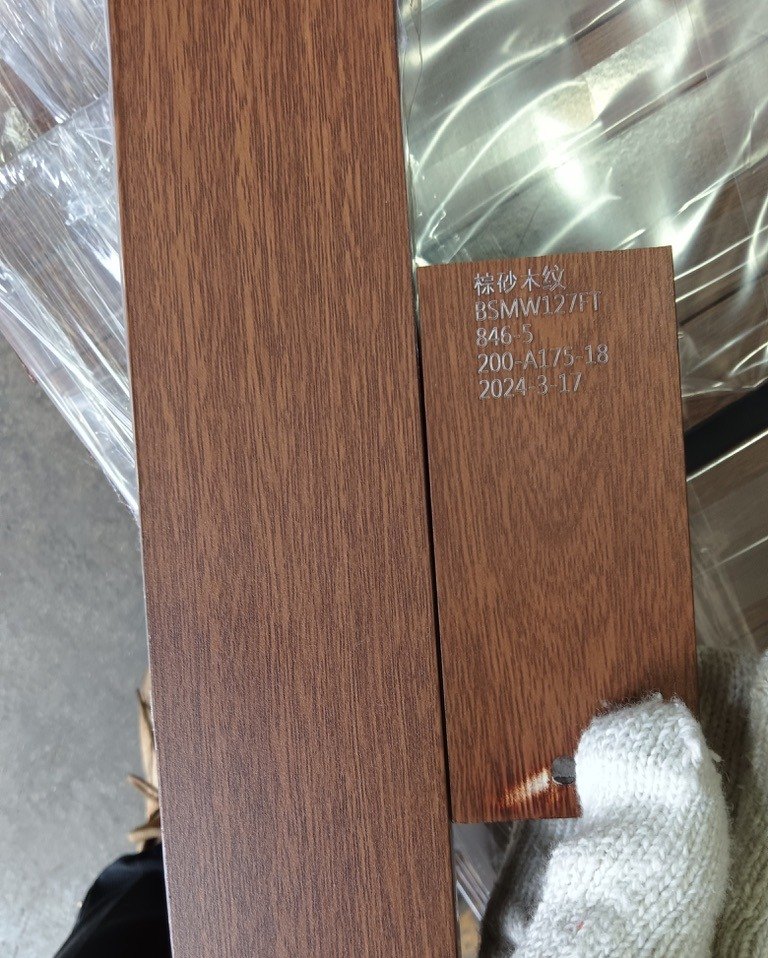
Wood grain is a transfer film over a powder base coat. The film is printed, so pattern and tone vary between rolls; an identical repeat from lot to lot is not achievable, and any supplier who promises it is promising something the process does not deliver.
For the chemistry behind these choices, see surface finishes compared. For the price question, the practical point is narrower: a quotation that does not state the anodizing class and the film build is not a comparable quotation.
What does a cheap quote leave out?
Four things, in the order they usually appear.
The die. Tooling is a one-off cost that depends on section complexity and press size, so it is quoted per project rather than published. A quote that folds the die into the per-kilogram price hides how much of your money is tooling — and says nothing about who owns the die, where it is stored, or what happens if you move supplier.
Machining. Hinge holes, handle cut-outs, mitre cuts and end milling are operations, not extrusion. At this plant they run in the same building as the press, which is why they can be quoted as part of the same order; a trader's quote often stops at the extruded bar.
Packing. Export packing is specified per order: protection film, interleaving between profiles, end caps, and bundle labels that match the packing list. On a container the difference is a few dollars per tonne; in claims it is the difference between a clean delivery and a shipment of scratched anodized faces.
Documents and cut lengths. A mill test certificate to GB/T 5237, a dimensional report on the critical dimensions and the anodizing class actually run are part of the delivery, not extras. Cut lengths matter too: there is no standard length here, profiles are cut to your list, a 20' container takes up to 5.85 m, a 40' takes 6.0 m and can carry two lengths, and cuts under 5 m carry a sawing charge.
How do you judge quality before you pay?
Four checks cover most of the risk, and none of them needs a lab.
| Check | How to run it | What passes |
|---|---|---|
| Substrate | Look at a cut face and a scratch; check hardness | Bright, uniform grain; no dark speckle, no porosity |
| Wall | Four points per section, three sections per bundle | Inside the drawing, no systematic shortfall |
| Colour | Compare against the sealed master sample outdoors, at about one metre | No visible difference at that distance |
| Coating | Film build gauge; cross-hatch on a sample | 60–80 µm powder, no bare spots, no lift-off |
Two failure modes deserve their own line. Sealing: anodizing that has not sealed properly corrodes from the surface, and it shows up months later as a chalky bloom or as adhesive left behind when the protective film is removed. If the film comes off with glue still on it, suspect sealing and packing moisture before you suspect the film. Adhesion: powder that lifts at a cross-hatch was either under-cured, applied too thin, or put on a substrate that should never have entered the line.
That last point is the one buyers miss. Powder hides the substrate, so a supplier chasing a low price can run second-hand billet and hold the tolerance at the bottom of the band; the part looks right in the crate and fails in service. Incoming inspection of chemistry, hardness and appearance is the only place that gets caught.
Colour acceptance is where a written standard saves an argument. At this plant the standard is visual: under outdoor natural light, at a viewing distance of about one metre, a difference that is not noticeable is acceptable. Dark anodized tones are judged by that rule, not against a laboratory number. Wood grain is judged against the approved sample, because it is a pattern, not a shade.
What we cannot do
We do not publish a price list. The billet moves daily, and a list would be wrong within a week; we quote against the billet basis and date in force when you ask.
We quote FOB Shenzhen or Guangzhou and nothing else. Freight, insurance and duty are handled by your forwarder, and the conversation about landed cost belongs there rather than in our quotation.
We do not run second-hand billet. If the application needs a lower price than virgin 6063 allows, the honest answer is a different section or a different finish, not a different substrate.
We do not promise batch-identical wood grain, and we do not promise zero colour difference on dark anodizing. What we do promise is a sealed master sample, a batch number on every carton, and the one-metre rule in writing.
What to send for a quote you can compare
Six items make quotations comparable line for line:
- Section drawing — DXF, DWG or a dimensioned PDF.
- Alloy and temper, or the job the part has to do.
- Finish and film: anodizing class, powder colour reference, or mill finish.
- Quantity per profile, and whether the order is a full container or LCL.
- Destination port and terms.
- Packing requirement, if the profiles will be machined or handled on site.
With those, the quotation can state the billet basis and date, the anodizing class, the die line separately, and what is included in packing — which is what makes two quotes comparable at all.
FAQ
Is aluminum extrusion priced per kilogram or per metre? Per kilogram. Metres convert through the theoretical weight of the section, so a quote per metre without the weight per metre is not checkable.
Why is your price higher than another Chinese supplier's? Usually three reasons: the billet basis (Guangdong prices off Nanhai Lingtong, the highest of the Chinese bases), the wall actually run, and whether die, machining and export packing are inside the number.
What is the one-metre colour rule? Under outdoor natural light, at about one metre, a shade difference that is not noticeable is accepted. It is the standard written into our order confirmation for dark anodized tones.
Do you use second-hand billet? No. Incoming billet is checked for chemistry, hardness and appearance before it reaches a press; material that fails is rejected.
Why can't wood grain match from batch to batch? It is a printed transfer film over a powder base coat. Ink, film roll and cure all vary slightly, so the approved sample is the reference rather than an exact repeat.
What is included in your quotation? Extrusion, the specified finish, cutting to your list, export packing and the mill certificate. Die tooling and machining are shown separately so you can see what you are paying for.
What is the minimum order? 500 kg per profile, whether the die is new or existing. A container can carry several profiles on one order.
Reviewed 2026-10-22 · LinkedAlu extrudes in Foshan on 26 presses (500–5000 MT), 100,000 t/year since 2005, FOB Shenzhen or Guangzhou.
Frequently asked questions
Is aluminum extrusion priced per kilogram or per metre? add
Why is your price higher than another Chinese supplier's? add
What is the one-metre colour rule? add
Do you use second-hand billet? add
Why can't wood grain match from batch to batch? add
What is included in your quotation? add
What is the minimum order? add
Customer cases and reviews
No reviews yet — be the first to review Why Aluminum Extrusion Quotes Differ.
Write a review
Reviews are read by our team before they appear here, usually within one working day. We publish what customers write; we only remove spam and abuse.
Keep reading

Aluminium Extrusion Tolerances
How extrusion tolerances are held in practice: GB/T 5237 high-precision class, grooves at plus or minus 0.1 mm, walls from 0.8 mm, and what…
Read article arrow_forward
Aluminum Extrusion HS Codes and Anti-Dumping: What Decides Your Duty
Aluminum extrusions enter under three headings, and the one you declare decides whether anti-dumping duty applies. A working guide to…
Read article arrow_forward
Aluminum Profile Surface Finishes: Anodizing, Powder Coating, PVDF
Anodizing, powder coating, PVDF, electrophoresis, wood grain and mechanical finishes are specified by different standards, applied at…
Read article arrow_forward