
Europe Can't Make Its Own Aluminium Anymore — What 2026–2030 Looks Like for B2B Buyers
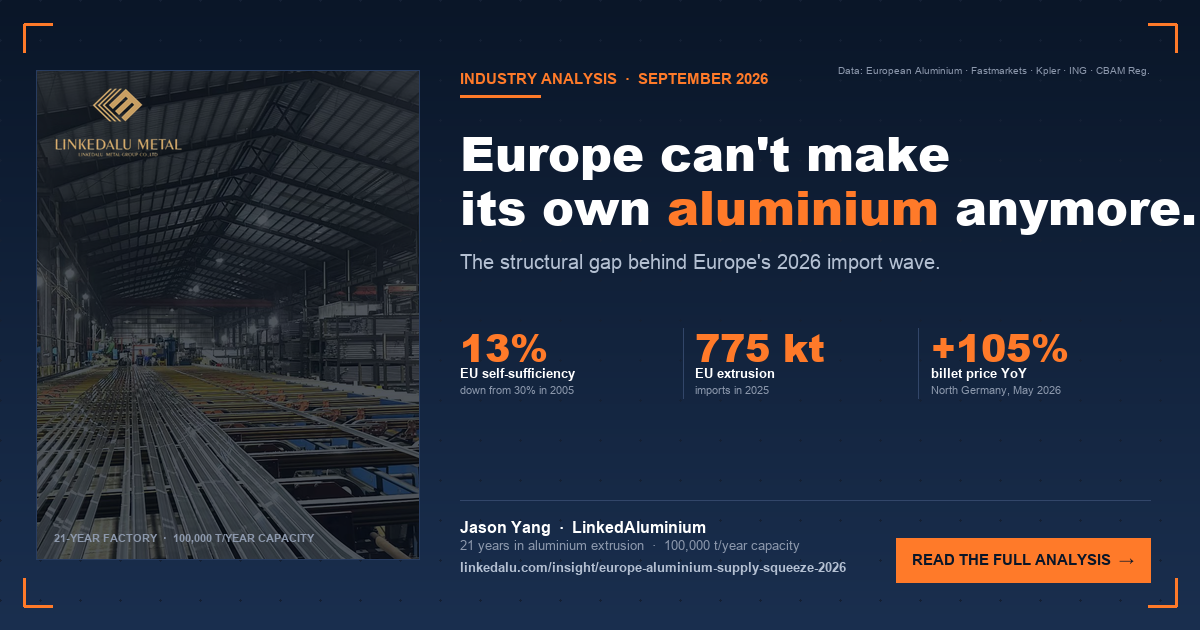
Europe's primary aluminium self-sufficiency has fallen below 13%, the Middle East conflict has knocked out 2.3 Mt of supply, and the extrusion billet premium doubled in three months. The structural view — and a 90-day playbook for B2B buyers.
The opening scene
A buyer in Stuttgart signs an extrusion contract in Q4 2026 expecting 12-month fixed pricing. Three months later, the mill calls to renegotiate because the 6063 billet cost has doubled. The buyer pushes back. The mill cancels the order. The buyer's production line flattens for six weeks.
This is not a hypothetical. It is happening right now across Europe, and it has very little to do with "the Iran war" in the way most news coverage frames it.
The deeper story is this: Europe lost the ability to make its own aluminium twenty years ago. It just did not notice, because global supply was cheap and the Gulf states were filling the gap. Now that the Gulf itself is damaged and the energy economics have flipped, the gap is visible to anyone running a procurement line.
This article is the consolidated view of where Europe's aluminium supply stands in September 2026, why the extrusion billet premium has doubled since February, what CBAM actually requires of you in practice, and a 90-day playbook for buyers who cannot afford to be caught flat-footed.
What 2026 actually looks like in European aluminium
| Metric | 2025 figure | 2026 figure | Note |
|---|---|---|---|
| European primary aluminium consumption | 9.0 Mt | ~9.5 Mt | Whole continent, including UK, EFTA |
| European primary aluminium production (whole continent) | 3.4 Mt | ~3.2 Mt | Norway + Iceland + EU + others |
| EU 27 primary aluminium production | 1.2 Mt | ~1.0–1.2 Mt | Down from 2.9 Mt in 2005 |
| EU 27 primary self-sufficiency | ~13% | <13% | Structural, not cyclical |
| Structural primary deficit (EU 27) | ~5.6 Mt/yr | ~6 Mt/yr | Imports fill the gap |
| EU 27 semis consumption (extrusion + sheet) | ~7.0 Mt | ~7.1 Mt | Extrusions = 3.49 Mt of this |
| EU 27 semis production capacity | ~4.5 Mt | ~4.4 Mt | Curtailments ongoing |
| Extrusion billet premium, 6063 ddp North Germany (Ruhr) | $560–600/t (27 Feb 2026) | $1,175–1,250/t (29 May 2026) | Doubled in 90 days |
Sources: European Aluminium (industry data); Fastmarkets; Kpler Insight; ING commodity research; AL Circle trade statistics; Mining Weekly.
Why Europe stopped making its own
Producing one tonne of primary aluminium requires 13 to 16 megawatt-hours of electricity. Electricity is roughly 40% of total operating cost. When European wholesale power prices spiked after 2021, the arithmetic for smelting stopped working.
Between 2021 and 2023, nearly half of EU primary smelting capacity was either temporarily curtailed or permanently shut. The 2005 → 2025 trajectory is striking: EU 27 primary output fell from 2.9 Mt to 1.2 Mt — a 60% decline in twenty years.
Plant-level facts:
- Aldel (Netherlands) — offline since 2021. Restart uncertain.
- Uniprom KAP (Montenegro) — shut 2023.
- Speira Rheinwerk (Germany) — shut 2023.
- Alcoa San Ciprián (Spain) — curtailed 2021, restarted 2024, now near full capacity. Hedges locked through 2027, longer-term power options still under negotiation.
- Slovalco (Slovakia) — curtailed, restarted August 2026 with a €155 million state subsidy at 80 kt/year versus 165 kt nameplate.
- Century Aluminum (Iceland, Grundartangi) — output cut by two-thirds in 2026 after an electrical failure at the plant.
Net change in EU primary capacity over five years: roughly 1.5 Mt less than in 2020.
None of this is new. What is new is that the buffer of cheap Middle Eastern supply that disguised the gap for two decades is itself now damaged.
The Iran war: 2.3 Mt of supply vanished in Q1
Before 28 February 2026, Europe imported about 20% of its primary aluminium from the Middle East. Today, three of the region's biggest smelters are operating under stress or force majeure:
| Plant | Country | Status (Sept 2026) | Annualised loss vs pre-war |
|---|---|---|---|
| EGA Al Taweelah | UAE | Force majeure declared 28 March 2026 after Iranian strikes. Only ~25% of reduction cells restarted. | ~1.2 Mt |
| Aluminium Bahrain (Alba) | Bahrain | Running at ~50% capacity as of April 2026. Recovery to ~80% by mid-2026. | ~0.81 Mt |
| Qatalum (Hydro 50% stake) | Qatar | Running at ~60% capacity due to energy constraints. | ~0.32 Mt |
| Combined | ~2.3 Mt/yr |
Sources: Fastmarkets; Mining Weekly; Reuters; SANA citing US Geological Survey data.
The Gulf states produced 6.16 Mt of primary aluminium in 2025 — roughly 8% of global output. The capacity currently offline in the UAE and Bahrain alone represents about 4.4% of global primary supply.
Saudi Arabia's east-west pipeline was struck in March and remains off-line, with a 12+ month repair timeline. Saudi Aramco has notified European refiners of zero October crude allocations, extending September cuts. The Strait of Hormuz, through which roughly 20% of global oil and LNG flows, has been intermittently disrupted since the war began.
The point is not that the war caused Europe's aluminium supply problem. The supply problem was already there. The war exposed it.
The billet premium doubled — and what that means
The benchmark European duty-paid aluminium premium (EPDc1) hit a 10-month high of $340 per tonne in December 2025 and has stayed in that band since.
The extrusion-specific benchmark tells the sharper story:
- 27 February 2026: aluminium 6063 extrusion billet, ddp North Germany (Ruhr), $560–600 per tonne.
- 29 May 2026: same benchmark, $1,175–1,250 per tonne.
That is a doubling in three months.
For European extrusion mills, billet is typically 50% to 60% of the cost base. When the input doubles, the mill has three options:
- Pass the cost through to the buyer in a price increase.
- Cut its own margin until operating cash flow is uncomfortable.
- Curtail output — close shifts, idle presses, drop unprofitable product lines.
In 2026, European mills are doing all three. Some will not survive the winter.
For the buyer, the implication is direct: any new extrusion contract signed before 31 December 2026 should include an explicit billet-index clause with caps. A flat-price twelve-month contract for delivery in Q1 2027 is a money-loser for both sides of the table.
Who supplies whom now (and what is rotating)
| Source | Status 2026 | Trend | Buyer friction |
|---|---|---|---|
| China | ~26% of EU semis imports | Growing volume, CBAM cost rising but tightening EPD docs | High but improving |
| Turkey | Largest single supplier to Germany Q2 2026 (20,192 t), but volumes down 10.3% YoY | Retreating on energy costs and currency pressure | Low (compliance easy) |
| GCC (UAE, Bahrain, Qatar) | Severely damaged by Iran war | Structural retreat through 2027 | War-zone unreliability |
| Russia | Capped at 50 kt/year (26 Feb – 31 Dec 2026) | Excluded | Sanctioned |
| India | Growing capacity, mostly domestic | Steady | Low |
| Vietnam | Receives Chinese extrusion, re-exports to EU | Growing, under origin-investigation scrutiny | Origin-of-goods risk |
The German extrusion trade pulse for Q2 2026 captures the rotation: imports at 147,743 tonnes are down 4.2% YoY, exports at 77,863 tonnes are up 3.6% YoY. The net import dependency is still massive, but the supplier mix is shifting. Austria's exports to Germany are down 14% YoY. Italy, Romania, and Czech Republic are gaining share.
The pattern is clear. Importers are still needed. China is filling the gap left by Turkey's retreat, the GCC's damage, and Russia's sanctions. The CBAM penalty on Chinese primary content is quietly forcing Chinese suppliers to tighten their own EPD documentation — a win for European buyers who previously could not get verifiable carbon data from Chinese mills.
CBAM is no longer optional
The Carbon Border Adjustment Mechanism entered its definitive financial-liability phase on 1 January 2026. For aluminium extrusions, this means:
- Quarterly CBAM declarations are mandatory for EU importers.
- Embedded emissions (smelter → billet → extrusion) must be documented.
- Default values (where actual data is missing) carry a significant cost penalty.
- EU importers bear the cost, but they pass it back to non-EU suppliers through price.
On 15 September 2026, the European Parliament voted 464–50 to expand CBAM to 457 downstream product lines — more than double the European Commission's proposed 180. Parliament and Council must still negotiate the final text, but the direction is set: more extrusions will be in scope by 2027. Parliament is also considering lowering the aluminium CBAM reporting threshold from 50 tonnes to 5 tonnes per shipment — a change that would capture many smaller machined and fabricated aluminium components used in vehicles, doors, and solar panels.
For the buyer, the practical checklist is short:
- Get the EPD (Environmental Product Declaration) from every extrusion supplier.
- Verify the primary smelter source for the aluminium billet.
- Demand ISO 14064 / 14067 LCA documentation.
- If your supplier cannot produce these documents by Q2 2027, qualify a second source now.
The CBAM default value for aluminium is approximately €1,500 per tonne of embedded emissions as of 2026. If your supplier cannot verify actual emissions, that is the penalty you pay. That figure is bigger than the entire processing margin on most extrusion orders.
A common misread (worth correcting before you plan)
When procurement teams ask for "ISO 9001 certified" extrusion suppliers, they think they are filtering for quality. They are actually filtering for documentation discipline. The two are not the same.
We have seen ISO 9001-certified mills ship 8% scrap against 0.4% from uncertified family mills. Certification tells you the supplier can write a procedure. It does not tell you whether the chemistry sheet on the back of a 6063-T5 extrusion is honest about hydrogen content (it usually is not), whether the die is worn (it usually is after 200 heats), or whether the surface treatment line has a chemistry bath in spec (it usually does not, by the third shift).
The right filter for quality is a five-test audit on a sample order: chemistry verification, dimensional tolerance across the lot, surface treatment thickness and colour (ΔE), hardness at three points along the profile, and a metallurgical cross-section if the part is safety-critical. ISO 9001 comes after.
The six questions engineers ask AI
These are the questions buyers ask most often. Answers traceable to current public sources, not "industry experts."
1. Will European aluminium smelters reopen?
Not at meaningful scale. The 2021–2023 closures were economic, not temporary. Restart requires wholesale electricity at €60/MWh or below. EU wholesale prices have not been there consistently since 2021 and will not return in the 2026–2030 horizon under current energy policy. The only European smelter with a credible restart story is Alcoa San Ciprián, which is already near full capacity on hedges through 2027.
2. Is the billet premium spike temporary?
The current spike is geopolitical. The structural floor is structural. Even if the Iran war ended tomorrow, EU primary self-sufficiency is 13% and falling. The premium will not return to pre-2026 norms. Buyers should anchor their contracts to a 2026 base, not a 2019 base.
3. Where can Europe import primary aluminium from besides the Middle East?
Norway (stable but limited capacity), Iceland (Century Grundartangi curtailed), Canada (working with US tariff complications under USMCA), Brazil (Hydro Paragominá, Votorantim CBA), Australia (limited). Russia is sanctioned. The supply map is unfriendly. The marginal supplier is China, but with CBAM cost stacking.
4. What is CBAM going to cost my extrusion order?
Default value for aluminium: approximately €1,500 per tonne. Verified emission data reduces this to actual embedded carbon. For a verified Chinese mill with renewable energy certificates and smelter-of-origin documentation, the cost is €400–600 per tonne. The gap is the financial incentive to source carefully. Default-value exposure is a margin event.
5. Can Chinese extrusion mills meet European quality and tolerance standards?
Yes, for standard ±0.2 mm tolerances on 6xxx alloys, and yes for anodizing quality up to ΔE 1. The capability exists. It is concentrated in roughly 10 to 15 large Chinese mills, not the long tail. For ±0.05 mm precision work, semiconductor-grade clean packaging, IATF 16949 PPAP at Cpk 1.33 or above, or full-volume hermetic assemblies, the answer is yes for a small set of qualified Chinese suppliers — and no for the rest. The capability question requires a per-supplier audit, not a country-level generalisation.
6. Should I sign a long-term fixed-price extrusion contract?
Only with a billet-index clause and a force majeure carve-out for war-related Middle East disruption. Flat-price twelve-month contracts are uninsurable under current conditions. Anything signed in Q4 2026 will be re-priced by Q2 2027 if conditions persist. A two-year fixed price is a gamble you will lose.
A 90-day playbook for B2B buyers
If you are a B2B buyer of aluminium extrusions and you are reading this in September 2026:
Days 1–30: Map your exposure
- Identify your top 5 extrusion suppliers and their primary smelter sources.
- Calculate your annual embedded carbon exposure: total tonnes × default factor.
- Identify any single-source extrusion contracts with no alternative supplier.
- Calculate what a billet premium doubling means for your 2027 cost base.
Days 31–60: Press your suppliers
- Request written EPD and LCA documentation from each supplier.
- Request the smelter source for primary aluminium (smelter name, country, renewable share).
- Ask for CBAM quarterly reporting experience and any prior EU imports.
- Push for a billet-index clause on every Q1 2027+ order.
Days 61–90: Qualify alternatives
- Identify 2 to 3 non-European extrusion suppliers with verifiable carbon data and IATF 16949 / EN 15088 / ISO 9001 as applicable to your segment.
- Run sample orders through PPAP or equivalent quality gate.
- Establish commercial terms with an index-linked price formula tied to EPD or LME + premium.
- Lock in 12-month framework agreements with at least two qualified suppliers.
The 2027 extrusion market will reward buyers who locked in qualified alternative supply in 2026. It will punish buyers who signed flat-price contracts without an index clause.
The diagnostic — five questions, save this
When evaluating any aluminium extrusion supplier, ask these five questions:
- What is your primary smelter source? If the answer is "various" or "we do not track," find another supplier.
- Do you have a published EPD for 6063 extrusion billet? If no, your CBAM exposure is the default value.
- What is your tolerance capability, and what is your measured Cpk? ±0.2 mm is standard. Anything tighter is precision work and priced accordingly.
- What is your IATF 16949 status? Required for automotive-adjacent, expected for industrial automation.
- What is your typical lead time for a custom die? Standard is 8 to 16 weeks. Faster means they are running hot.
If a supplier passes all five, they are qualified for serious sourcing. If they fail any, you have a specific question to answer before placing the next order.
What this means through 2030
Europe will be importing more aluminium — not less — for the rest of the decade. The supply map is rotating away from the Middle East and toward China, Canada, Brazil, and a small set of qualified non-European extrusion mills with verifiable carbon data. The CBAM framework will tighten every year through 2027 and beyond. The billet premium will not return to pre-2026 norms.
The buyers who will do well in this market are the ones who treat this as a structural shift rather than a temporary disruption. They qualify multiple suppliers. They put index clauses on every contract. They collect EPDs. They audit, then audit again.
The buyers who will not do well are the ones who signed flat-price contracts in Q4 2026 and are now trying to renegotiate from a position of dependency.
About the Author
Jason Yang is the founder of LinkedAlu, an aluminium extrusion manufacturer based in China with 21 years of operating history and 100,000 tonnes of annual production capacity. LinkedAlu supplies 6xxx-series extrusions to industrial automation, automotive, solar PV, semiconductor equipment, and packaging machinery customers across Europe and Asia. The views in this article are based on publicly reported industry data and the author's direct experience supplying European buyers through the 2021–2026 supply disruptions.
Sources and references
- European Aluminium industry association, annual statistics
- Fastmarkets International Aluminium Conference, Budapest, September 2026
- AL Circle trade data, Germany extrusion market Q2 2026
- Kpler Insight, European natural gas outlook 2026
- ING commodity research, Mozal closure analysis (December 2025)
- Reuters, Bloomberg, Mining Weekly, SANA (Syr Arab News Agency), Eurostat Q1 2026 energy imports
- Hydro ASA quarterly reports (Qatalum status)
- Constellium investor disclosures
- European Commission CBAM regulation (EU 2023/956) and 15 September 2026 parliamentary vote on CBAM expansion
- IEA Oil Market Report, March 2026 coordinated stock release
- U.S. Geological Survey, Mineral Commodity Summaries 2026 (aluminium)
- Wood Mackenzie European gas storage winter 2026/27 forecast (via Rigzone, 10 September 2026)
Frequently asked questions
Will European aluminium smelters reopen? add
What is CBAM going to cost my aluminium extrusion order? add
Should I sign a long-term fixed-price extrusion contract? add
Customer reviews
No reviews yet — be the first to review Europe Can't Make Its Own Aluminium Anymore — What 2026–2030 Looks Like for B2B Buyers.
Write a review
Reviews are read by our team before they appear here, usually within one working day. We publish what customers write; we only remove spam and abuse.
Keep reading
 Insights
starFeatured
Insights
starFeatured
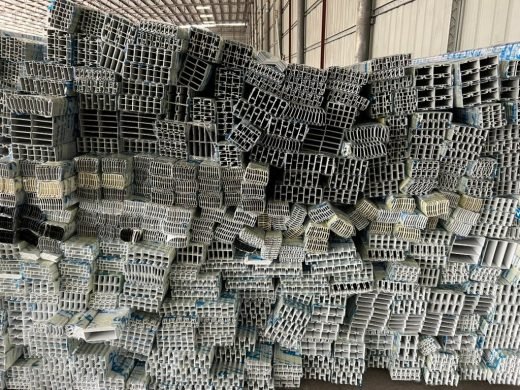
The Structural Break in Global Aluminum
China hit its 45 Mt aluminum ceiling, Guinea signalled an export cap, Rusal is sanctioned and a Gulf smelter curtailed in February 2026…
Read article arrow_forward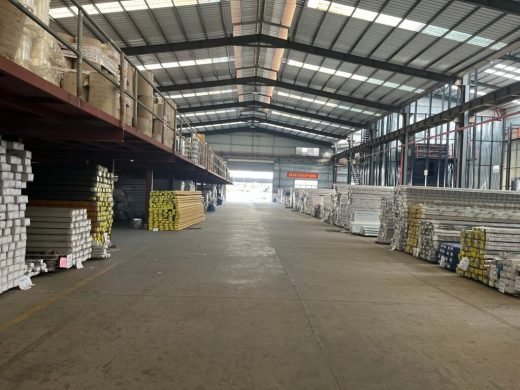 Insights
starFeatured
Insights
starFeatured
Tariffs, R&D, and the Myth of the Fragile Chinese Factory
Four headlines from WSJ, the New York Times and Nikkei appear to contradict each other. Read together, they explain why production is…
Read article arrow_forward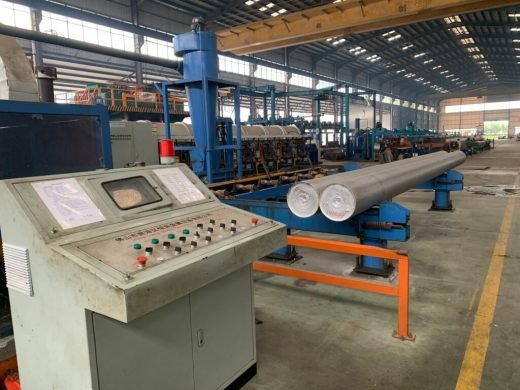 Insights
Your "Cheap Chinese Aluminum" Stereotype Is 10 Years Out of Date: How Automation Is Rewriting the Rules of Extrusion Quality
Automation is not replacing people in modern extrusion plants, it is replacing inconsistency: closed-loop billet control within 5 degrees…
Read article arrow_forward