
Tariffs, R&D, and the Myth of the Fragile Chinese Factory
Four headlines from WSJ, the New York Times and Nikkei appear to contradict each other. Read together, they explain why production is moving back to China and why enterprise-funded R&D matters more to buyers than subsidies.
Four Headlines, One Week, Seemingly Contradictory Stories
Four stories from three of the world's most influential business publications landed in the same week, and read separately they appear to contradict one another. The Wall Street Journal reported that China's economy has holes. The New York Times reported that companies are moving production back to China. Nikkei reported that China now leads the world in enterprise R&D spending. The Wall Street Journal also reported that China's tech sector is sprinting ahead.
Read together, they tell a far more interesting story - and for anyone buying from, selling to, or competing with Chinese manufacturers, that story matters more than any single headline.
The Two-Speed Economy
The Wall Street Journal frames China as a two-speed economy. One speed is high-tech manufacturing: electric vehicles, batteries, solar equipment, industrial automation and AI-related hardware. These sectors are expanding fast, gaining global market share and driving export growth. The other speed is domestic: property markets struggling, consumer confidence weak, local government debt unresolved.
That framing is fair, and any honest analysis has to acknowledge it. What gets less attention is what actually drives the high-tech engine. It is not running on government subsidies alone. It is running on something deeper.
The R&D Figure Nobody Expected
Nikkei reported that China's R&D spending reached $615 billion, taking the global lead. The figure is striking, but the critical detail is the funding source: the dominant share comes from commercial enterprises - companies reinvesting their own revenue into research and development - not from state grants.
Why Enterprise-Funded R&D Changes the Competitive Picture
A government-funded R&D program is a policy decision. Enterprise-funded R&D is a survival behavior. It means thousands of manufacturers are independently betting their own capital that better processes, tighter tolerances and superior surface finishes will win global market share. A buyer is then not competing against a subsidy. They are dealing with a supplier that reinvests profit to get better every quarter.
Tariffs Versus Ecosystem Density: Why Production Moves Back
The New York Times reported a trend that runs against the prevailing political narrative: several multinational firms that moved production out of China to avoid tariffs are now shifting it back. The logic is not sentimental. It is arithmetic. Tariffs added direct costs, but the alternatives introduced hidden ones:
- Fragmented local supplier networks.
- Extended lead times for specialized alloy tooling and components.
- Quality consistency challenges across multiple sites.
- High overhead from managing production across several jurisdictions.
When procurement teams calculated the true total cost of ownership - factoring in scrap rates, lead-time reliability and engineering support - China frequently came out ahead even with tariffs applied. A tariff is an explicit tax. A fragmented supply chain is an implicit tax paid in time, defects and lost management focus.
How High-Tech Precision Spills Over into Everyday Products
The second Wall Street Journal piece treats technological progress and broader economic health as separate tracks. In industrial manufacturing they share the exact same track. The advanced factories producing EV battery enclosures and solar infrastructure rely on the same core ecosystem that extrudes architectural frames, CNC-machined housings and heat sinks.
Process knowledge diffuses fast across sectors. A machining shop that has mastered 5-micron tolerances on automotive components applies the same discipline to standard industrial profiles. An extrusion plant that developed thin-wall structural profiles for solar frames transfers that metallurgy into commercial window systems. Capability is not siloed by product category; it is a plant-wide habit.
What This Means for Global Buyers
At Linkedalu we extrude aluminum profiles and machine them into finished components for customers in the solar, industrial automation, automotive and architectural sectors, operating directly inside that competitive ecosystem. In practice that translates into three working factors.
- Practical R&D. Not a theoretical line item: the tooling redesign that removed chatter marks on a custom profile, the process refinement that held tighter tolerances on a solar mounting rail, the die-steel trial that extended tool life by 40%. These improvements are funded from internal margin because the next order will demand higher precision.
- Supply chain consolidation. Tariffs changed the arithmetic but not the fundamentals of manufacturing density. Customers who attempted multi-country sourcing often returned, because managing one integrated supplier that holds plus or minus 0.1 mm machining tolerances is far more efficient than coordinating three vendors across three countries.
- Survival through capability. The Chinese factories that survived trade friction did not survive by being the cheapest. They survived on better tolerances, superior anodizing and powder finishes, complete CMM inspection reports and responsive English-language engineering support.
The Grounded Reality
Chinese manufacturing is not a monolith. Capabilities vary widely, and structural adjustments in property and local debt will take years to resolve. But the global supply chain story does not hinge on the domestic property market. It hinges on whether factories can consistently deliver high-precision products that global industries require.
The manufacturers still investing, improving and shipping are not fragile operations leaning on subsidies. They are lean, capable organisations that have learned to compete on engineering quality, process control and total cost efficiency. A tariff line in a spreadsheet does not measure any of that.
Customer reviews
No reviews yet — be the first to review Tariffs, R&D, and the Myth of the Fragile Chinese Factory.
Write a review
Reviews are read by our team before they appear here, usually within one working day. We publish what customers write; we only remove spam and abuse.
Keep reading
 Insights
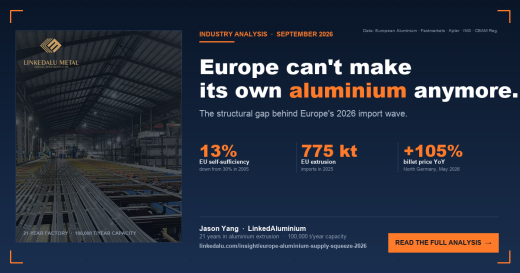
Europe Can't Make Its Own Aluminium Anymore — What 2026–2030 Looks Like for B2B Buyers
Europe's primary aluminium self-sufficiency has fallen below 13%, the Middle East conflict has knocked out 2.3 Mt of supply, and the…
Read article arrow_forward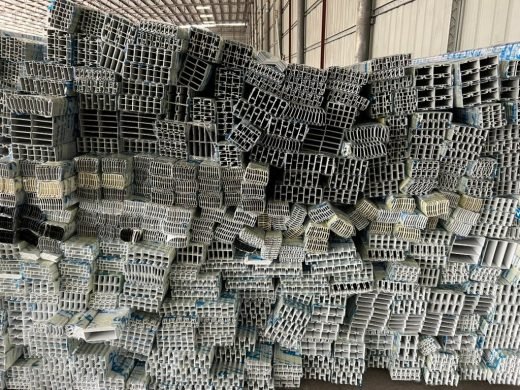 Insights
starFeatured
Insights
starFeatured
The Structural Break in Global Aluminum
China hit its 45 Mt aluminum ceiling, Guinea signalled an export cap, Rusal is sanctioned and a Gulf smelter curtailed in February 2026…
Read article arrow_forward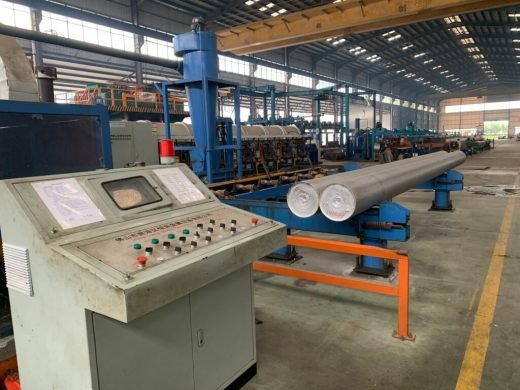 Insights
Your "Cheap Chinese Aluminum" Stereotype Is 10 Years Out of Date: How Automation Is Rewriting the Rules of Extrusion Quality
Automation is not replacing people in modern extrusion plants, it is replacing inconsistency: closed-loop billet control within 5 degrees…
Read article arrow_forward