The Structural Skeleton Inside Modern Shelters
If tent beams bend after one windy season, bolt holes will not line up without a file on site, or a bright powder coat fades to chalky pink by August, those are not tent problems. They are extrusion supplier problems. We manufacture the aluminum structural skeleton inside modern shelters: round tubes for heavy-duty pop-up canopies, rectangular beams for clear-span event marquees, oval poles for folding festival tents, and custom engineered profiles with integrated hinge bosses, sliding tracks and locking channels for military and rapid-deployment relief shelters.
Tent aluminum is not passive architectural cladding. It is erected and torn down repeatedly, packed into trailers and dragged across fields, baked in direct UV for months, and loaded by dynamic wind that yanks on every bolted joint. The profiles must be straight, strong and punched with precision, because when a two-person crew assembles a 10 m marquee in a remote field they do not have a drill press.
Beams and Poles: 6061-T6 for Clear Spans Over 6 m
For any clear-span marquee exceeding 6 m, or any temporary structure engineered for year-round snow loads, we default to 6061-T6. Its yield strength is approximately 240 MPa against roughly 160 MPa for 6063-T5, an increase of about 50%, which dramatically reduces elastic deflection for a given beam depth. It also lets a design engineer specify a slimmer, lower-profile beam while holding the required stiffness, saving transport weight and freight cost. Before cutting dies or extruding billets, our engineering team verifies the profile's section modulus and second moment of area against the target span, local wind loading codes and regional snow specifications. If the safety factor looks marginal we suggest targeted changes before tooling up: localized wall thickening at high-stress bending zones, internal structural webbing to prevent cross-sectional buckling, or an alloy upgrade from 6063-T5 to 6061-T6.
Bolt Holes Drilled From a Single Datum
A marquee side-wall frame can carry dozens of bolt holes that must register perfectly with matching connectors. Hand-drilled or jig-marked holes drift, and field crews end up enlarging holes with round files or cordless drills, which creates sloppy joints, makes the frame rattle in wind, and accelerates bolt shear wear. We CNC drill every mounting hole from a single absolute reference datum across the profile. Cut length is held to 0.15 mm so the frame squares up and the fabric roof fits snugly; hole position is held to 0.15 mm so bolts slide through without reaming; straightness is 0.5 mm/m or better so long roof beams do not bow; and pin holes are reamed to H8 tolerance for a precise pivot fit without slop. If you use standard cast aluminum nodes or stamped steel connectors, we can match-drill test samples to guarantee the fit. Every component is laser-engraved or inkjet labeled with its part number and alignment index marks.
Hinges and Pivot Points That Do Not Wallow Out
Folding canopies, pop-up tents and scissor-frame shelters rely on mechanical pivots, where stainless bolts or clevis pins run directly through aluminum walls. Over a busy event season the softer aluminum hole can wallow into an oval and the frame loses rigidity. We solve pivot wear at the design stage in three ways. Wall thickening is added only around the hinge boss zone instead of weight across the whole profile. Pin holes are reamed to H8 precision so the bore is mirror smooth rather than ridged, which cuts initial mechanical wear. For heavy-duty commercial hire stock or military shelters we factory-press stainless steel or self-lubricating nylon bushings into the reamed holes, so the pin rides on hardened steel or low-friction nylon rather than on the aluminum parent metal.
Coatings for High-UV Outdoor Exposure
Tent frames sit in high-UV environments for weeks at a time, and interior-grade polyester powder breaks down quickly, chalking white residue onto hands and fabric while brand colors fade. We specify architectural-grade systems: super-durable polyester powder for commercial marquees, rental pop-ups and festival structures, passing 1000+ hours of xenon arc testing with 10 to 15 years expected outdoors; PVDF fluorocarbon in two or three coats for permanent resort pavilions, glamping domes and coastal structures, at 20 years or more with maximum color stability; wood-grain sublimation with a topcoat for eco-lodges and pergolas; and anodizing at 15 to 25 µm for clean industrial shelters, expedition poles and sliding tracks. Before powder application every profile undergoes a multi-stage chrome-free conversion coating, which stops the creeping filiform corrosion that spreads beneath paint from a field scratch.
Supply by Tent Type and Ordering
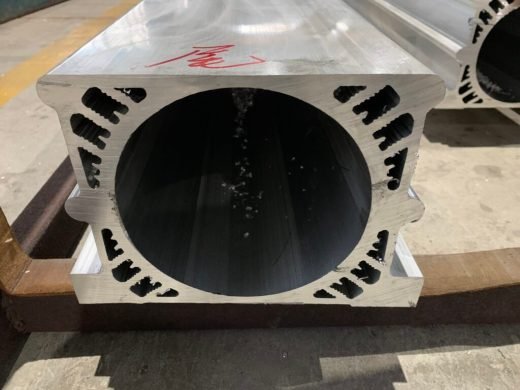
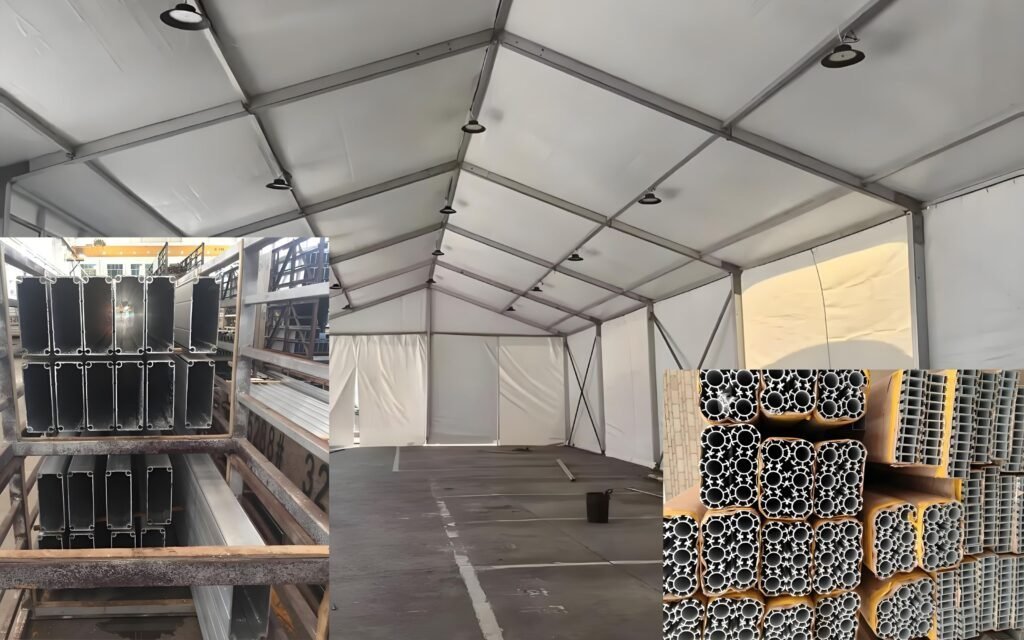
Clear-span event marquees get large multi-channel rectangular main beams such as 120×68 mm and 200×120 mm with round eave columns and base plates, supplied in 6061-T6 and pre-drilled with keder fabric slots. Commercial pop-up canopies use hexagonal or square leg profiles at 40 mm and 50 mm plus scissor truss bars in thin-wall 6063-T5 with tight tolerances for smooth telescopic sliding. Rapid-relief and military shelters use heavy-wall round tubes and reinforced connector nodes in high-strength 6061-T6 with ultra-durable coatings. Glamping domes and eco-resorts use architectural oval profiles and curved structural ribs. Standard length is 6 m, minimum order is 500 kg, and profiles ship as labeled, site-ready assembly kits.

 Industrial Aluminum