Custom Aluminum Profiles for Garage Rolling Shutters
A new aluminum rolling shutter that opens like a gunshot is a problem with the profile, not the operator. The owner hears "snap, snap, snap" as the curtain rolls up. The installer blames the motor. The buyer blames the supplier. Nobody looks at the slat hook geometry, the brush seal in the guide rail, the wall thickness tolerance on the curtain, or whether the header beam is level across the opening. These four details determine whether a rolling shutter runs quietly for fifteen years or starts clattering after season one.
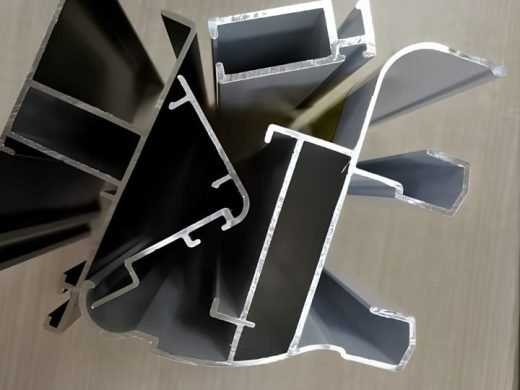
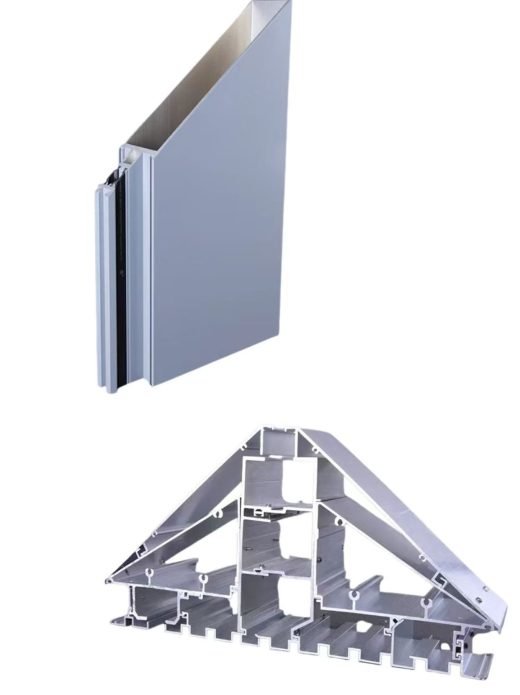
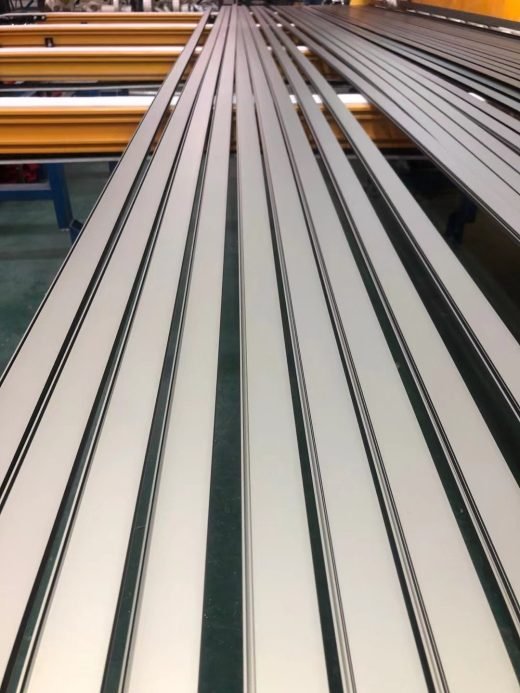
Linkedalu Metal Group Co., Ltd supplies custom extruded aluminum profiles for garage rolling shutter doors — interlocking slats, guide rails and bottom bars — engineered to project specification for quiet operation, smooth travel and long service life. Sections are extruded in 6063-T5 to GB/T 5237, EN 12020-2 and EN 16730 (the European door-set standard), with mill test certificates per EN 10204 3.1 shipped with every order. We currently ship to 50+ countries across Europe, the Americas, the Middle East, Africa, Asia and Oceania.
Three parts make a rolling shutter — and three parts make the noise
What the homeowner actually hears — and where it comes from
A rolling shutter is three parts, not one. The curtain (the interlocking slats), the guide rails (vertical channels on either side of the opening), and the bottom bar (the closing edge that meets the floor). Each contributes to the sound the door makes.
| Part | What it has to do | Where it goes wrong |
|---|
| Curtain (slats) | Interlock cleanly; coil evenly around the barrel; flex without permanent set | Hook geometry too tight → slats lock against each other during coiling |
| Guide rails | Hold the curtain aligned; seal against wind, dust, light and noise | Brush strip missing or undersized → curtain metal-on-metal contact |
| Bottom bar | Seal against the floor; absorb impact on close | EPDM seal undersized → wind-driven rain and dust enter |
Most "noisy shutter" complaints trace back to one of three causes: slat hook geometry that doesn't flex on coil, guide rails without the right brush profile, and a bottom bar without an EPDM weather seal. The profile is the cheapest place to fix all three at once.
The alloy and temper that makes a shutter quiet
Why 6063-T5 is the standard for rolling shutters
Rolling-shutter duty is a moderate-stress, high-cycle, surface-critical application. The curtain opens and closes tens of thousands of times over its service life; the surface is visible on every building facade; and the slat must flex on coil without permanent set. 6063-T5 is the alloy-temper combination used across the industry for these reasons:
- Extrudability — 6063 flows cleanly into thin walls and complex interlocking hook geometry, including the curved hook lips that are hard to fill in 6061.
- Surface finish — 6063-T5 anodizes uniformly and holds powder-coat adhesion well, so the same section can be finished to match any RAL colour reference.
- Strength — Tensile ≥ 160 MPa, yield ≥ 110 MPa (per GB/T 5237.1 / EN 755-2 minimums). Plenty for the curtain duty; not enough for the barrel axle or operator bracket (those go in steel).
- Weldability — Good; slats are usually mechanically interlocked rather than welded, but the bottom bar and guide rail are often welded to reinforcement plates in assembly.
For coastal and high-corrosion sites, 6063-T5 with AA20 anodizing or PVDF top-coat powder is the standard. 6061-T6 is not typically used for the curtain itself (harder to extrude into thin walls, harder to anodize) but does show up in the barrel axle bracket and operator mounting plate where higher strength matters.
Mechanical properties that matter for slat duty
| Property | 6063-T5 minimum (GB/T 5237.1 / EN 755-2) | Practical range for slats |
|---|
| Tensile strength Rm | ≥ 160 MPa | 160–210 MPa |
| Yield strength Rp0.2 | ≥ 110 MPa | 110–160 MPa |
| Elongation A50 | ≥ 8 % | 8–12 % |
| Brinell hardness | ~ 60 HB | 55–70 HB |
| Anodizing response | Excellent (uniform, bright) | Standard |
| Surface roughness after extrude | Ra 0.8–3.2 µm | Depends on die finish |
Slat profile engineering — interlocking, hook geometry, sealing
Single-layer slats for residential and light commercial doors
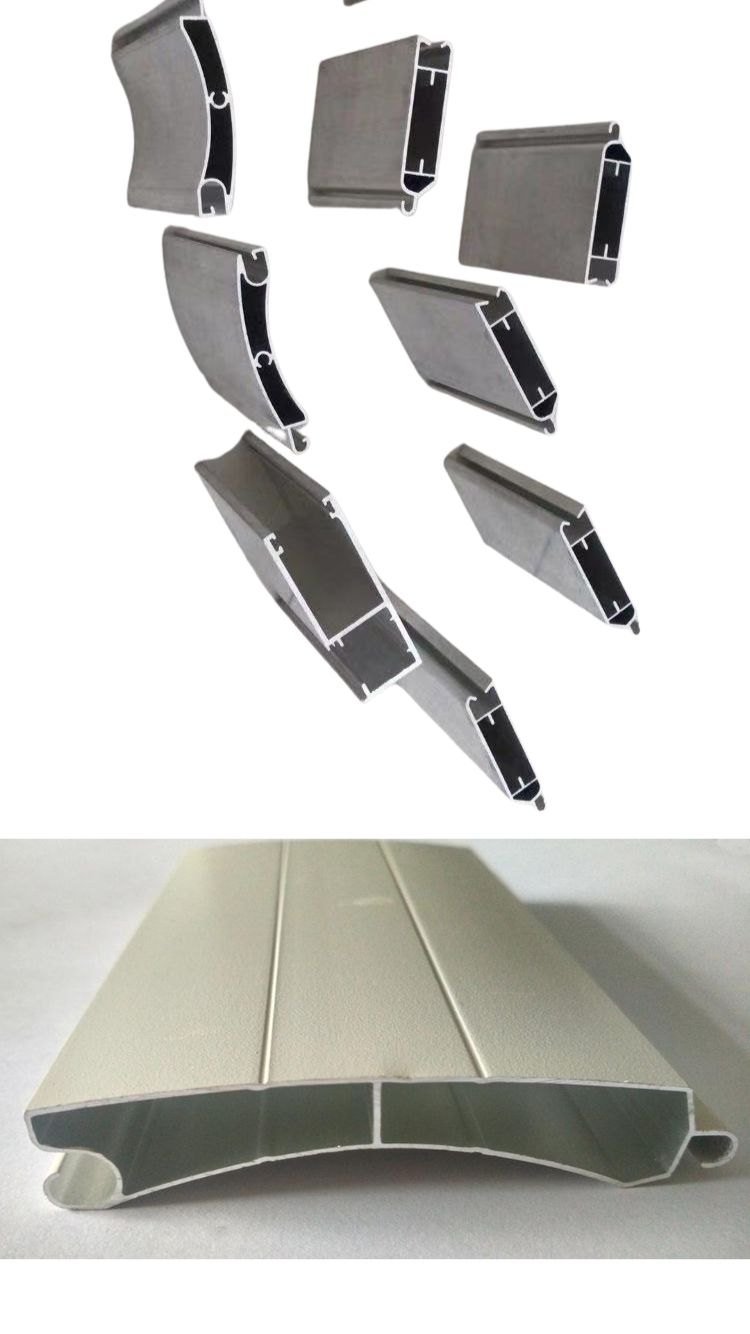
Single-layer is the workhorse. One extruded aluminium section, one interlock, one brush seal per guide rail. Wall thickness typically 1.0 / 1.2 / 1.4 / 2.0 mm; pitch (slat height) typically 55 to 100 mm. Sound reduction Rw is in the 15–20 dB range when properly sealed — quieter than a standard glass window, comparable to a domestic interior wall.
The slat hook geometry is the engineering that makes or breaks the door. The hook has to:
- Lock firmly when the curtain is in the closed position (security).
- Flex without permanent set as the curtain coils around the barrel (cycle life).
- Slide smoothly along the guide rail brush without catching (noise).
A hook that's too tight locks firmly but cracks after 5,000 cycles. A hook that's too loose opens quietly but rattles in wind and can be pried open. The right answer is in the middle, and it's a die-design decision we make before cutting steel.
Double-layer foam-filled slats for sound and thermal
Where the spec calls for sound reduction Rw ≥ 25 dB or thermal insulation (often coastal villas, premium residential, or commercial buildings adjacent to busy roads), double-layer slats are the standard. Two aluminium profiles are coextruded or mechanically assembled, with a polyurethane foam core in the cavity between them. Sound reduction moves to the 25–35 dB range; thermal performance improves by ~25 %.
Pitch height, wall thickness and how they trade off
| Pitch (slat height) | Typical wall | Typical use |
|---|
| 55–65 mm | 1.0–1.2 mm | Small residential doors, tight coil |
| 75–90 mm | 1.2–1.4 mm | Standard residential and light commercial |
| 95–110 mm | 1.4–1.6 mm | Larger residential, small commercial |
| 120–140 mm | 1.6–2.0 mm | Commercial / industrial, large openings |
Wider pitch + thinner wall = more material cost per door (the wider extrusion needs slower press speed and larger container in the billet log). Narrower pitch + thicker wall = stiffer curtain that won't coil as tightly and may need a larger barrel. We work through this trade-off on your drawing before the die is cut.
Guide rail and bottom bar — the parts that make it quiet
Guide rail section, brush strip and EPDM seal
The guide rail is the section the curtain slides against on every open and close. Three details matter:
- Section dimensions — typically 70 / 80 / 100 / 120 mm width, 2.0–2.5 mm wall. The rail section must match the curtain hook geometry within ±0.2 mm; otherwise the curtain binds.
- Brush strip — a polyprop or nylon filament brush inserted into a slot in the rail's inner edge. The brush keeps the curtain off the metal rail, seals light and wind, and absorbs the noise of curtain travel. A correctly specified brush is the difference between a quiet door and a noisy one.
- Anchoring — the rail must mount to a structurally sound surface (concrete, masonry, structural steel). It cannot mount to plasterboard alone; the door will distort, the curtain will bind, the noise will follow.
Bottom bar, EPDM weather seal and end caps
The bottom bar is the closing edge of the curtain. Three details:
- Section — typically 40×90 mm aluminium extruded bar with an integrated slot for the EPDM weather seal. The bar stiffens the bottom edge against wind and impact.
- EPDM weather seal — sits in the bottom bar's T-slot, compresses against the floor on close. Prevents wind-driven water, dust and noise ingress; provides the second line of acoustic insulation behind the brush strip.
- Plastic end caps — close off the bar at both ends, prevent lateral curtain movement, keep the bar from marking the side guides.
Alignment tolerance — why the header matters
This is the most-overlooked field installation detail. The header (top guide / barrel support beam) must be level across the opening within ±3 mm over the full width. If it's not, the curtain coils onto the barrel at an angle, the slats wedge against each other, and the door makes a "snap, snap, snap" as it opens. The profile isn't the problem; the header is. We supply the profile to spec; the installer is responsible for the header. The two have to meet on site.
Tolerances, standards and what they actually hold
Per-profile extrusion tolerance per GB/T 5237.1 / EN 12020-2
| Dimension | Standard tolerance |
|---|
| Slat pitch (height) | ± 0.2 mm for small slats; ± 0.3 mm for slats > 80 mm |
| Wall thickness | ± 10 % of nominal |
| Hook lip width | ± 0.15 mm (functional — affects interlock) |
| Guide rail width | ± 0.3 mm |
| Straightness | ≤ 0.8 mm per 1000 mm |
| Length — standard cut | ± 1 to ± 5 mm |
| Length — precision cut (door kits) | ± 0.5 mm |
Door-set testing per EN 16730 / EN 13241-1
EN 16730 is the European standard specifically for rolling shutter doors without counterbalance. EN 13241-1 is the broader industrial / commercial door standard. Both call out:
- Mechanical endurance (typically 25,000 cycles for residential; 100,000+ for commercial).
- Wind load class (Class 1–5, with Class 2 ≈ 500 Pa for typical residential).
- Sound reduction Rw (lab-measured per ISO 717-1).
- Safety edge and anti-crush protection.
We supply profiles that meet the dimensional requirements of EN 16730. The door-set certification (CE marking under EN 13241-1) is the assembler's responsibility; we provide the test data on the profile that supports the certification.
Sound reduction (Rw) and how it is measured
| Configuration | Sound reduction Rw |
|---|
| Single-layer slat, brush seal only | 15–20 dB |
| Double-layer foam-filled slat, brush seal | 25–30 dB |
| Double-layer foam-filled + acoustic bottom seal | 30–35 dB |
These are lab-measured figures under ISO 717-1. Real-world reduction depends on the opening perimeter, the surrounding wall construction, and whether the door is fully closed.
Surface finish — anodizing, powder coating, RAL colours
Anodizing for coastal and high-UV sites
6063-T5 anodizes uniformly — the standard Class AA10 for inland, Class AA15 / AA20 for coastal and high-UV sites. Anodizing is integral to the substrate (not a coating that peels), so it survives the curtain coiling and uncoiling for the full service life.
Powder coating for the widest RAL palette
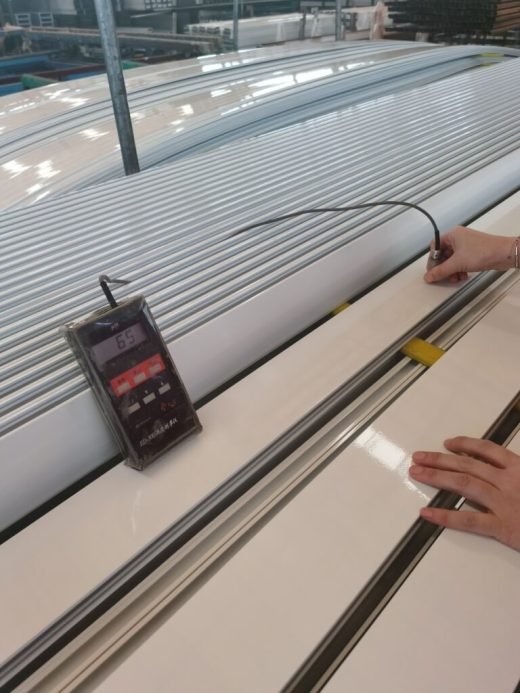
For projects where colour match to the surrounding facade matters — RAL 7016 anthracite, RAL 9005 black, RAL 9016 white, custom — polyester or PVDF powder coating is the standard. Specify the gloss level (matte is the residential default) and we hold ΔE ≤ 1.0 batch-to-batch.
ΔE batch control across a multi-shipment project
On multi-phase rollouts (e.g., a residential development with 200 doors across 4 phases), we run all phases on the same coating line and verify every batch with a digital colorimeter. The ΔE between the first door in phase 1 and the last door in phase 4 stays inside your spec, not inside our hope.
How a rolling shutter profile order moves through the mill
- You send the drawing — slat pitch, wall thickness, hook geometry, guide rail section, bottom bar section, finish, fabrication list.
- We review extrudability, check hook geometry for cycle life, propose alloy/temper and finish.
- New die or reused die; locked to a single billet batch.
- Extrusion → straightening → cut-to-length → brush strip insertion (if ordered) → end cap installation → finish → labeling.
- MTC (EN 10204 3.1) issued to GB/T 5237, EN 12020-2 with measured mechanical properties, chemical composition and coating parameters.
- Packed in kits per door or per project phase, with bundle labels traced to billet batch and coating run.

 Architectural Aluminum