A U-Channel Is a Slot, a Track or a Frame
Two legs, a base and a 90 degree inside corner looks like the simplest profile to specify. It usually is not, because the open slot that makes a U-channel useful is also what makes it hard to extrude: two thin legs standing on a flat base are a metal-flow problem at the press and a warping problem after the quench. What the pocket does defines the specification.
- A slot that holds something — frameless glass retention in storefronts and balustrades, panel receivers in facade cladding, signage frame inserts. The legs are the bearing surface, so leg height and parallelism decide how cleanly the mating part slides in.
- A track that something slides along — sliding door rails, drawer slides, machine linear guides, cable carriers. The base must be flat, the inside corner consistent and the surface must not gall against the moving part.
- A frame that caps an edge — countertop and panel edge protection, worktop trim, decorative reveals, where finish, corner radius and straightness are what get judged.
Linkedalu Metal Group Co., Ltd extrudes custom aluminum U-channel for glass retention, panel systems, sliding tracks, edge protection, cable management and structural framing, with mill test certificates against GB/T 5237, EN 755-9 or ASTM B221 on every order.
U-Channel vs C-Channel
A U-channel has two straight legs at 90 degrees to the base. A C-channel adds an inward return lip on each leg, which stiffens the section against local buckling and gives a screw head something to bite into. Use U-channel where the mating piece needs a clean sliding fit and the load is modest, such as glass, panels and light rails. Use C-channel where the section has to carry more load, mount to a substrate with self-tapping screws, or hold a rigid insert against pull-out. They look alike and behave differently.
Wall-Thickness Ratio: The Silent Cause of Warping
Hot aluminum leaving the die cools unevenly. Thick sections cool slower than thin ones, and the differential contraction distorts the profile as it leaves the press. The rule most extrusion designers work to is a ratio of 2:1 or less between adjacent wall thicknesses. A 3 mm leg next to a 1.5 mm tongue is fine; a 3 mm leg next to a 1 mm tongue will twist even when the rest of the section is in tolerance. On a U-channel the failures show up first at the inside corner radius and where the leg meets the base. We catch this at die design, and if a drawing arrives with a 4:1 ratio built in, we flag it before any steel is cut. Fixes include redistributing material toward the thin section, adding a fillet to ease the transition, or adding internal stiffening.
CCD and Weight per Meter
Two numbers decide whether a custom U-channel is economical to produce. The circumscribing circle diameter, the smallest circle enclosing the whole cross-section, extrudes efficiently between roughly 25 and 200 mm; below that the die work is fine and fragile, above it a larger press and slower speed are needed. Weight per meter is best kept around 1.5 kg/m or less, because heavier channels need slower press speeds, larger billet logs and more quench control. Neither constraint reaches a unit price until the first production run.
Alloy Selection: Visible Work vs Structural Duty
6063-T5 is the default for architectural and visible work. It extrudes cleanly, anodizes uniformly and carries enough strength for glass retention, panel receivers, edge trim and light framing. 6061-T6 is the structural channel, with roughly double the yield strength at 240 MPa against 110 MPa, and is specified when the channel carries load, is welded into a frame, or sits in a high-vibration assembly. 6060-T5 serves European specifications for fine, clean sections with tighter visual standards, and 5052 or 5005 covers marine and chemical environments where corrosion dominates over strength.
Tolerance Reality: What Extrusion Actually Holds
No extruded profile is perfectly dimensioned, and the honest specification is the one the process can hold. Per GB/T 5237.1 and EN 12020-2, cross-sectional dimensions up to 100 mm hold plus or minus 0.2 to 0.5 mm, and dimensions above 100 mm hold plus or minus 0.5 to 1.0 mm. Wall thickness holds within 10 percent of nominal. Length holds plus or minus 1 to 5 mm on a standard cut and plus or minus 0.1 to 0.5 mm on a precision cut. Straightness is 0.8 mm per 1,000 mm or better, twist 0.5 degrees per 1,000 mm or better, and angularity between legs and base 1 to 2 degrees.
Tighter tolerances slow the extrusion speed, add inspection steps, sometimes force a die modification and raise the price, so the useful question is whether the assembly actually needs them. A glass retainer that the glazier will shim on site can hold standard tolerance on slot depth; a sliding track that a roller rides against needs parallel legs and a flat base. State the application on the drawing and we will say which tolerances the specification needs.
Where U-Channel Is Specified
Glass retention is the largest single use. Anodized U-channel is the standard receiver for frameless glass in storefronts, office partitions and balustrade base shoes. The channel width must match the glass thickness, commonly 8, 10 or 12 mm, and the inside corner has to be smooth so the glass does not chip during installation. 6063-T5 with a clear or black anodized finish is the default. U-channel is also the insert receiver for ACM, HPL and decorative panel cladding, and the structural backbone of framed photovoltaic modules and many solar mounting rails, where a Class AA15 anodized finish has to survive 25 years of ultraviolet and salt-spray exposure. Machine guards and cable trays use 6063-T5 as standard and 6061-T6 where the guard must pass an impact test, and retail fit-out uses short runs under 500 kg from existing dies.
Finishing, Fabrication and Order Flow
Finish options are mill finish as standard supply, anodizing at Class AA10, AA15 or AA20 in clear, champagne, bronze or black, architectural-grade powder coating at 40 micrometers and above, and PVDF fluorocarbon coating in two, three or four coats for high-UV and coastal conditions. Fabrication covers cut-to-length, drilling, slotting, mitering and labeling to your elevation or call-up list, with slot tolerances held to plus or minus 0.15 mm where the mating part requires it and pieces packed in sequence so the installer works straight from the crate. Standard length is 6.0 m; minimum order is 500 kg for a new die and 200 to 500 kg for sections already in the die library.

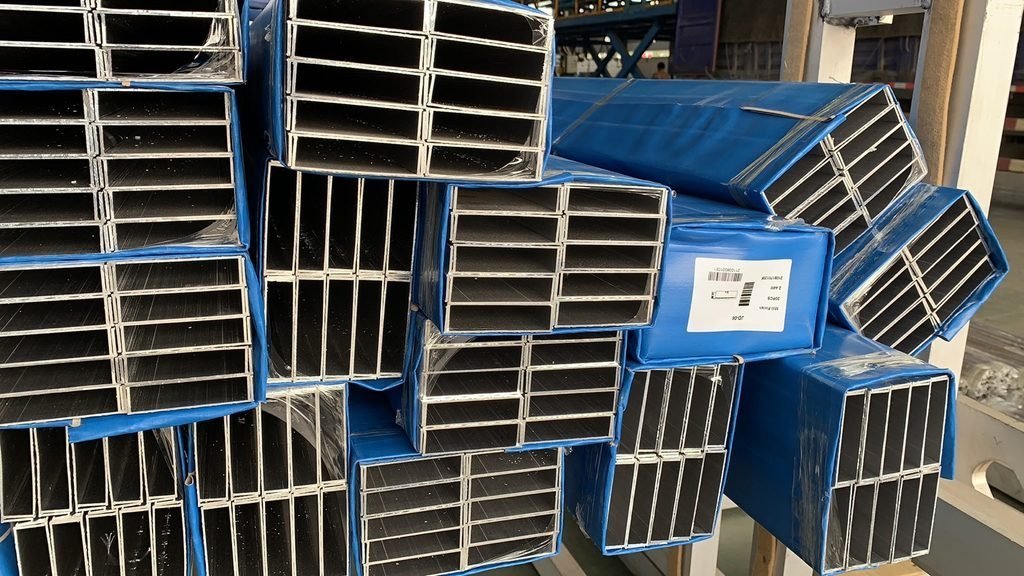
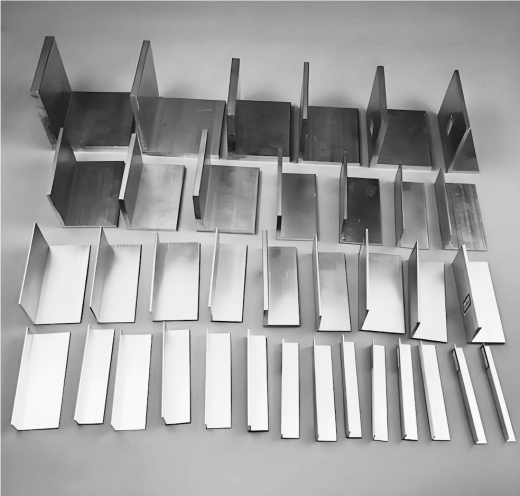 Standard Aluminum Shapes