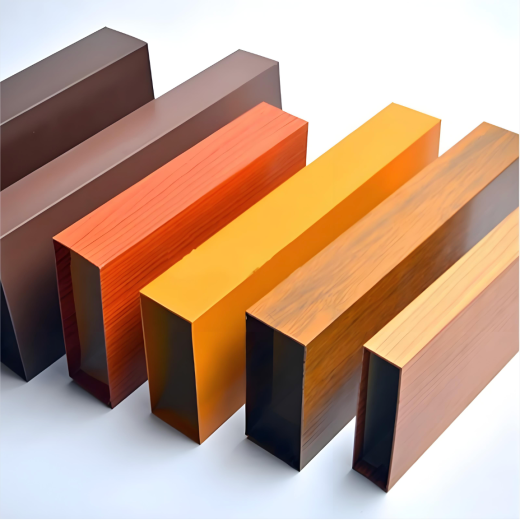
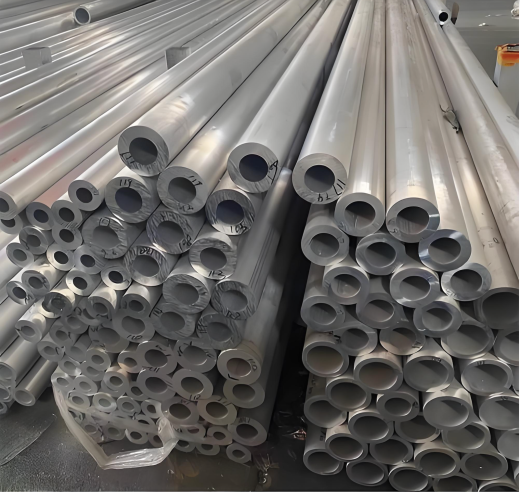
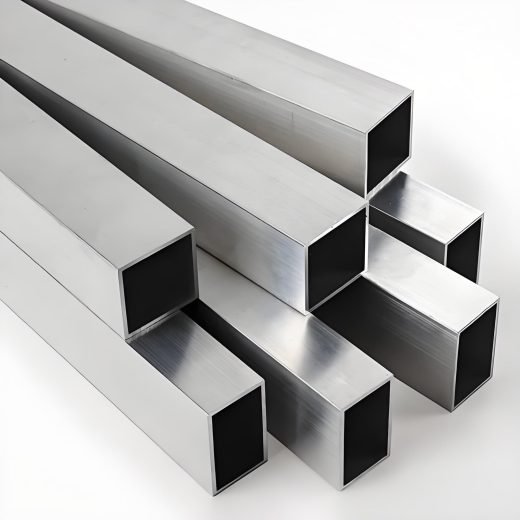
An Aluminum I-Beam Is Extruded, Not Rolled
A steel wide-flange beam is hot-rolled and can run 600 mm deep. An aluminum I-beam is pushed through a die in a hydraulic press, so the section is limited by what the press can take and what the die can hold. That is why commercial aluminum I-beams rarely exceed 250 to 300 mm depth, and why the flange is normally uniform in thickness with no taper. These are not defects; they are the geometry that comes with extrusion, and designing around them is what makes aluminum work in a structural frame.
Linkedalu Metal Group Co., Ltd extrudes custom aluminum I-beam and T-profile sections for structural framing, stiffening, machine bases, transport equipment and architectural work where steel is simply heavier than the specification allows. Mill test certificates against GB/T 5237, EN 755-9 or ASTM B221 ship with every order.
Aluminum vs Steel: An Honest Comparison
| Property | Steel (ASTM A992) | Aluminum 6061-T6 (ASTM B221) |
|---|
| Density | 7.85 g/cm3 | 2.70 g/cm3 |
| Tensile strength | 400-550 MPa | 260 MPa min. |
| Yield strength | 250-345 MPa | 240 MPa min. |
| Elastic modulus | 200 GPa | 69 GPa |
| Thermal expansion | 11.6 x 10⁻⁶ /C | 23.1 x 10⁻⁶ /C |
| Manufacturing | Hot rolled | Extruded |
At an equal cross-section a 6061-T6 aluminum beam carries roughly 35 to 40 percent of the load a steel beam carries, at about one-third the weight. Two numbers are routinely missed. Aluminum's elastic modulus is about one-third of steel's, so a same-size aluminum beam deflects roughly three times more under the same load. Its thermal expansion is about twice steel's, so long-span members need movement allowed at the connection rather than only at the surface.
Stiffness: What 69 GPa Costs You, and How to Recover It
Because deflection is rarely fixed by changing alloy, it is fixed by changing geometry or span. Three levers work: go deeper, since moving from a 100 mm to a 150 mm aluminum I-beam roughly doubles the moment of inertia; add internal stiffening ribs in the extrusion, which puts material where stress is highest for little weight penalty; or accept the lower stiffness and reduce the unsupported span with closer supports. A drawing review will tell you which lever the section geometry allows.
Extrusion also lets the cross-section be designed for the load path rather than for a rolling mill, using tapered wall thickness, a hollow tubular web or internal ribs. Those are the design moves that let aluminum win on specific strength. Welding follows the usual aluminum rules: 6061-T6 welds cleanly with TIG or MIG using 4043 or 5356 filler, and the heat-affected zone loses temper, dropping to roughly T4 strength in the weld zone.
I-Beam Sizes, Limits and Tolerances
On presses from 500 MT to 5,000 MT the practical envelope is a depth up to about 300 mm, a flange width up to about 200 mm, web and flange thickness from 2 mm to 25 mm depending on depth, and a weight per meter that normally stays below 15 kg/m. Beyond about 300 mm depth the web cools slowly while the flanges cool fast, and the differential contraction warps the section.
| Section h x b (mm) | Web t (mm) | Flange t (mm) | Weight (kg/m) |
|---|
| 50 x 30 | 3.0 | 4.0 | 0.95 |
| 80 x 40 | 4.0 | 5.0 | 2.10 |
| 100 x 50 | 4.5 | 6.0 | 3.20 |
| 150 x 75 | 5.5 | 8.0 | 6.50 |
| 200 x 100 | 6.5 | 10.0 | 11.00 |
| 300 x 150 | 8.0 | 12.0 | 18.50 |
Weights are theoretical and for reference only; the certified figure travels on the mill test certificate. Dimensional tolerances run to depth plus or minus 0.5 to 1.5 mm depending on size, flange width plus or minus 0.5 to 1.0 mm, web and flange thickness plus or minus 10 percent of nominal, straightness within 0.8 mm per 1,000 mm, twist within 0.5 degrees per 1,000 mm and web flatness within 0.5 percent of web height. Tighter tolerances slow the press, add inspection and sometimes force die modification, so they are worth specifying only where the assembly needs them, such as machined mating faces and bolted flange connections.
T-Profile Variants and Alloy Choice
Four decisions change what a T-profile does. An equal T, where flange width and stem height are similar, is the default for stiffeners, ceiling grids and partition frames because loading across the flange is symmetric. An unequal T, with a flange wider than the stem, suits display frames, architectural reveals and signage holders where the mounting surface needs more contact than the stem needs for stiffness. Sharp corners give a clean architectural line with a modest stress concentration, while radiused corners distribute stress better, extrude more easily and are safer to handle, which is why visible architectural T profiles almost always use radiused corners.
6061-T6, with a minimum tensile of 260 MPa and yield of 240 MPa, is specified for structural T-bars, stiffeners, welded machine frames and transport equipment. 6063-T5, at 160 MPa tensile and 110 MPa yield, is the default for visible architectural T profiles, ceiling grids and reveals because it anodizes bright and uniformly. 6060-T5 serves European specifications with tighter visual standards, and 5052 or 5086 covers marine plate and secondary members.
A structural T-profile is not a T-slot profile. T-slot extrusions such as 2020, 2040, 4040 and 4080 are a separate product family with slots machined into the flange to accept T-nuts for modular framing. They look similar and do different jobs, so say explicitly that you want a structural T.
Where These Sections Work
Transport equipment is aluminum's home ground: an aluminum 6061-T6 I-beam frame can cut frame weight by 40 to 50 percent against a steel equivalent and convert that saving directly into payload. Machine builders move to aluminum I-beams when the machine has to be repositioned regularly or when corrosion matters, as in food processing and wash-down areas. T-profiles in 6063-T5 sit behind suspended ceiling grids, partition framing and architectural reveals, and a T-profile bonded to the back of a flat panel raises the panel's moment of inertia so a flexible sheet becomes structural. Marine structures such as boat lifts, dock frames and gangways use aluminum because it needs no painting at the waterline.
Fabrication covers cut-to-length, drilling, mitering, welded sub-assemblies and labeling to your call-up list. Standard length is 5.8 m, with 6.0 m available by project review, and finishes run from mill finish through anodizing at AA10, AA15 or AA20, architectural powder coating at 60 micrometers and above, and PVDF for high-UV or coastal exposures. Minimum order is 500 kg for a new die and 200 to 500 kg for sections already in the die library.

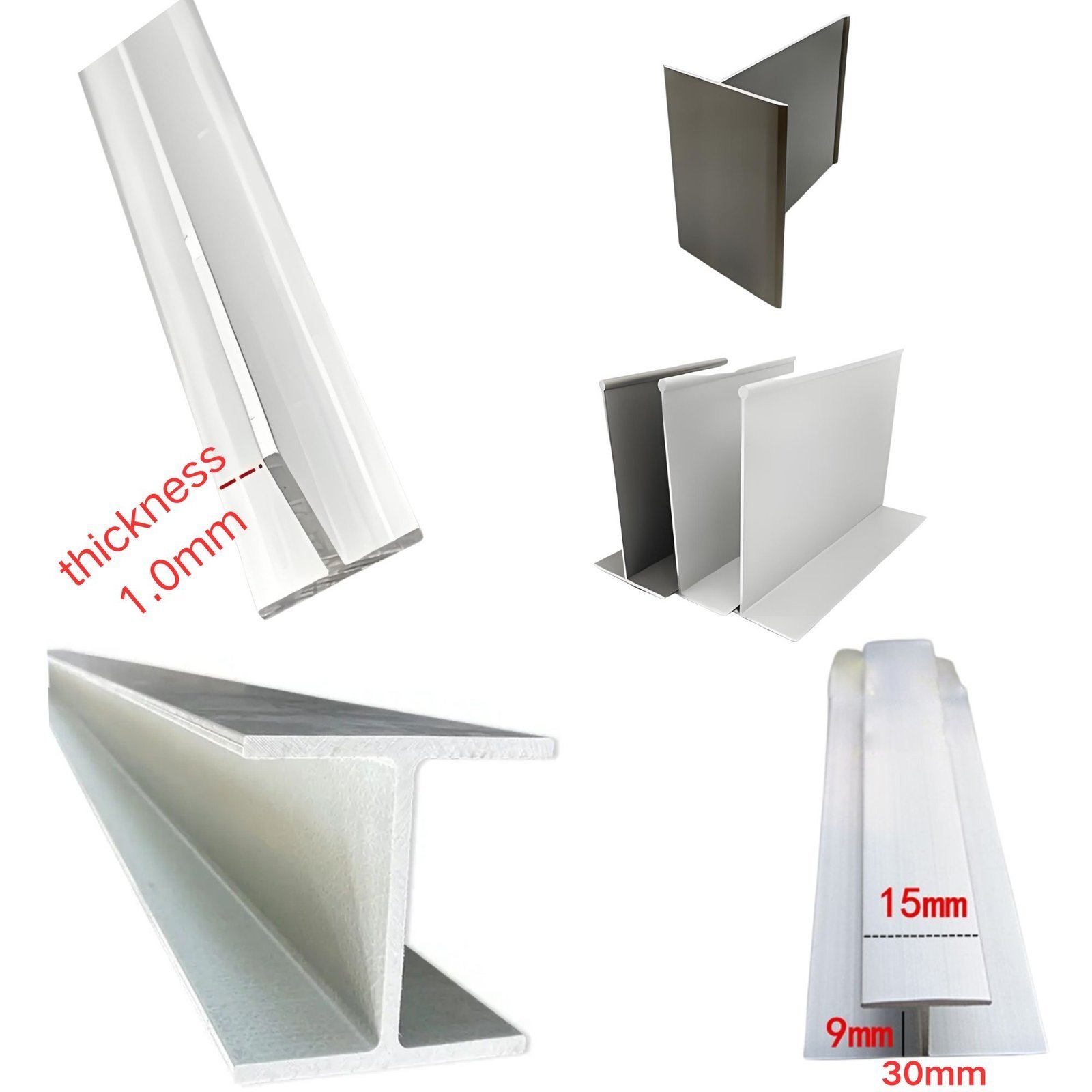
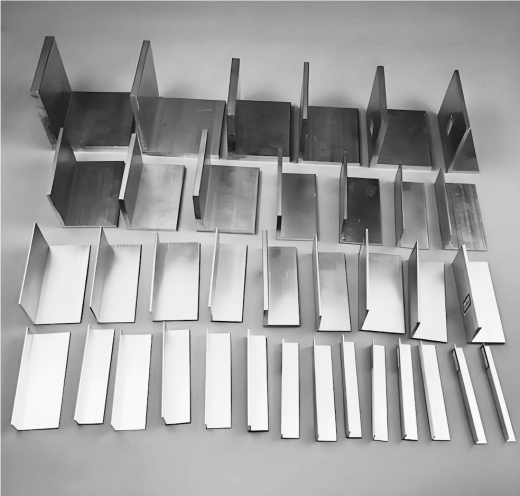 Standard Aluminum Shapes