Why Aluminum Angle Is the Most-Used Profile in Fabrication
Ask any fabricator which extrusion comes off the rack most often and the answer is the same: aluminum angle. Two legs meeting at 90 degrees resist bending in two directions at once in a section that weighs roughly a third of the equivalent steel angle. It braces, frames, trims, reinforces and mounts. Linkedalu Metal Group Co., Ltd extrudes custom aluminum angle in equal-leg and unequal-leg configurations for framing, bracing, corner reinforcement, shelving and structural brackets, with mill test certificates issued to GB/T 5237, EN 755-9 or ASTM B221.
Because the section is extruded rather than press-braked from sheet, the cross-section repeats from one end of the bar to the other, the inside corner is consistent and the wall thickness is uniform. That repeatability is what allows a mating component to fit and a load path to be predicted.
Equal Leg vs Unequal Leg: Choose by Load Path
- Equal leg (a/b = 1.0) — 25 x 25, 50 x 50 and 100 x 100 mm are the default workhorses. Both legs share the structural duty, so a load can arrive from either direction. Specify equal leg for enclosure corner reinforcement, square machine-base framing, shelf supports and architectural trim where visual symmetry matters.
- Unequal leg — 50 x 25, 75 x 50 and 100 x 50 mm pair a longer leg for fastening or stiffness with a shorter leg that keeps the profile compact. Typical uses are wall-mounted shelf brackets, ledge and awning supports, panel edge framing and asymmetric connections where the load is heavier in one direction.
Choosing wrongly usually shows up as wasted material or a poor fit. When in doubt, equal leg for balanced duty and unequal leg for one-sided mounting.
Alloy and Temper: 6063-T5, 6060-T5 and 6061-T6
| Property | 6063-T5 | 6060-T5 | 6061-T6 |
|---|
| Tensile strength Rm | 160 MPa min. | 160 MPa min. | 260 MPa min. |
| Yield strength Rp0.2 | 110 MPa min. | 120 MPa min. | 240 MPa min. |
| Elongation A50 | 8 % min. | 8 % min. | 8 % min. |
| Anodized appearance | Bright and even | Bright and even | Slightly grayish |
| Weldability | Acceptable, light duty | Acceptable, light duty | Excellent |
These are minimum thresholds from GB/T 5237.1 and EN 755-2; the figures that apply to your order are the measured values on the mill test certificate. 6061-T6 has roughly twice the yield strength of 6063-T5, which makes it the safer choice for machine bases, welded frames, roof-rack crossbars and any angle that carries real load. 6063-T5 extrudes more cleanly and anodizes more uniformly, so it is the right answer when the angle is visible and the duty is light.
Buckling, Slenderness and the b/t Rule
On a 100 x 50 mm unequal-leg angle under compression, the long leg is stiffer because it carries more material while the short leg is more slender and therefore more prone to local buckling. The section does not fail uniformly; it fails where slenderness is highest. For compression-loaded angles, prefer equal leg where the geometry allows. Where unequal leg is required, size the short leg so its width-to-thickness ratio stays at or below about 12, or move up from 6063-T5 to 6061-T6 so the section can develop its yield capacity before elastic buckling begins. Yield strength alone is not a sufficient check on a thin-wall unequal angle.
Reference Weights for Equal-Leg Angle
| Leg x Leg (mm) | Wall t (mm) | Weight (kg/m) |
|---|
| 25 x 25 | 2.0 | 0.26 |
| 40 x 40 | 3.0 | 0.62 |
| 50 x 50 | 3.0 | 0.78 |
| 60 x 60 | 5.0 | 1.54 |
| 100 x 100 | 6.0 | 3.11 |
| 100 x 100 | 10.0 | 5.08 |
Values are theoretical kilograms per meter and reference only. Actual mill weight varies with tolerance and corner radius, so the certified weight travels on the mill test certificate.
Where Aluminum Angle Replaces Steel Angle
Aluminum weighs roughly 35 percent of steel by volume, so an equal-strength bracket ships and installs lighter and imposes less load on the structure it bolts to. Aluminum angle also survives humid, marine and mildly chemical environments without rusting, and it cuts, drills, taps and machines with standard tooling. Steel still wins on raw load capacity per unit cost, so for a heavy stationary machine base or a structural column where weight is not a constraint, steel remains the economical choice. The case for aluminum is the problem it solves rather than the strength it claims.
Cut, Drill, Tap, Weld and Finish
Standard mill length is 6.0 m. We cut to your call-up list with a length tolerance of plus or minus 0.5 mm on pieces up to 3 m and plus or minus 1.0 mm on longer mill lengths, and programmable miter saws handle angled ends and notches. CNC drilling holds hole position to plus or minus 0.2 mm, and tapped holes such as M5, M6, M8 and M10 are produced to a 6H fit. Where an assembly depends on matched holes, mating parts are drilled and tapped in the same setup so they index correctly on site.
6061-T6 welds excellently with TIG or MIG using 4043 or 5356 filler; the heat-affected zone loses some temper, so welded 6061 angles are specified as 6061-T6 base with the weld zone allowance built into the design. 6063-T5 can be welded but is normally chosen for non-welded assemblies.
Finish options run from standard mill finish through anodizing at Class AA10, AA15 or AA20 for marine and visible architectural work, architectural-grade powder coating at 60 micrometers and above, and PVDF for high-UV or coastal exposure.
How an Angle Order Moves Through the Mill
- You send the drawing: leg lengths, wall thickness, alloy, temper, finish and fabrication list.
- We confirm extrudability and return theoretical weight per meter and per piece, flagging geometry that will not extrude cleanly.
- New die or reused die, locked to a single billet batch.
- Extrusion, straightening, cut-to-length, CNC drilling, tapping or notching, then finishing and labeling.
- A mill test certificate to EN 10204 3.1 is issued against GB/T 5237, EN 755-9 or ASTM B221.
Minimum order quantity is 500 kg for a new die, with smaller trial quantities reviewed against our existing die library. Bars are supplied shrink-wrapped and labeled to your call-up list.

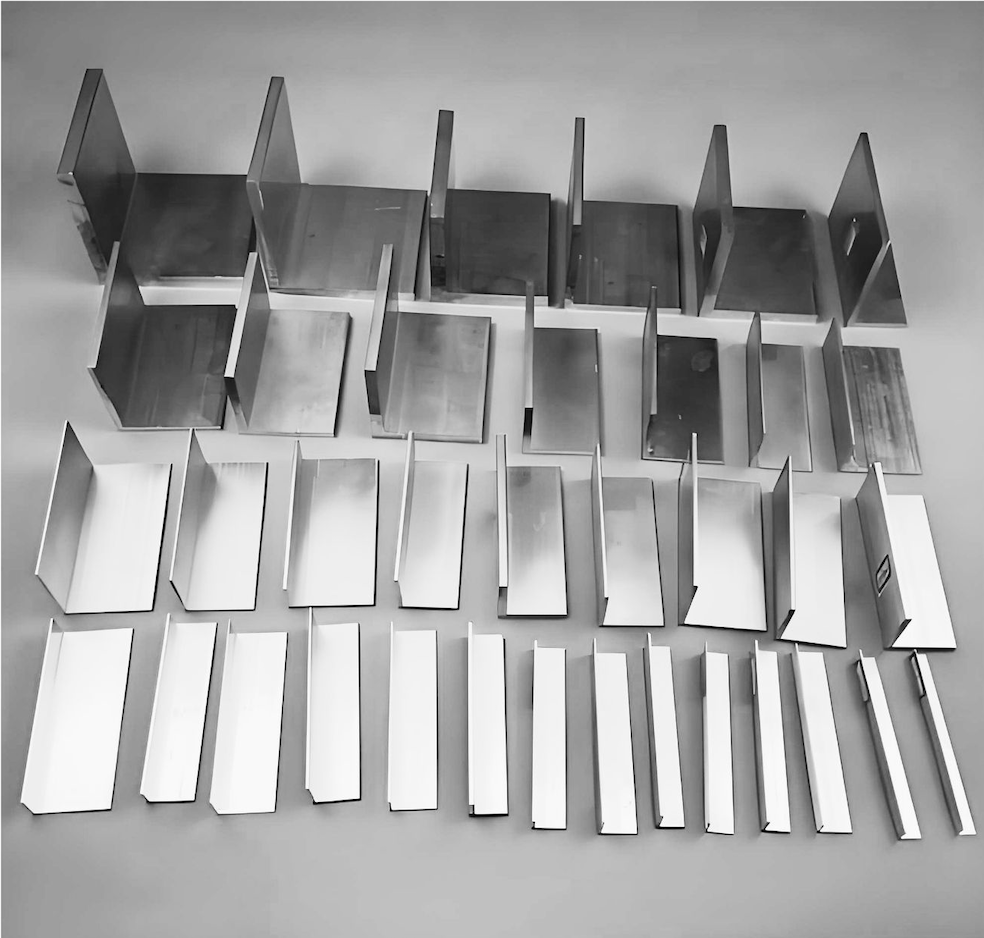
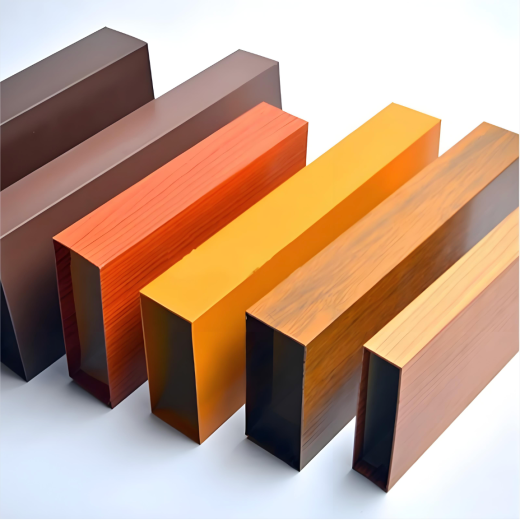 Standard Aluminum Shapes