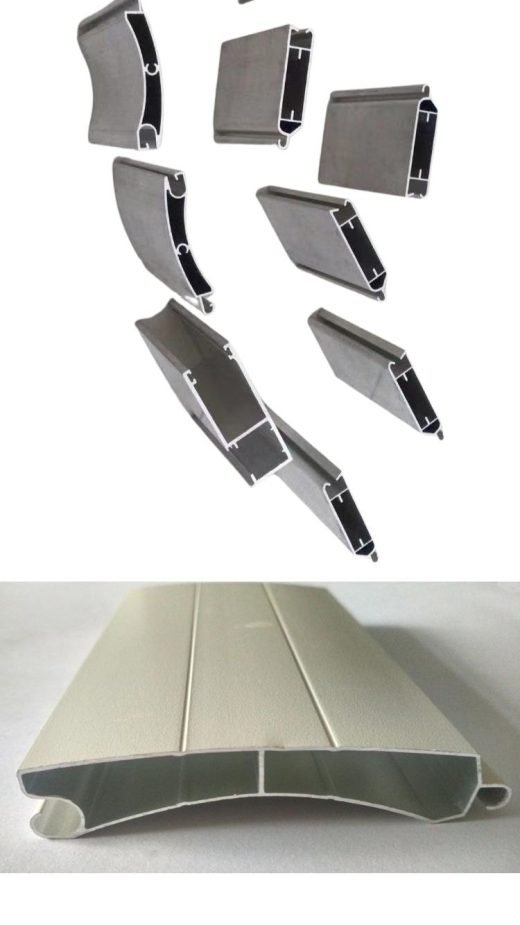
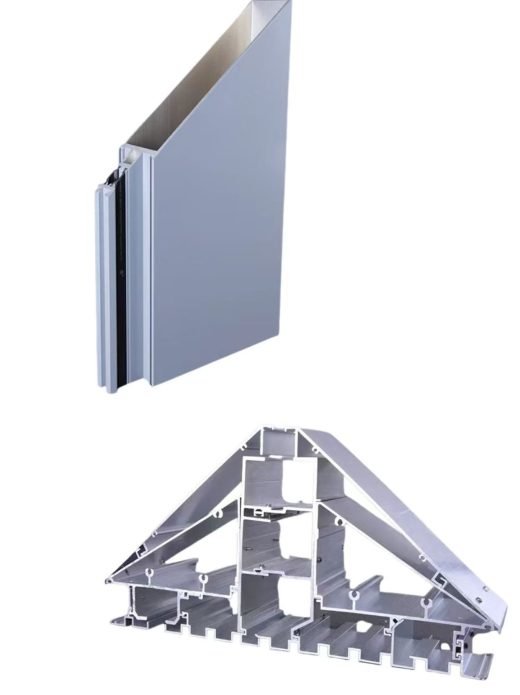
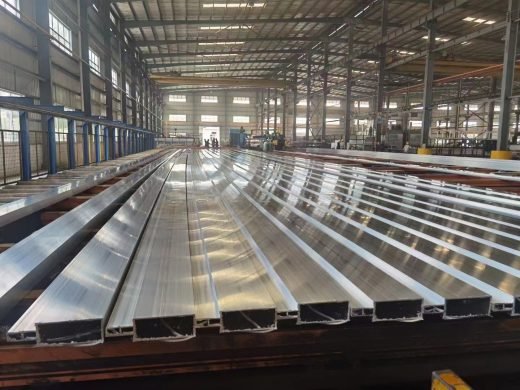
Linkedalu Metal Group extrudes aluminium handrail and guardrail profiles for balconies, stair flights, terraces, walkways and pool decks: top rails, wall-mounted handrails, posts, balusters and infill rails, cut, drilled and tapped to your drawing. This page covers the railing systems that do not use glass. If your project clamps laminated glass in a base shoe, our glass balustrade page is the closer match.
Handrail, guardrail, balustrade — three jobs, three different sections
The three words get used interchangeably in enquiries. They should not be. A handrail is the part a person grips, sized by hand geometry and grip load. A guardrail is the barrier that stops a fall at a level change, sized by a code line load and a deflection limit. A balustrade is the whole assembly: top rail, posts, balusters and infill.
The most common mistake we see is a handrail section quoted for a job that needs a guardrail. A 38 mm handrail tube is comfortable to hold and will not pass as a guardrail post on a 6 m span at any wall thickness. Decide which job the section has to do before choosing anything else.
| Component | Sized by | Typical section we extrude |
|---|
| Handrail (grip) | Hand span, grip comfort, point pull | 38 mm or 50 mm round; 40 × 60 mm shaped oval; flat-bar wall rail |
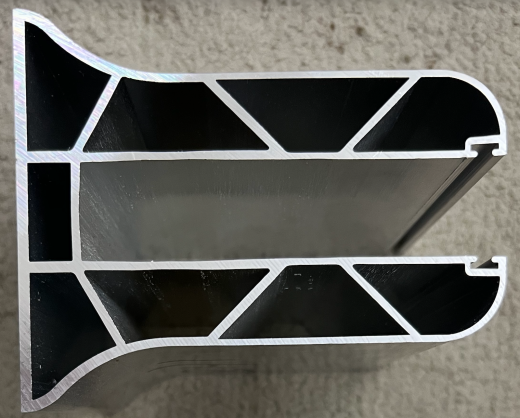
| Guardrail top rail | Line load and deflection over the post spacing | 50 mm round tube, 2.0 mm wall; 60 × 40 mm box; shaped top rail with a screw channel |
| Post | Cantilever moment from the line load; base fixity | 60 × 60 mm or 80 × 40 mm multi-chamber; 100 × 50 mm with an infill slot |
| Baluster / infill | Sphere-gap rule, picket or panel spacing | 25 × 25 mm; 30 × 30 mm; 40 × 20 mm flat oval; 50 mm flat bar |
| Wall-mounted handrail | Grip and bracket pull-out | 38 mm or 50 mm round with a bracket slot; flat back-plate section |
The load a guardrail has to carry
Codes describe a guardrail with two numbers: a uniform line load along the top rail, and a concentrated load at any point. The IBC, for example, puts 0.73 kN/m uniform or 0.89 kN concentrated on the guardrail of a dwelling; assembly occupancies and vehicle areas are higher. Gulf and Latin American codes set their own figures, and the one that governs is the one on your permit — not the one in a supplier’s catalogue.
Infill carries load too, and on an open balcony it is also a sail for wind. Above roughly the fourth floor in an exposed location, wind on the infill usually governs the post rather than the line load.
Deflection picks the section, not stress. A guardrail almost never fails on strength — the aluminium has strength to spare. It fails on movement, because a barrier may flex a little and not much: 30 mm at the top of the post is a common cap, and some codes allow H/24 or more. Deflection grows with the cube of the span and falls with the section’s second moment of area. Double the post spacing on the same post and it does not move twice as much — it moves eight times as much. That is why post spacing cannot be answered without the section properties, and why we publish I and Z with every quotation so your engineer can run the check rather than take a rule of thumb.
The codes your inspector will name. Brazil’s ABNT NBR 14718 requires a guarda-corpo wherever the level change exceeds 0.60 m, at 1.10 m minimum above the finished floor and 1.20 m on accessible roofs. Dubai and Abu Dhabi require balcony balustrades in vertical rods rather than horizontal rails, so children cannot climb them. Saudi projects work to the Saudi Building Code. Industrial guardrails follow EN ISO 14122-3 at 1,100 mm. Send us the code and the design load with the enquiry and the section we propose arrives with the check already run.
Hot, humid and coastal sites
In Gulf and tropical sun a dark matt handrail runs 20 to 30 K above ambient. That is uncomfortable to grip and can fall foul of accessibility requirements, and it is not fixed by making the section thicker. Light finishes reflect more and stay cooler. Where the architect has fixed a dark colour, a polyamide thermal break — separating the sun-heated outer skin from the fixing web — is the usual answer. It is not part of our standard handrail range; we run it on request where a project’s temperature requirement justifies the die, and we will say plainly when a lighter finish solves the same problem for less.
Fasteners and the 0.5 V rule. Stainless steel and aluminium form a galvanic couple, and in a damp coastal detail the aluminium is the part that disappears — a bare section in direct contact with a stainless fastener can lose measurable metal within 18 to 24 months. It is designed out, not maintained out: nylon or EPDM isolating washers and sleeves at every stainless fastener; no stainless bearing directly on bare aluminium; a base plate sealed at the perimeter but with a weep path so water cannot stand in the post foot; cut ends and drilled holes kept clear of standing water and touched up on site. A post foot sitting in a puddle will corrode whatever is done above it. On pool decks and beachfront work, add a freshwater wash to the maintenance schedule — salt left on the surface is the slow version of the same failure.
Baluster and infill design
Two numbers cover most residential railing rules: no opening in the infill may pass a 100 mm sphere, and the barrier must reach at least 1.10 m above the finished floor. Measure the sphere rule at the widest point of the opening — including the gap under the bottom rail and any diagonal opening formed at a post, which is measured on its widest dimension rather than its side.
Vertical infill is the safer default, and the required one for balconies in Dubai and Abu Dhabi: horizontal rails read as a ladder to a child. Where a project genuinely needs the horizontal line across a long terrace, set the spacing and any intermediate rails so the assembly is not climbable, and record the decision in the design rather than settling it on site.
| Infill | Where it works | Watch out for |
|---|
| Vertical aluminium balusters | Balconies, stairs, terraces — the lightest option | Set the sphere gap correctly; fewer thicker balusters read cleaner than many thin ones |
| Flat-bar or oval pickets | Where a solid, private look is wanted | More metal, more weight, higher cost per metre |
| Perforated or slotted aluminium panels | Car parks, plant enclosures, high-wind sites | Wind load on the panel usually governs the post; the sphere rule applies to the apertures |
| Stainless cable | Views, terraces, feature stairs | Cable needs tensioning maintenance and correct fittings; anchor loads are high |
Alloys, wall thickness and finish
6063-T6 covers handrails, balusters, infill and cover caps, and 6061-T6 is what we run for base plates, brackets and industrial guardrails that are drilled or tapped. Higher-strength 6005A-T6 is not our standard alloy for handrail sections; where a post or a long cantilever genuinely needs more stiffness than 6063 gives, tell us the span and the design load and we will look at it for that section.
Wall thickness starts at 0.8 mm and is set by the section and the load it carries. Where a section has to be tapped, we thicken the wall locally in the die so the thread has material to bite into. Manufacture is to GB/T 5237, and to ASTM or EN on request, with mill test certificates giving composition, temper and mechanical properties.
Finish is covered in detail elsewhere on this site, so in short: anodizing AA10 and AA15 are what we run as standard, with AA20 on request. Powder coating and PVDF are available but carry a substantial cost premium and are quoted only when a project specifies them.
One point worth making, because it is the most expensive mistake we see: trimming a post wall saves a few percent of metal and cuts the section’s stiffness enough to change the maximum post spacing or the permitted height. If a tender has to come down, take it out of the infill count, not out of the post.
Die, MOQ, machining and packing
We cut dies in-house. MOQ is 500 kg per section, whether it runs on a die already in our library or a new one is cut for it. If you are evaluating a design, ask for a sample length from the first pressed billet before committing to the run.
Extrusion is invoiced on weight, and a ±10 % tolerance on total weight is normal for custom work, so a nominal 500 kg order can arrive between roughly 450 kg and 550 kg. We quote the section weight per metre up front so the reconciliation on arrival is arithmetic rather than a dispute. Tell us if your order has to be firm.
Bars ship in whatever state your installation sequence needs: mill finish cut to rough length, cut to a finished-length list, or fully prepared with mitres, drainage holes, tapped fixing points, countersinks and notches. Notching and drilling are cheap at our end and expensive on a balcony. Send a DXF or PDF cut list and we machine to the drawing, not to a description.
On packing: a 20 ft container takes up to 5.85 m, so 6.0 m bars ship in a 40 ft or 40 HQ, or we cut them to your list before packing. Decide this early — it changes the cut list, the scrap allowance and the price. Coated bars are sleeved and interleaved, bundled with the ends protected, and labelled by assembly zone so a crew opens one bundle per balcony or per stair flight instead of sorting a mixed pile on the slab. Transit damage to the coating is the most common claim on a railing shipment, and most of it is avoidable with proper interleaving and lifting.
Questions that arrive with the enquiry
Which alloy — 6063, 6005A or 6061? Handrails, balusters and infill run in 6063-T6 as standard, and base plates and drilled brackets in 6061-T6. 6005A-T6 is not our standard handrail alloy; if a post or cantilever needs more than 6063 gives, send the span and the design load and we will discuss it for that section.
The screws strip when we tap the post. Why? Thread engagement. A tapped thread in aluminium needs about 1.5 times the screw diameter in depth to reach its rated load, so an M8 screw needs roughly 12 mm of tapped depth — more than a thin-wall post can offer. The answer is designed in: a heavier local wall, an internal boss thickened in the die, or a through-bolt with an isolation sleeve. We mark tapping zones on the section drawing. Adding wall thickness afterwards is not possible.
How far apart can the posts be? It comes from the section, not from habit. Give us the line load, the post height above the fixing and the base condition — cast into the slab, surface-mounted base plate, or bolted to a steel embed — and we return the maximum spacing that holds the deflection limit, together with the anchor pull-out the base needs. Between 1.2 m and 1.5 m covers most residential balcony work.
How do we stop corrosion at the base plate? Isolate the aluminium from any steel or stainless, seal the plate perimeter to the slab, and give the water a way out. Galvanic corrosion needs a metal pair and an electrolyte; crevice corrosion needs standing water. Remove either and the base lasts.
Typical applications
- Balcony and terrace guardrails
- Stair, landing and ramp handrails
- Wall-mounted corridor handrails
- Pool-deck and beachfront railings
- Walkway and mezzanine edge protection
- Industrial and plant guardrails to EN ISO 14122-3

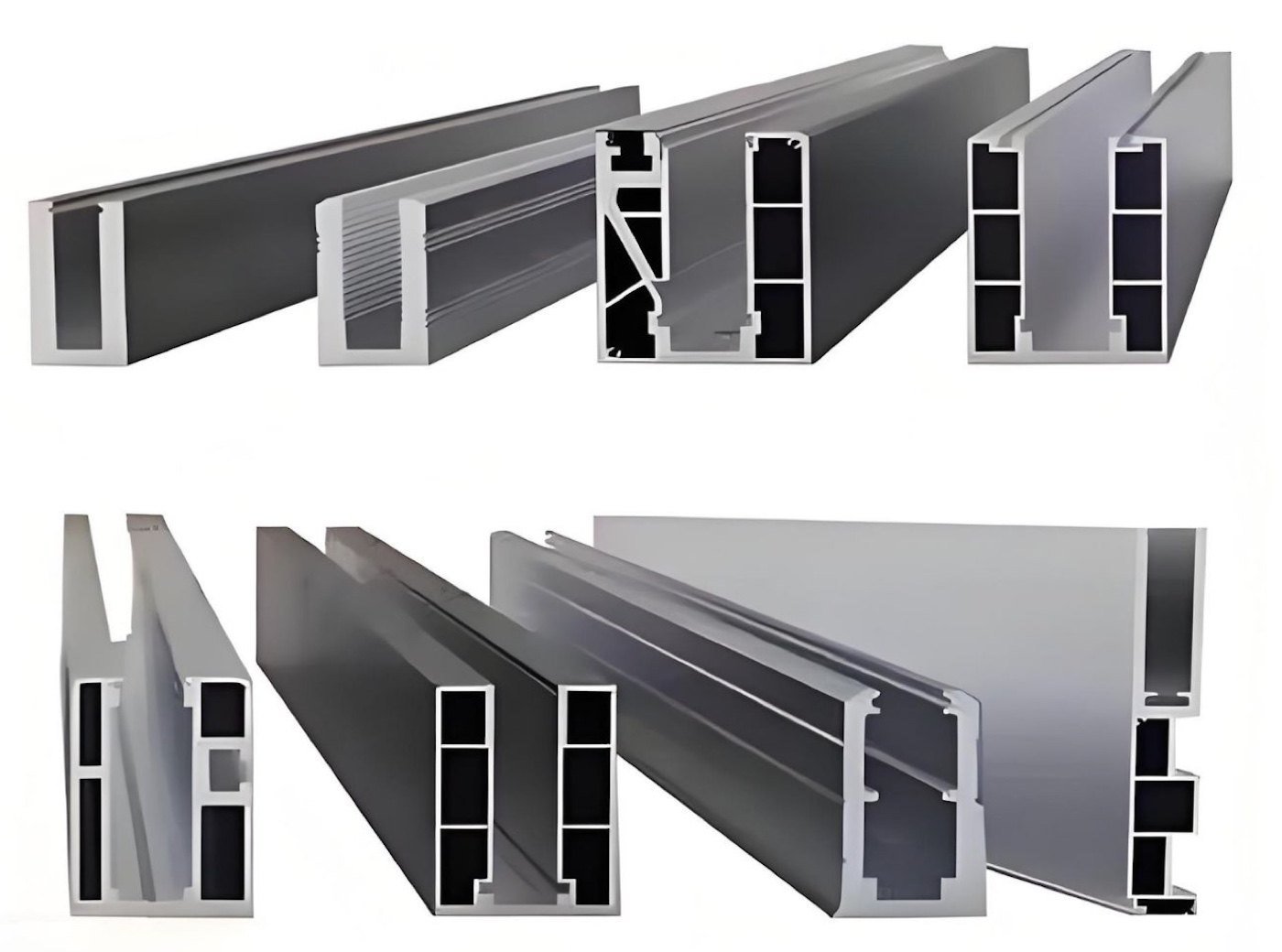
 Architectural Aluminum
starFeatured
Architectural Aluminum
starFeatured