We Ship Frame Kits, Not Random Bars
If you have built with T-slot before you know the frustrations: a T-nut that jams halfway down the slot, a 2 m bar with a visible bow, a frame that rocks on a flat floor because one extrusion twisted during cooling. Those are not assembly errors, they are profile errors that left the factory. We extrude T-slot and V-slot aluminum profiles for industrial frames, automation guarding, workstations, linear rails and custom machine builds, and we work from your drawings rather than a catalog.
Slot Widths Held to 0.15 mm
Some suppliers treat T-slot grooves as a rough feature. They are not. If the slot opening varies by 0.3 mm across a batch, a standard T-nut slides freely in one bar and needs hammering into the next, and the day disappears into sorting hardware and filing burrs.
We hold slot width to 0.15 mm on the common sizes of 6 mm, 8 mm and 10 mm. The die tongues that form the slots are cut from H13 steel with proper heat treatment and triple tempering, and every 50 bars are checked with a go/no-go gauge during production. When a tongue starts to wear, the die comes off the press for repair before bad bars leave the line. Slot walls are clean and burr-free, so a T-nut slides without binding and locks without play.
Straightness, Tension Stretching and Machined Faces
Extruded aluminum leaves the die hot, runs through quench and can twist or bow as it cools. If the mill does not stretch the material properly, residual stress stays locked in, and a cut 2 m piece springs into a banana. Frames built from those bars never square up, and a linear rail mounted on a bowed face follows the curve.
Every T-slot and V-slot profile passes through a tension stretcher after extrusion, giving 1 to 3% permanent elongation that pulls out internal stress. We guarantee straightness at 0.5 mm per meter or better. For a surface that carries a precision guide rail, the as-extruded face may still not be flat enough, so we recommend post-extrusion CNC milling on that face, where we hold flatness within 0.05 mm.
One Order, One Color
A two-tone frame happens when the base profiles and the uprights are ordered separately. The first batch looks fine, and a month later the second batch arrives with a faint champagne shift that everyone notices once the frame stands in a customer lobby. We treat a frame order as one production batch: same billet heat, same anodizing tank, same cycle. Silver anodizing is the default for industrial frames because it is the most stable in color; where black is required we run it in a dedicated black tank. Before packing, all bars for the same order are checked side by side under the same light, and we keep a color reference sample so a later reorder can be matched within ΔE 1.0.
What We Extrude
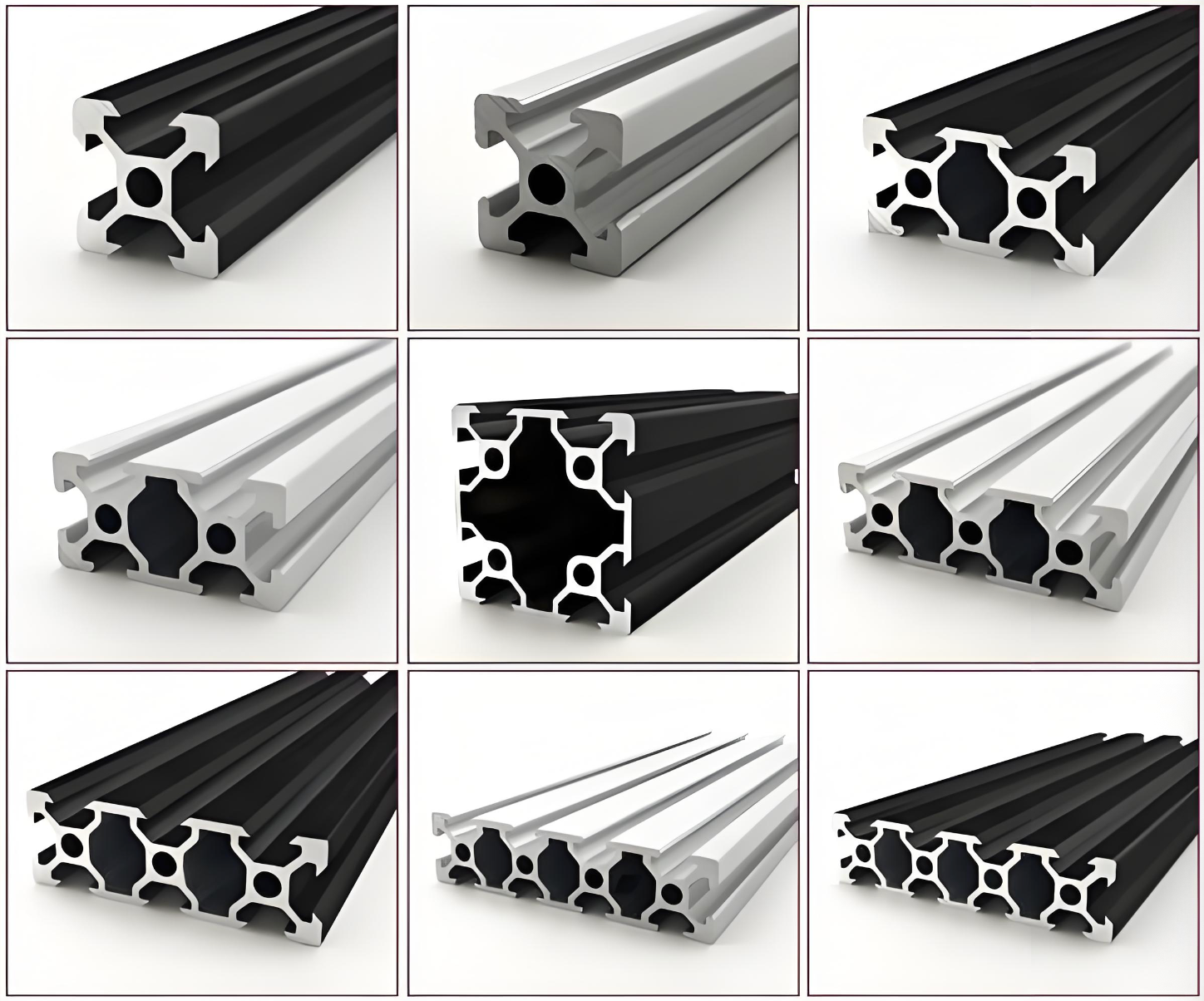
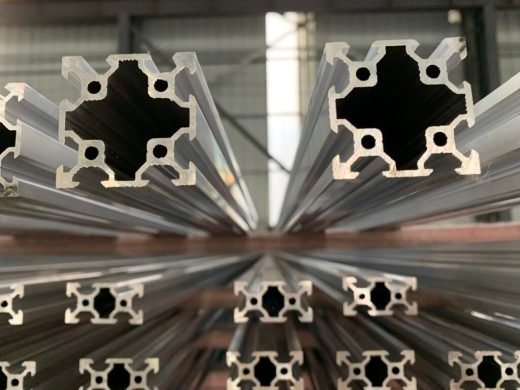
T-slot profiles are the workhorse, with T-shaped grooves on one, two, three or four faces, designed for T-nuts that rotate 90 degrees and clamp. They are the standard for machine frames, guarding, workstations and modular structures.
V-slot profiles carry V-shaped grooves with angled sidewalls, typically 45 degrees. These work directly with V-wheel bearings for linear motion, with no separate rail needed, which is why they are common in 3D printers, CNC routers, laser engravers and camera sliders.
Custom mixed geometries put T-slots on three faces and a V-slot on the fourth, which suits a gantry beam that needs both frame connections and a motion axis.
We extrude in 6063-T5 as standard with 6061-T6 available for high-load applications. Standard cross-sections range from 20 by 20 mm to 160 by 160 mm with slot widths of 5 mm to 10 mm, and larger custom sections are possible.
Cut, Drilled, Tapped, Labeled
Send a bill of materials and we handle the rest: precision sawing to 0.1 mm with square, burr-free cuts; CNC drilling of through, stepped and access holes per your drawing; end-face tapping for hidden connectors and side tapping for brackets in M3 to M12 at 6H class; and end milling for notches, steps, miter cuts and flat mounting faces. Every bar gets a label with its part number from your drawing, so the crew builds by the numbers with no saw, no drill and no guesswork on site. These profiles end up in machine frames and guarding, 3D printer and CNC router gantries, assembly benches, test and measurement fixtures, and enclosure frames with infill panels. Minimum order is 500 kg for a new die, or 200 kg from an existing cross-section.

 Industrial Aluminum