2020, 2040, 4040 or 4080: Choosing the Right Size
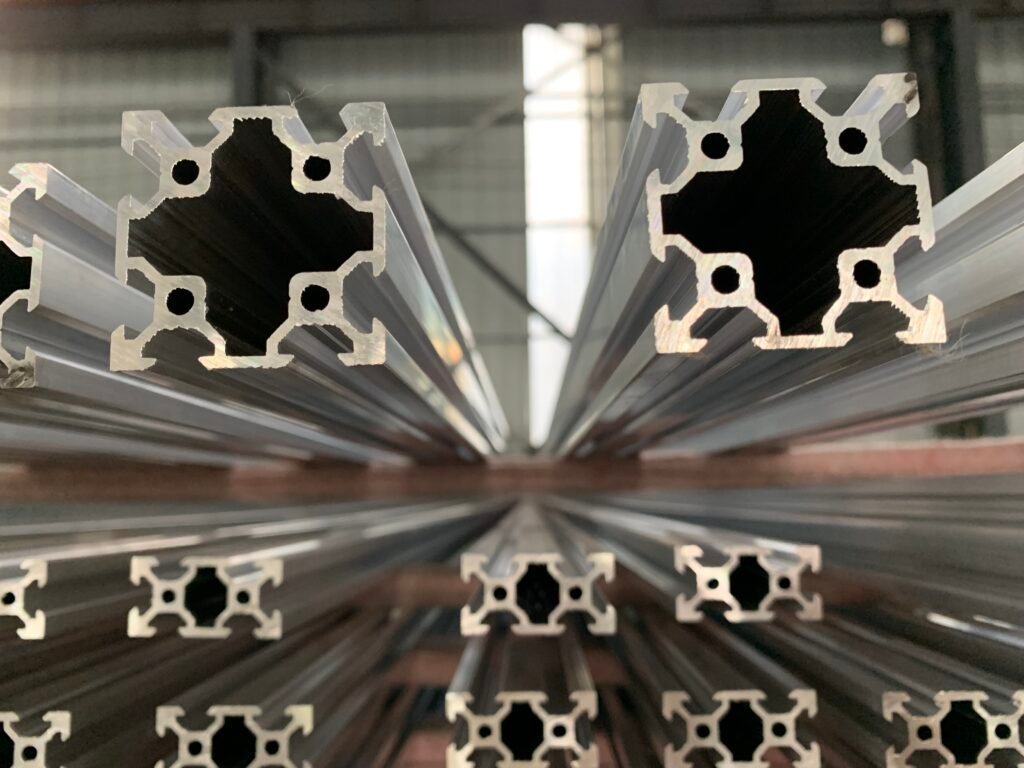
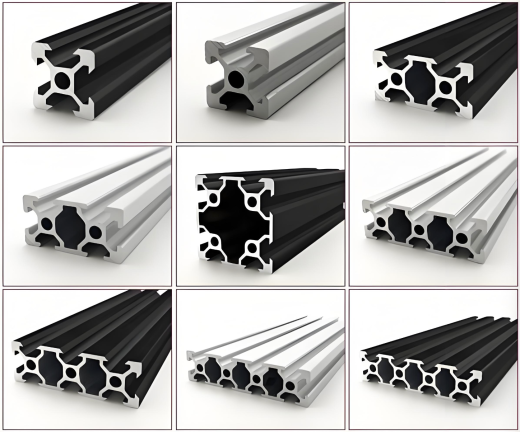
We extrude and machine four core industrial aluminum profile sizes that cover the vast majority of automation frames, workstations, enclosures and machine guards: 2020, 2040, 4040 and 4080. The numbers are cross-sectional dimensions in millimeters, so a 2020 is 20 by 20 mm and a 4080 is 40 by 80 mm. The sizing is straightforward; choosing the right profile for a given span and load is where the cost is won or lost.
The Cost of Under-Sizing
A 2020 looks perfectly adequate for a 1.2 m machine base carrying a vision system and a linear actuator. It is not. The moment of inertia is small, so at that span even the profile's own weight produces measurable sag. Add a 30 kg actuator moving back and forth and the frame sits in constant micro-motion: the camera loses its reference position, measurements drift, and the machine never reaches its accuracy specification. That is not a material defect, it is what physics says a 20 by 20 mm aluminum bar does at 1.2 m. As a rough guide for moderate loads under 50 kg, up to 0.5 m suits 2020, 0.5 to 1.2 m needs 2040 at minimum, and anything over 1.2 m or carrying moving parts calls for 4040.
Mixing 20-Series and 40-Series Profiles
Many frame designs mix series deliberately: 4040 legs, 2040 cross beams and 2020 stiffening braces, each chosen for a reason. The headache appears at assembly, because 20-series profiles use a 5 mm T-slot and 5 mm T-nuts while 40-series profiles use an 8 mm slot and 8 mm nuts. They are not interchangeable, and the connector joining a 4040 post to a 2040 beam has to accommodate two slot widths and two face dimensions. Transition brackets exist and work well, but they have to be planned. When a BOM includes both series we flag the mixed joints during review and pack connectors by assembly joint, each bag labeled with the two profiles it joins.
2020: Light-Duty, Short Spans
At 20 by 20 mm with a 5 mm slot and a weight of roughly 0.5 to 0.6 kg per meter, 2020 is the smallest profile in common industrial use. It suits 3D printer frames, small laser engraver bodies, electronics test fixtures, bench-top enclosures, light dust covers and splash guards, cable trays and sensor rails. It does not suit any span over half a meter that bears weight, frames carrying moving actuators, or guarding someone might lean against.
2040: The Same Width, Twice the Height
At 20 by 40 mm, 2040 shares its 20 mm width with 2020, so it takes the same T-nuts and connectors. The extra height gives far better bending resistance in the vertical direction, and for a horizontal beam carrying load, height does the work. Weight is roughly 0.9 to 1.2 kg per meter. Typical uses are conveyor support beams and bracket arms, mid-size inspection machine bases, workbench sub-frames and equipment mounting rails inside larger frames.
4040: The Workhorse
If industrial aluminum framing had a default setting, it would be 4040 at 40 by 40 mm with an 8 mm slot and roughly 1.3 to 1.8 kg per meter. The square section gives good stiffness in both directions, and the 8 mm slot takes larger T-nuts with higher clamping force than 5 mm hardware. For spans between 1 and 2 m under typical automation loads it hits the performance-to-cost sweet spot. It is the right choice for automation machine frames, robot cell bases, inspection and test structures, heavy-duty workbenches, and guarding posts up to about 1.5 m apart. Step up to 4080 for main beams spanning more than 2 m under load.
4080: Heavy Loads, Long Spans
At 40 by 80 mm, 8 mm slot and roughly 2.5 to 3.5 kg per meter, 4080 is the heavy-lifter. On a 2 m span with real load, the difference between 4040 and 4080 is the difference between visible flex and a structure that feels solid. It belongs under main beams spanning 2 to 3 m, robot mounting bases where rigidity drives positioning accuracy, AGV chassis rails and multi-level shelving columns. It is overkill for enclosure frames, guarding panels and light-duty brackets, which 4040 or 2040 handle at lower cost and weight. If your drawing shows 4080 where the load does not justify it, we will mention it during review and you make the call.
Machining to Your BOM
We do not ship 6 m raw bars unless you ask. Most customers send a bill of materials or an assembly drawing and we handle the rest: precision cutting to length at 0.1 mm with square, burr-free ends, CNC drilling of through, stepped and access holes, end-face tapping for hidden corner connectors and side tapping for brackets in M3 to M12, and a label on every bar matching its callout on your drawing. Profiles are packed by assembly zone so the crew opens one crate and builds that section. Surface finish options are silver anodized for most machine frames, black anodized for optical inspection equipment where reflections matter, and mill finish for internal structure. All profiles in an order are anodized in a single batch, so legs and cross beams match.
Material Test Reports are provided with every batch, and the minimum order is 500 kg.

 Industrial Aluminum