Custom Powder Coated Aluminum Window & Door Profiles
Custom powder coated aluminum window and door profiles. Standard polyester, super-durable, and PVDF powders explained. Indoor vs outdoor vs coastal. Qualicoat. No chalking. No peeling. Send drawing.
Technical Specifications
Certified precision data per ISO 9001:2015
Details
Certified precision data per ISO 9001:2015
10 / 15 / 20+ Year Architectural Durability Tiers
We extrude, pretreat, and powder-coat aluminum architectural profiles in-house for high-performance window, door, and curtain wall systems:
- Outer Frame & Sash Extrusions
- Mullions, Transoms & Thermal Break Sections (PA66-GF25)
- Glazing Beads, Sub-Frames & Coupling Profiles
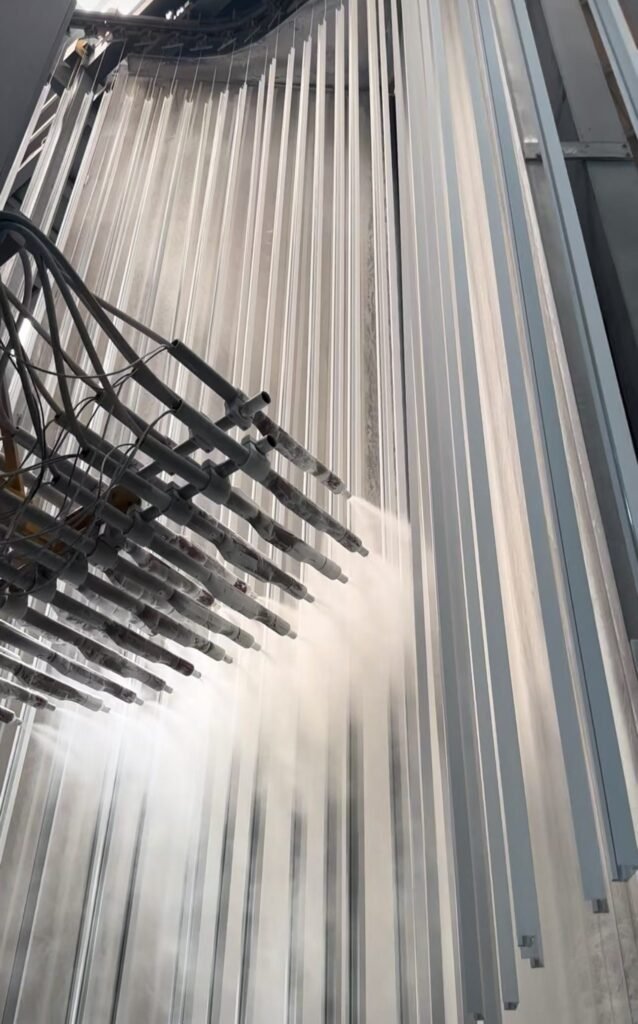
Send us your architectural CAD drawings. We manage the entire chain: custom die cutting, precision extrusion, multi-stage chemical pretreatment, automated electrostatic powder application, oven curing, and full laboratory testing. Select your target RAL color, texture finish, and durability grade—we deliver profiles that match your physical sample and stay consistent across every container shipped.
The Reality of Architectural Coatings: Two suppliers can quote you “powder-coated aluminum windows.” One uses a standard polyester resin that chalks and fades within three years facing direct sunlight. The other uses a super-durable resin that retains its gloss and color for fifteen years. Both look identical on Day 1. You find out which one you bought when the sun and salt air have done their work.
The Resin Chemistry Drives UV Longevity
Powder coating is a dry plastic powder that gets electrostatically sprayed onto aluminum, then baked at 180–200°C. The powder melts, flows out into a continuous film, and crosslinks into a hard, durable coating. That coating does three jobs: it provides color, it blocks moisture and oxygen from reaching the aluminum, and it resists sunlight without degrading.
The part that determines how well it resists sunlight is the resin. Resin is the backbone of the powder formulation. If the resin breaks down under UV, the coating chalks, fades, and eventually stops protecting the metal underneath. Different resins have different price tags and different outdoor lifespans.
| Powder Grade | Resin Type | Outdoor Life (Typical Warranty) | Where It Belongs | Standard |
|---|---|---|---|---|
| Standard polyester | Standard polyester resin, TGIC or HAA cured | 1–3 years outdoors / 10+ years indoors | Interior doors, interior partitions, decorative trim | — |
| Weather-resistant polyester | Modified polyester with UV stabilizers | 5–10 years outdoors | Standard residential windows and doors, balcony railings | Qualicoat Class 1, AAMA 2603 |
| Super-durable polyester | Super-durable polyester resin, high-performance pigments | 15–20 years outdoors | High-end residential windows, commercial doors, curtain walls | Qualicoat Class 2, AAMA 2604 |
| PVDF fluoropolymer | 70%+ PVDF resin | 20–25+ years outdoors | Coastal curtain walls, landmark buildings, extreme climates | Qualicoat Class 3, AAMA 2605 |
Standard polyester resin has ester bonds in its molecular backbone. UV light breaks those bonds. After a couple of years of direct sun, the resin starts to degrade. The surface goes chalky—run your finger across it and it leaves a white residue. That residue is the pigment and filler left behind after the resin around them has broken down. Gloss drops. Color shifts. The coating still looks intact from a distance, but it’s no longer doing its job.
Super-durable polyester uses a different resin chemistry. The molecular structure is more resistant to UV breakdown. The pigments are selected for UV stability. The combination buys you an extra ten to fifteen years of appearance retention. For a window frame that faces south in a sunny climate, that’s the difference between a coating that looks tired at year five and one that still looks clean at year fifteen.
PVDF fluoropolymer is a different material entirely. The carbon-fluorine bond is one of the strongest chemical bonds there is. UV doesn’t break it. PVDF coatings on aluminum curtain walls routinely last 25 years or more without significant color change or chalking. The cost is higher, the color range is narrower, and the application process is more demanding. For a coastal high-rise where scaffolding for repainting costs more than the original coating, PVDF is the right call.
Pretreatment: Why Coatings Peel Off in Sheets
A complaint that shows up regularly on construction forums: the powder coating on a window frame has started to peel. Not chalking. Not fading. Peeling in strips, with bare shiny aluminum underneath.
That’s not a powder failure. That’s a pretreatment failure. Or more often, the complete absence of pretreatment.
Aluminum comes off the extrusion press with a thin oxide layer, residual lubricant, and whatever else it picked up during handling and storage. If you spray powder directly onto that surface and bake it, the coating might look fine at first. It’s sitting on top of the contamination, not bonded to the aluminum. Thermal cycling, moisture, and time eventually break that weak interface. The coating lets go.
The standard pretreatment process before powder coating is a conversion coating:
- Degreasing — removes oil and processing residue
- Rinse — removes the degreasing chemicals
- Conversion coating — forms a thin chrome or chrome-free passive film on the aluminum surface
- Rinse and dry — removes residual chemicals and dries the profile
The conversion film is only 0.1 to 0.5 microns thick. You can’t see it. What it does is give the powder something to grip. The film is micro-rough, and when the powder melts and flows into that roughness, it creates a mechanical bond. More importantly, the conversion film blocks filiform corrosion.
Filiform Corrosion: The One That Creeps Under the Paint
Filiform corrosion looks like thin worm-like tracks spreading under the coating from a scratch or a cut edge. You see it most often near screw holes, at sawn ends, or where an installer’s tool nicked the frame. If you lift the coating over the track with a knife, there’s white powdery corrosion product underneath.
What’s happening: moisture and oxygen enter through a small break in the coating. If there’s no conversion coating underneath, the corrosion spreads sideways along the aluminum-coating interface. The conversion film—if it’s there and properly formed—seals that interface and stops the corrosion at the original damage point.
This matters more in coastal zones and industrial areas, where the air carries salt or acid compounds that accelerate interfacial corrosion. A project half a kilometer from the ocean needs better pretreatment than one fifty kilometers inland.
Common Surface Defects and What Causes Them
Orange Peel
The coating surface has a wavy, dimpled texture like the skin of an orange. A slight orange peel is normal. A heavy orange peel looks cheap.
It happens when the powder doesn’t flow out properly during curing. The melt viscosity was too high, or the heating rate was too slow for the powder to level before it crosslinked and set. Powder particle size distribution also plays a role.
Qualicoat standards include visual comparison panels for orange peel. For architectural surfaces, the rule of thumb is that it shouldn’t be obvious from 3 meters away. For curtain wall panels viewed up close, we use a tighter standard.
Grit and Pinholes
Small bumps on the surface are usually dust or dirt that landed on the profile between spraying and curing. Pinholes are tiny craters where gas escaped during curing and the coating didn’t flow back to fill the hole. Gas can come from moisture trapped in the pretreatment layer that vaporized during baking, or from micro-porosity in the aluminum itself.
The fix: keep the spray booth clean, run the pretreatment dryer properly, and use quality billet that doesn’t carry casting porosity to the surface.
Color Variation Within a Batch
The window frames on one elevation look slightly different from the frames on another. They were all supposed to be the same RAL 7016.
This happens when profiles from different production runs get mixed on the same project. One batch of powder might be from a different manufacturing lot than another. Even small differences in curing temperature or time can shift the final shade.
For a project order, we coat every profile—frames, sashes, mullions, glazing beads—in one continuous production run using the same powder lot and the same oven settings. The color is consistent across the whole order because it was all made together.
How Thick Should the Coating Be?
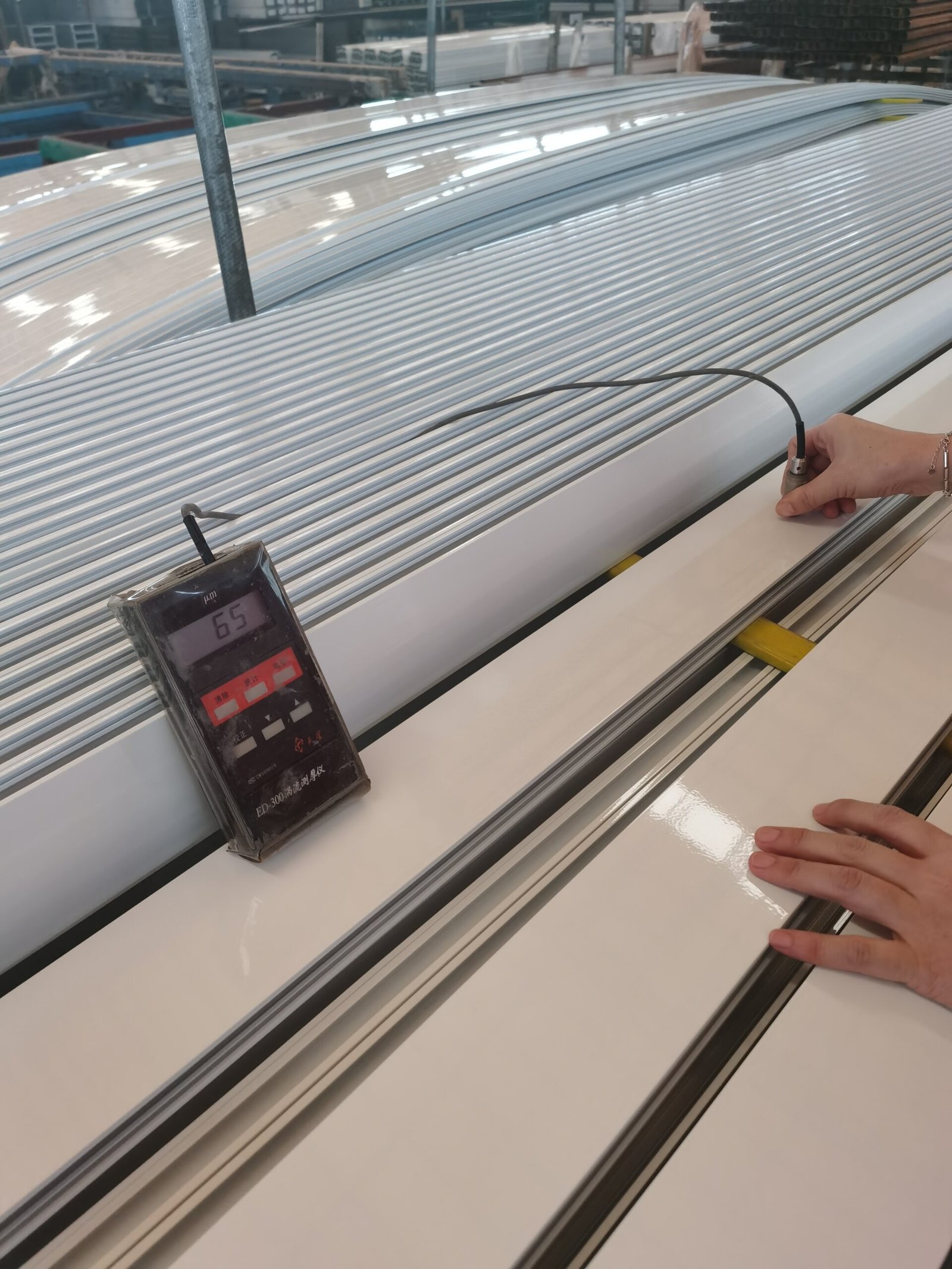
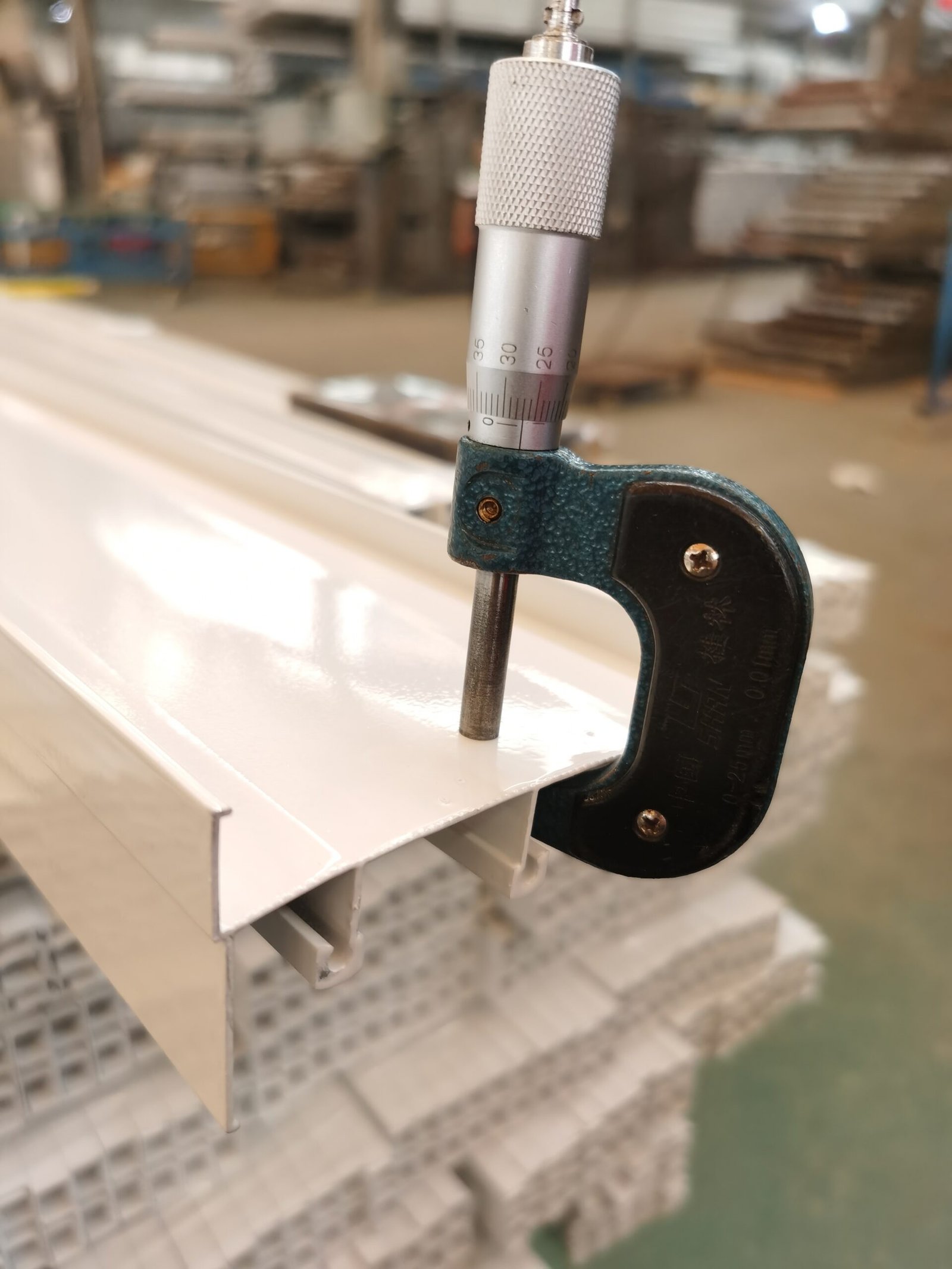
Qualicoat Class 1 requires a minimum local film thickness of 50 µm. Class 2 and Class 3 require 60 µm minimum. For architectural windows and doors, 60–80 µm is the practical range.
Below 50 µm, the coating is noticeably thinner at edges and corners, where coverage is hardest to achieve. UV penetrates thin spots faster. Pinholes become more likely. The coating simply wears out sooner.
Edge coverage deserves special attention. Powder coating relies on electrostatic attraction. The charged powder particles wrap around the profile to some extent, but they don’t hug sharp corners the way a liquid paint would. On a window profile with crisp 90-degree edges, the coating on the very corner can be significantly thinner than on the flat faces. We adjust gun settings and check corner thickness with an eddy current gauge on samples from every production run. If an edge is consistently reading low, we adjust the process.
Which Powder for Which Job
| Application | Powder Grade | Film Thickness | Expected Life | Standard |
|---|---|---|---|---|
| Interior doors, partitions | Standard polyester | 60 µm | 10+ years indoors | — |
| Residential windows, inland | Weather-resistant polyester | 60–80 µm | 10–15 years | Qualicoat Class 1 |
| High-end residential, villas | Super-durable polyester | 60–80 µm | 15–20 years | Qualicoat Class 2 |
| Commercial curtain walls | Super-durable polyester or PVDF | 80 µm / 30+ µm | 20–25 years | Qualicoat Class 2/3 |
| Coastal windows and curtain walls | Super-durable polyester minimum, PVDF recommended | 80 µm / 35+ µm | 20–25+ years | Qualicoat Class 2/3, AAMA 2605 |
| Industrial zones, acid rain | PVDF | 35+ µm | 25 years | AAMA 2605 |
A practical note on coastal projects: salt spray and UV often work together. The combination degrades coatings faster than either one alone. If the budget can stretch to PVDF, use it. If not, super-durable polyester with a full 80 µm thickness and a properly applied conversion coating is the minimum.
In-House Powder Coating Capability
| What We Do | Details |
|---|---|
| Pretreatment | Chrome or chrome-free conversion coating, full immersion and spray |
| Powder application | Electrostatic spray, manual and automatic guns, RAL full range plus metallics |
| Film thickness | 60–80 µm standard, adjustable per specification |
| Quality checks | Film thickness on edges and faces, gloss level, color vs. master sample, adhesion (cross-hatch Class 0), impact resistance, cure verification |
| Profile types | Window frames, sashes, mullions, transoms, glazing beads, coupling profiles, full system kits |
| Color matching | Master sample retained from first batch. Reorders matched to ΔE ≤ 1.0 |
All profiles for one project are coated in one production run—same powder lot, same oven, same shift. The frames match the sashes match the beads.
Frequently Asked Questions
Q1: We are replacing coastal apartment windows that show white corrosion tracks and peeling paint. What specification prevents this?
That failure is classic filiform corrosion driven by salt air and inadequate pretreatment. For coastal installations, specify Super-Durable Polyester (Qualicoat Class 2 Seaside) or PVDF (AAMA 2605) over a high-performance conversion coating. Ensure all field-cut ends are sealed with an anti-corrosion primer before installation.
Q2: Can you produce wood-grain finishes on window extrusions?
Yes. We apply a durable base powder coat (Super-Durable Polyester), wrap the profile with a vacuum-sealed wood-grain sublimation transfer film, bake to transfer the pattern into the coating layer, and finish with a UV-resistant clear topcoat to prevent outdoor fading.
Q3: What is the primary difference between Qualicoat Class 1, Class 2, and Class 3?
The difference is verified outdoor weatherability based on long-term Florida exposure testing:
- Class 1: 50% gloss retention after 1 year in Florida (Standard Polyester).
- Class 2: 50% gloss retention after 3 years in Florida (Super-Durable Polyester).
- Class 3: 50% gloss retention after 10 years in Florida (PVDF Fluoropolymer).
Q4: Can we powder-coat thermally broken profiles with PA66 polyamide strips?
Yes. Polyamide 66 reinforced with 25% glass fiber (PA66-GF25) easily withstands powder coating oven curing temperatures (180–200℃). We can powder-coat the individual aluminum profiles prior to crimping or coat the fully assembled thermal break profiles depending on your system design and color requirements.
Schematics
Cross-sectional dimensions
Related Profiles
Complementary hardware for your structural assembly
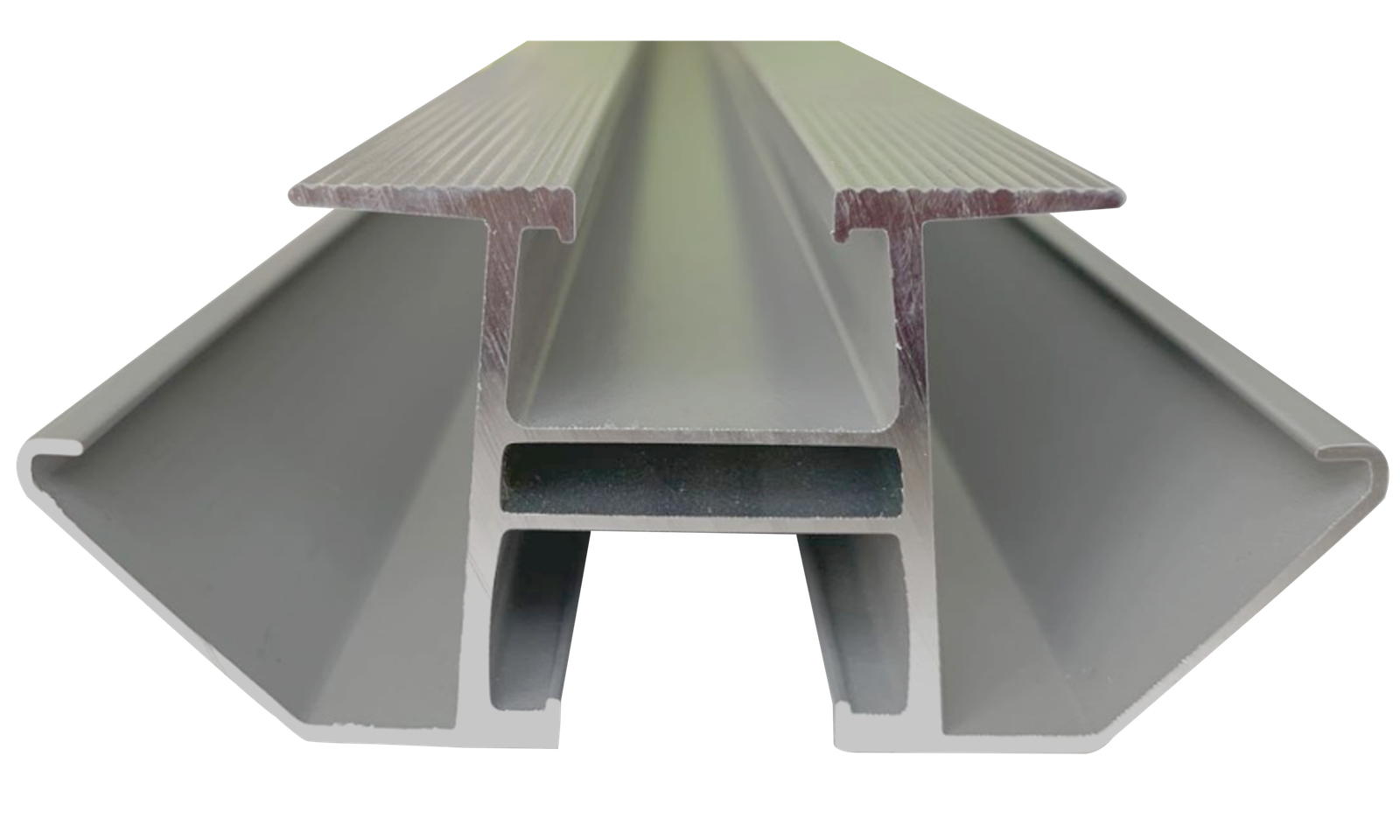
Aluminum Solar Mounting Profiles | Standard Rails & Custom Tracker Extrusions
Standard aluminum tubes and custom-extruded solar mounting profiles—rails, columns, clamps. 6005-T5 & 6063-T6, anodized or PVDF coated. Pre-cut, punched, labeled.…
Details
LED Light Aluminum Extrusion Profiles | Housing, Channels & Rails
Custom aluminum profiles for LED tube lights, linear fixtures, strip channels, and track rails. 6063-T5, black or silver anodized. Pre-cut,…
Details
2020, 2040, 4040, 4080 Aluminum Extrusion Profiles | Frame Sizing & Load Guide
Don't guess the wrong size. 2020, 2040, 4040, and 4080 aluminum profiles explained with real span and load guidance. Cut,…
Details