Custom Aluminum Angle Profiles — Equal & Unequal Leg For Framing, Bracing, Corners, Brackets & Structural Applications
Extruded aluminum L-angle for structural framing, bracing and brackets. Equal and unequal leg in 6063-T5 and 6061-T6. Buckling-resistant cross-sections, welded assemblies, anodized and powder coated finishes. Engineering data per GB/T 5237, EN 755-9 and ASTM B221.
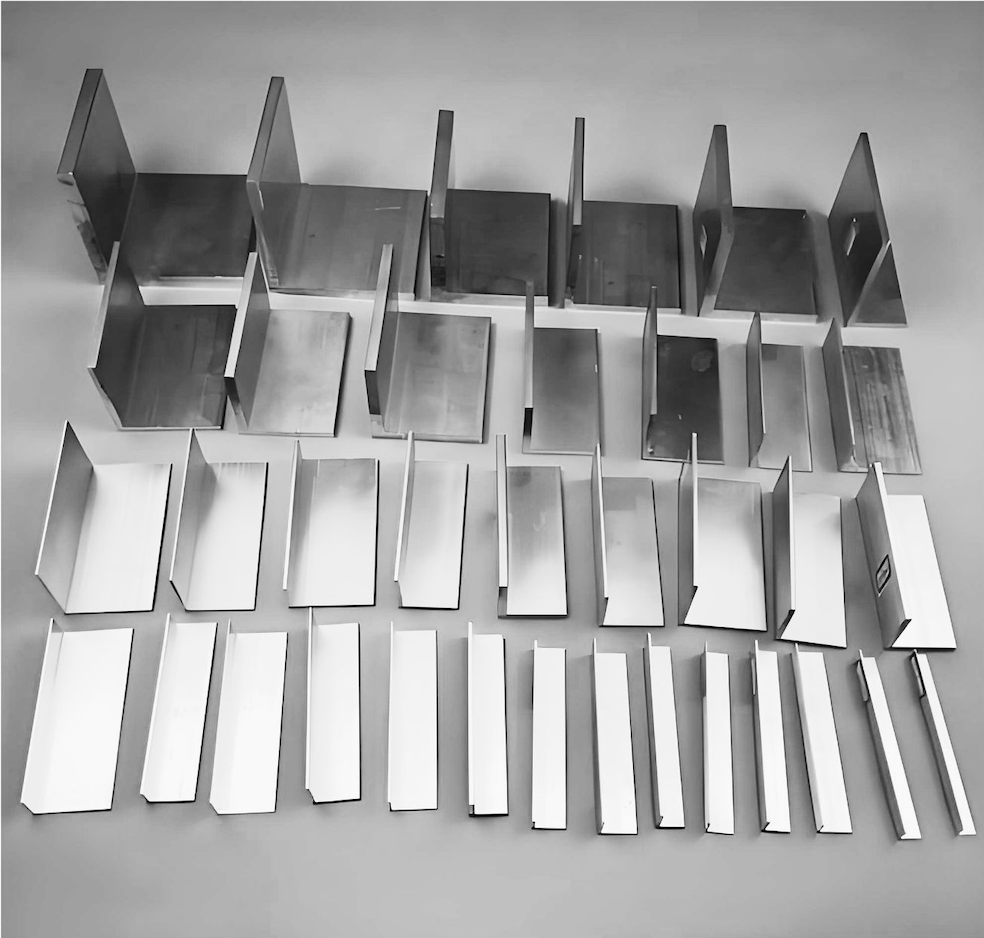
Technical Specifications
Certified precision data per ISO 9001:2015
Details
Certified precision data per ISO 9001:2015
Walk into any fabrication shop and ask for the most-used profile off the rack. The answer is almost always the same: aluminum angle. It braces, it frames, it trims, it reinforces, it mounts. The simple L-shaped cross-section solves more problems than almost any other extrusion — which is why it shows up in everything from a machine base to a shelf bracket to a curtain-wall reveal.
The challenge isn’t finding a use for it. It’s picking the right version. Equal leg or unequal. 6063-T5 or 6061-T6. 2 mm wall or 6 mm wall. Anodized or mill finish. Get those four decisions right and the angle does its job for decades. Get them wrong and you’ll find out in service.
Linkedalu Metal Group Co., Ltd extrudes custom aluminum angle — equal leg and unequal leg — for framing, bracing, corners, brackets, shelving and structural applications. We hold tight dimensional tolerances, mill test certificates against GB/T 5237, EN 755-9 or ASTM B221, and we walk you through the alloy and geometry choice before the die is cut.
Why aluminum angle is the most-used profile in any fabrication shop
Two legs meeting at 90° give you resistance to bending in two directions at once, in a profile that weighs roughly a third of the equivalent steel angle. That combination — light, stiff in two planes, easy to cut, drill, tap and weld — is why the L-section shows up in places where designers never specified it by name.
Because the profile is extruded (not bent from sheet), the cross-section is consistent from one end of the bar to the other, the inside corner is repeatable, and the wall thickness is uniform. That consistency matters anywhere the part has to fit a mating component or carry a predictable load.
Equal leg vs unequal leg — which one and why
Equal leg: balanced load and visual symmetry.
Equal leg angles — 25 × 25, 50 × 50, 100 × 100 — are the default workhorses. Both legs share the structural duty, so loads can come from either direction without favoring one. Use them for corner reinforcement on enclosures, frames and panels; square framing for machine bases and equipment cabinets; shelf supports where both ends of the angle share the load; and architectural trim where visual symmetry matters.
Unequal leg: when one face does more than the other.
Unequal leg angles — 50 × 25, 75 × 50, 100 × 50 — give you a longer leg for fastening or stiffness and a shorter leg to keep the profile compact in the other direction. Use them for wall-mounted shelf brackets (long leg to the wall, short leg under the shelf), ledge supports and awning frames, panel edge framing where one face mounts and the other caps, and asymmetric structural connections where the load is heavier in one direction.
Picking the wrong one usually shows up as wasted material (an equal leg whose second leg is bigger than the job needs) or a poor fit (an unequal leg whose geometry doesn’t match the surfaces it has to join). When in doubt, equal leg for balanced duty, unequal leg for one-sided mounting.
Alloy and temper: 6063-T5 vs 6061-T6 — the real difference
| Property | 6063-T5 | 6061-T6 | 6060-T5 |
|---|---|---|---|
| Tensile strength Rm | ≥ 160 MPa | ≥ 260 MPa | ≥ 160 MPa |
| Yield strength Rp0.2 | ≥ 110 MPa | ≥ 240 MPa | ≥ 120 MPa |
| Elongation A50 | ≥ 8 % | ≥ 8 % | ≥ 8 % |
| Surface finish | Excellent (anodizing-ready) | Good (slightly greyish anodized) | Excellent |
| Weldability | Acceptable for light loads | Excellent | Acceptable |
| Machinability | Good | Excellent | Good |
| Best for | Visible trim, light framing | Structural brackets, welded frames | European preference |
These are minimum thresholds from GB/T 5237.1 and EN 755-2. Final figures are stated on the MTC.
6061-T6 has roughly twice the yield strength of 6063-T5. For a structural bracket, a machine base, a welded frame, a roof rack crossbar or any application where the angle has to carry real load, 6061-T6 is the safer choice. 6063-T5 extrudes more cleanly, takes anodizing more uniformly, and produces a brighter, more even surface — pick it when the angle is visible and isn’t carrying structural load.
Geometry and buckling: a/b aspect ratio matters more than you think
This is the question most catalogs don’t answer. Take a 100 × 50 unequal leg angle under compression. The longer leg (100 mm) is stiffer because it has more material; the shorter leg (50 mm) is more slender — it has a larger width-to-thickness ratio (b/t) and is more susceptible to local buckling. The cross-section doesn’t fail uniformly; it fails where the slenderness is highest.
Recent parametric studies on aluminum angle under uniform compression confirm this: as the aspect ratio a/b increases from 1.0 (equal leg) to 2.0 (highly unequal), the ultimate compressive load drops because the shorter leg buckles first in the elastic range. Conversely, going from a slender section to a stocky one lets the cross-section develop stresses up to 40 % above yield before local buckling kicks in.
Practical takeaway for specifiers:
- For compression-loaded angles, prefer equal leg (a/b = 1.0) when geometry allows.
- For unequal leg under compression, size the short leg so b/t ≤ 12 for typical aluminum, or upgrade the alloy from 6063-T5 to 6061-T6 to raise the yield threshold and delay elastic buckling.
- Don’t trust the yield strength alone. Check b/t against the slenderness limit before specifying a thin-wall unequal angle for a structural bracket.
Weight chart (equal leg)
Theoretical values (kg per meter). Actual mill weight varies ±5 % depending on tolerance and corner radius.
| Leg × Leg (mm) | Wall t (mm) | Weight (kg/m) |
|---|---|---|
| 20 × 20 | 2.0 | 0.20 |
| 25 × 25 | 2.0 | 0.26 |
| 25 × 25 | 3.0 | 0.38 |
| 30 × 30 | 2.0 | 0.31 |
| 30 × 30 | 3.0 | 0.46 |
| 40 × 40 | 2.0 | 0.42 |
| 40 × 40 | 3.0 | 0.62 |
| 40 × 40 | 4.0 | 0.81 |
| 50 × 50 | 2.0 | 0.53 |
| 50 × 50 | 3.0 | 0.78 |
| 50 × 50 | 5.0 | 1.27 |
| 60 × 60 | 3.0 | 0.94 |
| 60 × 60 | 5.0 | 1.54 |
| 60 × 60 | 6.0 | 1.83 |
| 75 × 75 | 5.0 | 1.94 |
| 75 × 75 | 8.0 | 3.05 |
| 80 × 80 | 6.0 | 2.47 |
| 100 × 100 | 6.0 | 3.11 |
| 100 × 100 | 8.0 | 4.11 |
| 100 × 100 | 10.0 | 5.08 |
Need a different size or unequal leg? Send your spec and we’ll calculate the theoretical weight and confirm what’s extrudable.
Where aluminum angle replaces steel — and where it doesn’t
Aluminum weighs roughly 35 % of steel by volume. For an equal-strength bracket, that means lighter shipping, easier installation, less load on whatever structure the angle is bolted to. It also means aluminum angle survives outdoor, humid, marine and chemical environments where steel angle would rust. Aluminum cuts, drills, taps and machines with standard tooling, takes anodizing and powder coating cleanly, and welds (especially 6061-T6) for assemblies that need to be one piece.
Steel angle is cheaper per kilogram and stronger per unit cross-section. For a high-load structural column or a heavy machinery base where weight isn’t a constraint and corrosion isn’t an issue, steel still wins on cost-per-MPa. The case for aluminum isn’t that it’s stronger — it’s that it solves problems steel can’t.
Fabrication: cut, drill, tap, weld, bend, finish
Cut-to-length tolerances.
Standard length is 6.0 m; we cut to your call-out list with ±0.5 mm length tolerance on pieces up to 3 m, and ±1.0 mm on longer mill lengths. Mitre saws, notch cuts and angled end-mills are programmed from your drawing.
Hole and thread tolerances.
CNC drilling holds position to ±0.2 mm; tapped holes (M5 / M6 / M8 / M10 typical) are cut to 6H fit. For matched-hole assemblies, we drill and tap mating parts in the same setup so they index correctly on site.
Welding 6061-T6 vs 6063-T5.
6061-T6 welds excellently with TIG or MIG using 4043 or 5356 filler. The heat-affected zone loses some temper (T6 → T4 in the weld zone), so welded 6061 angles are typically specified as 6061-T6 base with weld strength accounted for in the design. 6063-T5 can be welded but is generally chosen for non-welded assemblies.
Surface finishes.
- Mill finish — standard supply.
- Anodized — Class AA10 / AA15 / AA20 for marine or visible architectural use.
- Powder coated — architectural-grade, ≥ 60 μm, Qualicoat or GSB certified.
- PVDF — for high-UV or coastal environments.
How an angle order moves through the mill
- You send the drawing — leg lengths, wall thickness, alloy, temper, finish, fabrication list.
- We confirm extrudability, return theoretical weight per meter and per piece, and flag any geometry that won’t extrude cleanly.
- New die or reused die; locked to a single billet batch.
- Extrusion → straightening → cut-to-length → CNC drilling / tapping / notching → finish → labeling.
- MTC (EN 10204 3.1) issued to GB/T 5237, EN 755-9 or ASTM B221.
- Packed and labeled to your call-up list.
Frequently Asked Questions ( FAQ )
Q1: Should I use 6061-T6 or 6063-T5 for an aluminum angle bracket?
It depends on whether the bracket is structural or decorative. 6061-T6 has roughly twice the yield strength of 6063-T5 (240 MPa vs 110 MPa), welds cleanly, and is the safer choice for any angle that has to carry load — machine bases, welded frames, roof racks, structural brackets. 6063-T5 extrudes more cleanly, takes anodizing more uniformly, and produces a brighter, more even surface; pick it when the angle is visible and isn’t carrying structural load.
Q2: Does the unequal leg angle buckle at the short leg?
Usually, yes. The longer leg is stiffer because it has more material; the shorter leg has a larger width-to-thickness ratio (b/t) and is more susceptible to local buckling. Under compression, the section fails where the slenderness is highest — typically the short leg buckling first in the elastic range. To avoid this, keep b/t ≤ 12 for typical aluminum angle under compression, or upgrade from 6063-T5 to 6061-T6 so the cross-section can develop its yield capacity before elastic buckling kicks in.
Q3: How much does aluminum angle weigh per meter?
Depends on leg length and wall thickness. A 50 × 50 × 3 mm 6063-T5 equal leg weighs roughly 0.78 kg/m; a 100 × 100 × 10 mm angle weighs about 5.08 kg/m. Theoretical weights for the standard equal-leg range are in the table above; for unequal leg or non-standard sizes, send your spec and we’ll calculate it.
Q4: Can aluminum angle replace steel angle for my bracket?
Often yes, with caveats. Aluminum angle weighs roughly 35 % of equivalent steel, doesn’t rust, machines and welds with standard tooling, and is the right call for weight-sensitive assemblies, outdoor/marine/chemical environments, visible architectural work, and non-sparking/non-magnetic applications. Where steel still wins is raw load capacity per dollar — for heavy structural columns or machine bases where weight isn’t constrained, steel angle is cheaper per MPa.
Q5: Can 6063-T5 aluminum angle be welded?
Yes, but with caveats. 6063-T5 has good weldability for non-structural assemblies, but the heat-affected zone loses temper and the weld zone ends up roughly at T4 strength. For welded light-duty frames, we usually recommend 6061-T6 anyway — it welds more cleanly, holds post-weld strength better, and gives the design engineer a more predictable strength to work with.
Q6: What documents ship with an angle order, and can you cut and drill to my drawing?
A mill test certificate (EN 10204 3.1) with measured mechanical properties, chemical composition and coating parameters, issued to GB/T 5237, EN 755-9 or ASTM B221 as the project requires. We cut to length (±0.5 mm tolerance on pieces up to 3 m), drill and tap holes (M5 / M6 / M8 / M10 typical, ±0.2 mm position tolerance), and label every piece to your call-up list so it arrives ready to assemble.
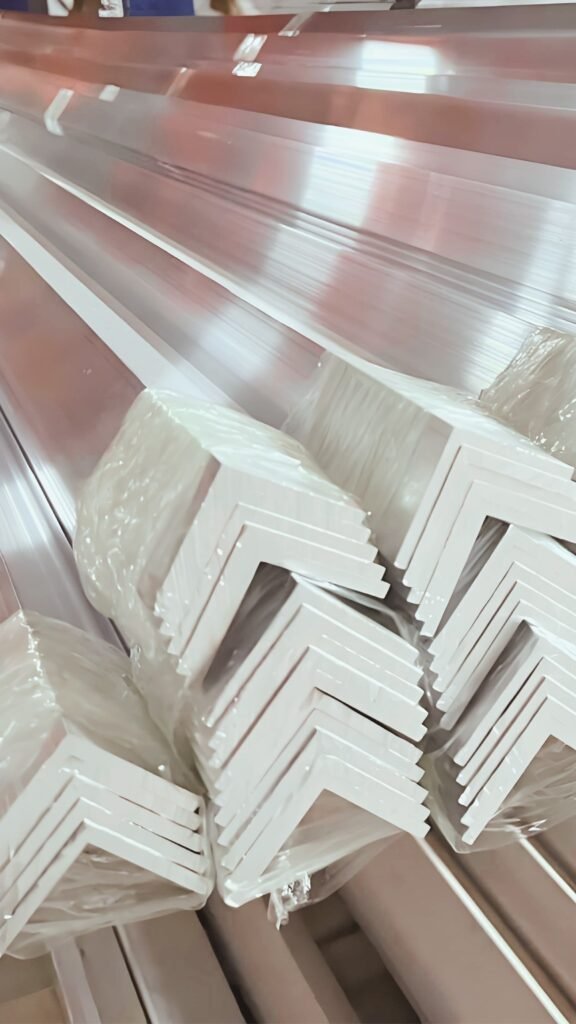
Schematics
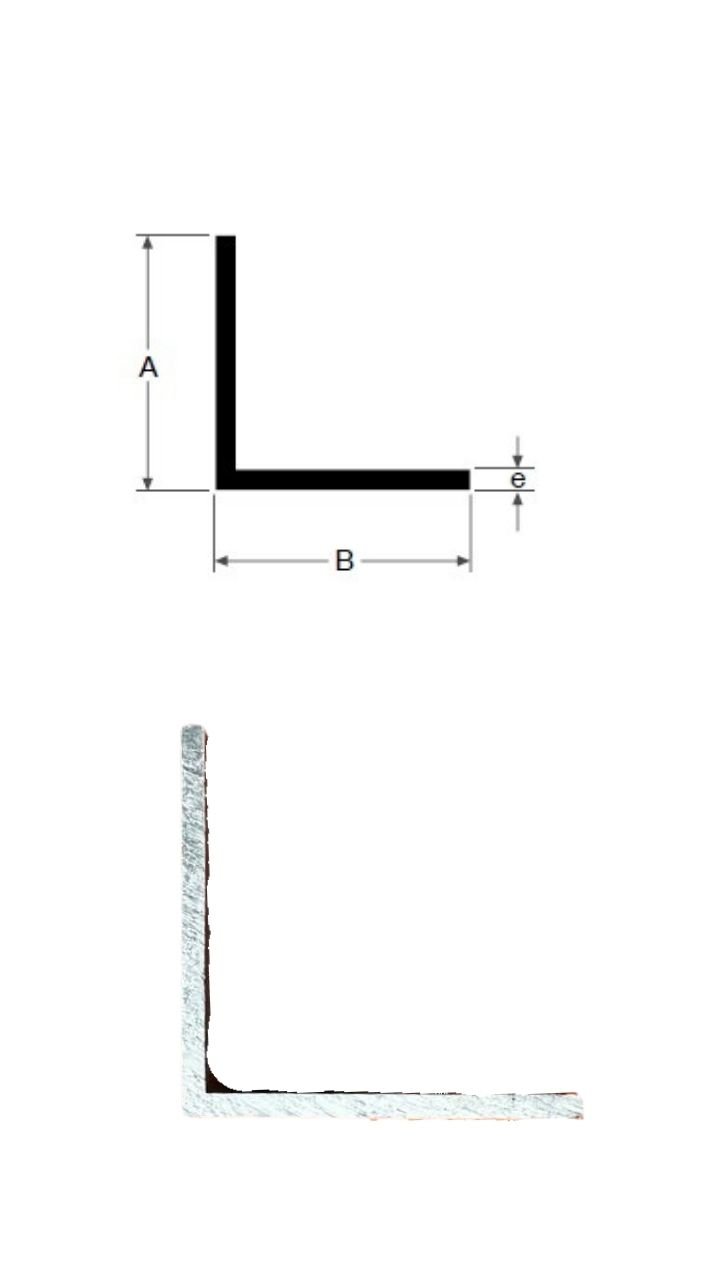
Cross-sectional dimensions
Related Profiles
Complementary hardware for your structural assembly
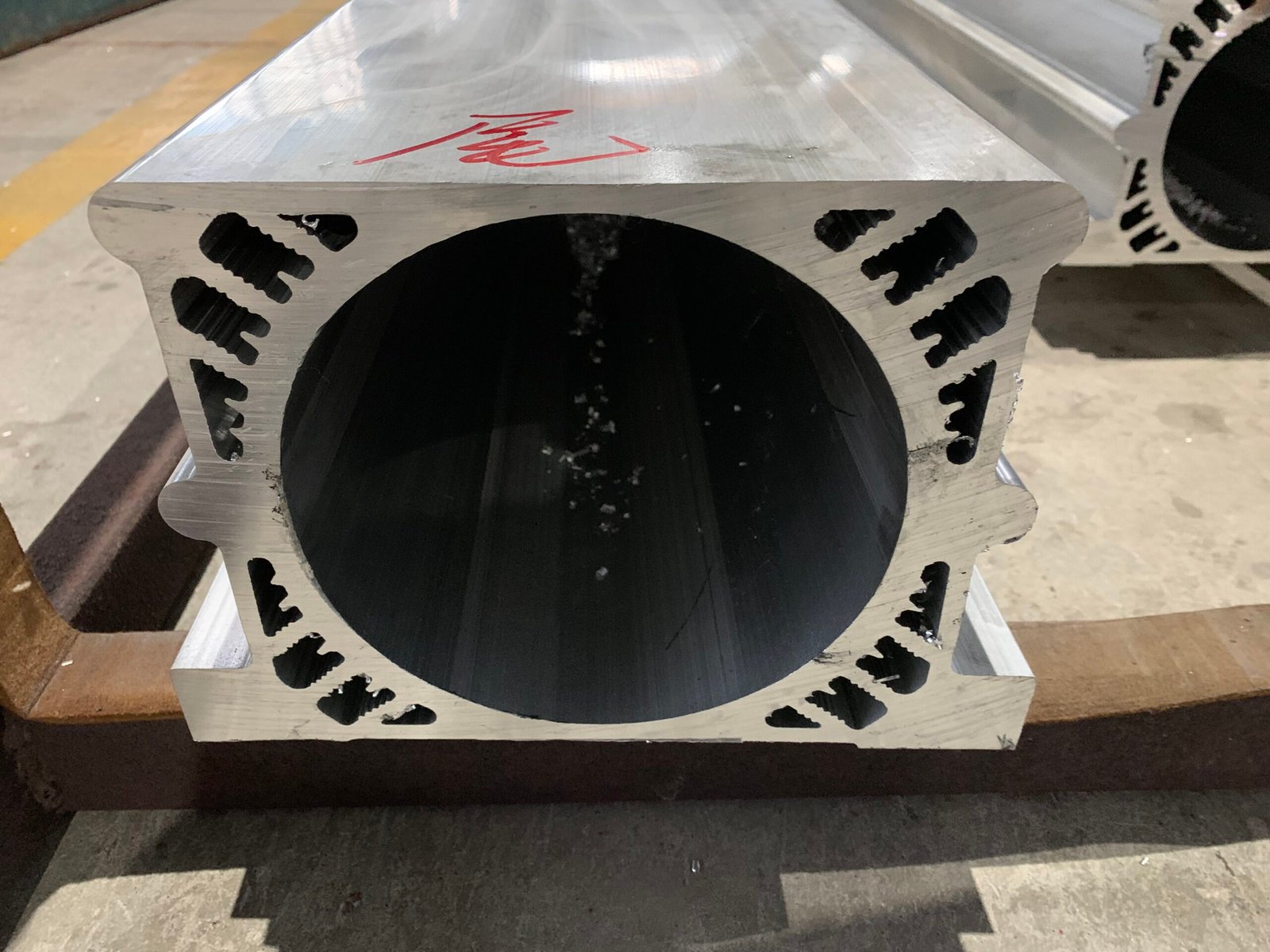
Custom EV Motor Cooling Enclosures | Extruded Aluminum Servo, Stepper & EV Motor Shells
Custom extruded aluminum motor housings with integral cooling fins. Tight bore roundness ≤0.05 mm. Black anodized, hard anodized. Cut, bored,…
Details
Custom Aluminum Rectangular Tubes | 6063 & 6061 Extruded Tubing
Factory-direct custom extruded aluminum rectangular tubes & flat pipes. 6063/6061 alloys, tailored wall thicknesses & interior ribs. CNC fabrication &…
Details
Custom Aluminum Heat Sink Extrusions | 6063 LED & Power Heatsink Profiles
We extrude custom aluminum heat sink profiles in 6063-T5. Capabilities include high-density fins (up to 1.5mm pitch), black anodizing for…
Details