
Extruded vs. Die-Cast Motor Housings: An Engineer's Guide to Choosing
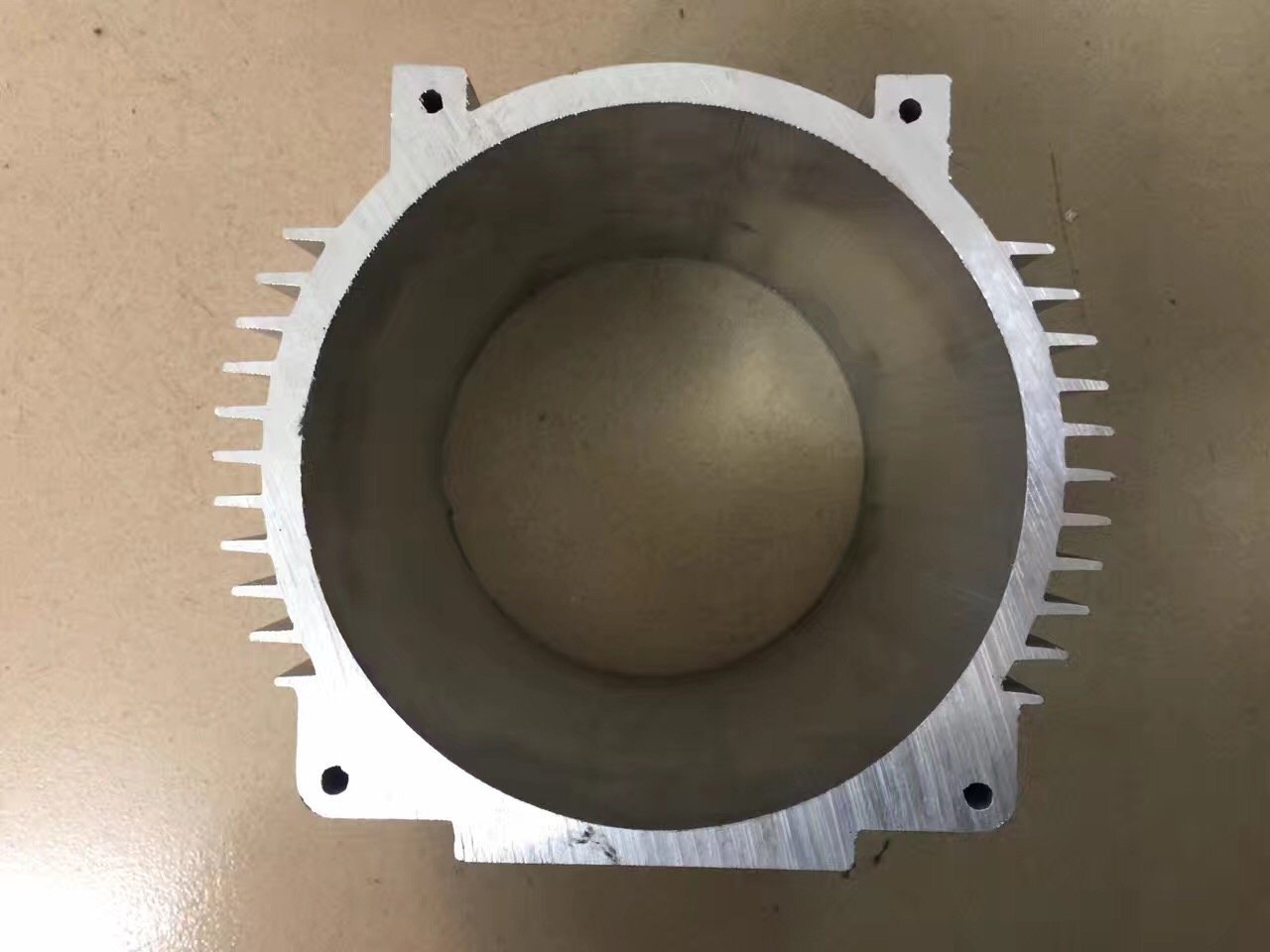
Extrusion gives dense, weldable metal and tall fins; die casting gives complex bosses and near-net shape. A practical comparison of thermal performance, porosity, tooling cost, lead time and finishing for motor and servo housings.
Two Processes, Two Sets of Trade-offs
When you specify an aluminum motor housing, the first fork in the road is not alloy or surface finish. It is the manufacturing process. Extrusion and die casting both produce aluminum shells, and that is roughly where the similarity ends. They differ in what shapes are possible, what the material can do thermally and structurally, what you pay up front and how fast you can iterate.
Extrusion pushes a heated aluminum billet through a shaped die opening under high pressure. The profile emerges as a continuous length with a constant cross-section, and you cut it to housing length and machine the bore, spigots, end faces and mounting holes afterwards. Die casting injects molten aluminum into a reusable steel mold under high pressure, filling the entire cavity in seconds to produce a near-net-shape part with complex external geometry. The key phrase is constant cross-section: extrusion gives you that, and die casting does not need it.
Thermal Performance: The Extrusion Advantage
Heat kills motors, and a housing that shaves a few degrees off the winding temperature can add years of insulation life.
Material density matters
Extruded aluminum is wrought material, hot-worked from a cast billet, which refines the grain structure and closes internal voids. Die-cast aluminum solidifies from liquid in seconds, so even with vacuum assist it carries microscopic gas porosity distributed through the wall. Those voids insulate. In practice an extruded 6063 housing conducts heat roughly 10-20 percent more effectively through the wall than the same wall thickness in die-cast A380.
Fin geometry flexibility
With extrusion, fin height, thickness, pitch and taper are built into the die. You can pack high-aspect-ratio fins around the perimeter, exactly the geometry a die-cast mold struggles with because the metal freezes before it reaches the fin tip. For high-density natural-convection cooling, extrusion is the standard for a reason. Die casting can include fins, but they are shorter, thicker and carry generous draft angles, and if they fill at all, tip porosity reduces their real heat transfer below the modeled value.
Structural Integrity: Porosity, Pressure Tightness and Fatigue
Die-cast parts always contain some gas porosity. For a motor housing this matters when the housing forms part of a sealed enclosure and becomes a leak path, when mounting feet are welded on and expanding gas causes blowout, and under vibration or thermal cycling, where porosity acts as a stress raiser. High-pressure die casting reduces porosity without eliminating it, and vacuum die casting gets close at a cost.
Extruded profiles are inherently pore-free. Weldability is excellent, so a 6061-T6 extrusion welds cleanly, while welding a die-cast A380 housing is a gamble. For EV traction motors or any design where the housing is a structural member, this factor alone can decide the process.
Strength and ductility differ in character as well as magnitude. Die-cast A380 has respectable tensile strength around 324 MPa but very low elongation, typically under 4 percent. Extruded 6061-T6 delivers roughly 290 MPa tensile with 8-10 percent elongation, so it bends before it breaks. In a motor that sees shock loads, vibration or thermal expansion stress, that ductility margin matters.
Design Freedom: Where Die Casting Wins
- Complex external geometry - mounting flanges with thick bosses on two sides, an integrated connector box and asymmetric stiffening ribs, all formed in one shot. Extrusion cannot produce side features, so they must be machined from solid or bolted on.
- Undercuts and partial features - extrusion dies can create internal splines, screw bosses and ribbed bores as long as they run the full length of the profile. Die casting can form partial-depth pockets, side holes and recesses that do not pass through the whole part.
- Wall thickness variability - die casting handles a 2 mm wall next to a 10 mm boss far more gracefully than extrusion, though solidification shrinkage must be managed.
- The extrusion workaround - extrude a blank with a thicker wall section and machine away material to create pockets, grooves and mounting features. It adds a step, but keeps the thermal and structural benefits while adding geometric complexity.
Tooling Cost, Lead Time and Iteration Speed
| Factor | Extrusion | Die casting |
|---|---|---|
| Tooling cost | Lower, single-figure thousands | Higher, often an order of magnitude more |
| Lead time to first samples | A few weeks | Two to three times longer |
| Order quantity to start | A few hundred kilograms | Several hundred to a thousand pieces |
| Design change | Modify the die at modest cost | Mold modification is limited and expensive |
| Iteration risk | Low: tweak the profile and re-run | High: a wrong mold costs the full tooling budget again |
If you expect two or three housing revisions during prototyping, extrusion saves weeks and money at every turn: the die is a simple steel disc with a shaped aperture. Die casting pays back once the design is frozen and volumes are high enough for lower per-part machining to offset the mold investment.
Dimensional Precision and Post-Processing
Both processes need secondary machining, but the starting blank is different. An extrusion gives you a very consistent blank: wall thickness, straightness and cross-section are tightly controlled because the die opening barely changes over a run, and there is no rapid-solidification stress locked into the material. Bore roundness of 0.05 mm or better is straightforward with proper machining, and finer roundness is achievable with honing.
Die casting starts closer to net shape, so you machine less, but the process adds variability: parting-line flash, draft angles and distortion during cooling. Machining setups must compensate, which slows cycle times, and critical bearing bores carry extra stock to clean up surface porosity.
Surface finishing follows from the same difference. Extruded surfaces are dense and take anodizing beautifully, so black anodized extruded servo housings are an industry standard. Anodizing a die casting is difficult because silicon in the skin and subsurface porosity cause discoloration and poor adhesion, so most die-cast motor housings are painted, powder coated or left as-cast. If the housing must be anodized, extrusion is almost always the answer.
How to Decide
- Choose extrusion when the housing is tubular or prismatic with a constant cross-section, when heat dissipation needs tall or dense fins, when an anodized finish is required, when the housing may be welded or must be pressure tight, or when you are prototyping and expect design changes.
- Choose die casting when the housing has complex external geometry that would be expensive to machine, when annual volumes are high and the design is frozen, when features must change along the housing length, or when a painted finish is acceptable.
- Consider the hybrid: an extruded body tube for thermal and structural performance, with die-cast or CNC end bells and mounting feet bolted or friction-stir welded on. It is not always the cheapest option, but for high-power-density servo motors it is often the best-performing one.
The Bottom Line
For the tubular, finned housings that dominate the servo and stepper motor world, extrusion is the default: thermally superior, dimensionally stable and dramatically cheaper to prototype. Die casting earns its place when the shape becomes too complex for a constant cross-section and volumes justify the tooling. Send us the cross-section or 3D model for a DFM review and extrusion tooling and per-part costs.
Customer reviews
No reviews yet — be the first to review Extruded vs. Die-Cast Motor Housings: An Engineer's Guide to Choosing.
Write a review
Reviews are read by our team before they appear here, usually within one working day. We publish what customers write; we only remove spam and abuse.
Keep reading
 Knowledge
Aluminum Profile Surface Finishes: Anodizing, Powder Coating, PVDF
Anodizing, powder coating, PVDF, electrophoresis, wood grain and mechanical finishes are specified by different standards, applied at…
Read article arrow_forward Knowledge
7075, 7050, and 7005: When 6061 Isn't Strong Enough
The 7xxx family is the strongest extrudable aluminum, reaching roughly 572 MPa in 7075-T6. What 7050 and 7005 add, why 7xxx extrusion runs…
Read article arrow_forward Knowledge
How Extrusion Dies Shape Aluminum Profile Quality: Steel, Tolerances, and Surface Defects Explained
Wall thickness drift, die lines and streaking are signatures left by the extrusion die, not the alloy. How H13 die steel, nitriding…
Read article arrow_forward