
6005 vs 6005A vs 6061 vs 6063: What's the Real Difference?
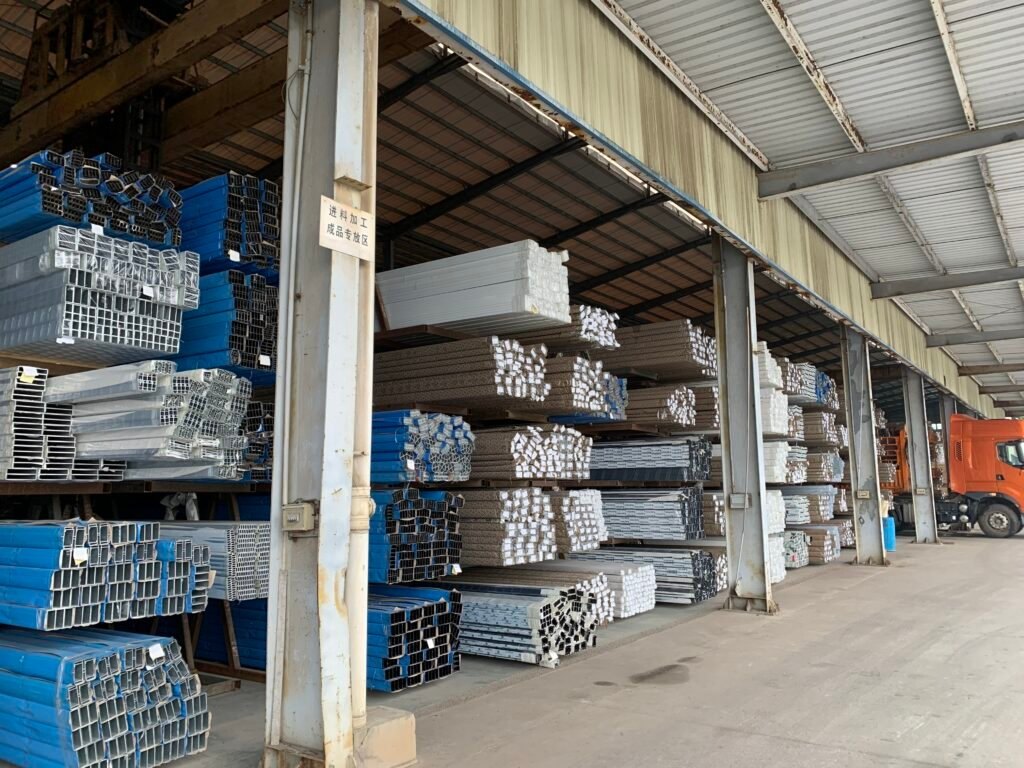
6005A-T6 reaches near-6061 strength while extruding faster, costing less per meter and holding more strength after welding. The real difference between these four alloys, and where each one wins.
The Gap Between 6063 and 6061
If you have spent any time in aluminum specifications for a solar mounting system, a structural railing or a vehicle frame, you have hit the same wall. 6063 feels too soft for the load case, 6061 feels like overkill and costs too much per meter, and then someone mentions 6005 or 6005A. Here is what the difference actually is, and where each alloy earns its place.
What 6005 and 6005A Actually Are
6005 is a magnesium-silicon alloy positioned deliberately between 6063 and 6061. It carries more silicon and magnesium than 6063, so it age-hardens to a much higher strength, while retaining far better extrusion behavior than 6061. 6005A is the refined version: a tighter chemistry window with a controlled manganese-plus-chromium dispersoid addition that improves quench sensitivity and grain structure, and a tighter limit on copper.
That copper limit matters more than it looks. Copper raises strength but reduces corrosion resistance and can cause discoloration and blotching during anodizing. By capping copper lower, 6005A delivers more consistent anodized appearance and slightly better corrosion performance than a higher-copper variant of the same family.
Mechanical Comparison
| Alloy and temper | Tensile (min) | Yield (min) | Elongation | Character |
|---|---|---|---|---|
| 6063-T5 | 160 MPa | 110 MPa | 8% | Best extrudability and surface, lowest strength |
| 6005-T5 | 260 MPa | 215 MPa | 9% | The middle ground, good surface, much stronger than 6063 |
| 6005A-T5 | 270 MPa | 225 MPa | 8% | Refined chemistry version of 6005-T5 |
| 6005A-T6 | 285 MPa | 240 MPa | 8% | Further heat treatment, approaching 6061 strength |
| 6061-T6 | 290 MPa | 240 MPa | 8% | The structural standard: weldable, slower to extrude |
The progression is the whole story. 6005A-T6 lands within a few percentage points of 6061-T6 on yield strength, yet it extrudes faster, costs less per meter, and holds a higher proportion of its strength in the as-welded condition. If a design is even marginally inside the strength envelope of 6005A-T6, switching down from 6061-T6 often saves real money.
Why Not Simply Use 6061 Everywhere?
Because you pay for that strength three times over. It extrudes slower, so the press produces fewer meters per hour. It produces a worse surface on complex shapes, which matters if the profile will be anodized and visible. And it wears dies faster, which shows up as more frequent tool maintenance and shorter tool life. A 6061 rail may be stronger on paper, but on a section with fine teeth the die wears quickly and the anodized channel finish can vary. 6005A is where the balance sits.
Extrusion Speed and Real Cost per Meter
- 6063 extrudes fastest: up to roughly 50-60 m/min on simple architectural sections.
- 6005A runs at roughly 80-90 percent of the 6063 speed on the same geometry.
- 6061 runs at roughly 60-70 percent of the 6063 speed, and less on thin-walled hollows.
- Die wear follows the same order: 6061 consumes tool life fastest, and 6063 is gentlest.
On a long production run those percentages are not academic. They translate directly into cost per kilogram quoted back to you.
The Temper Question: T5 or T6 in the Same Alloy
If your 6005A-T5 design is close to a deflection or stress limit, stepping to T6 within the same alloy is usually easier than redesigning the section or moving to 6061. The chemistry does not change and the die does not change; only the heat treatment cycle after extrusion changes. That makes the T6 upgrade a low-risk lever when a calculation comes back marginal.
Welding: Where 6005A Earns Its Place
In T5 or T6 temper, 6005A retains a higher proportion of its strength in the as-welded condition than 6061-T6 does. That single property is why it is a preferred alloy for welded aluminum structures such as trailer frames, truck bodies and some solar support frames, where the heat-affected zone of a 6061-T6 weld would force an expensive post-weld heat treatment or an upsized section.
Where Each Alloy Makes Sense
6005 and 6005A-T5: solar, railings and medium structures
You get 260-270 MPa tensile in a profile that still extrudes well and takes anodizing or powder coating without trouble. Solar rail profiles often mix small screw channels with a load-bearing body, which is exactly the geometry that punishes 6061 tooling.
6005A-T6: when you are right at the T5 limit
Use it when the calculation is close but the section is already optimized. Recover the margin in the heat treatment cycle rather than in a new die.
6061-T6: heavy structural and highly machined parts
When loads are genuinely high, when the part is mostly machined, or when the section is simple enough that slow extrusion does not hurt much, 6061-T6 remains the industry standard and the easiest alloy to buy.
6063-T5: lowest cost per meter and the best surface
Nothing beats it for architectural frames and visible trim where loads are low and appearance is everything.
Quick Decision Table
| Your priority | Best choice | Reason |
|---|---|---|
| Lowest cost per meter, best surface, light loads | 6063-T5 | Fastest extrusion, best anodizing response |
| Best balance of strength, cost and finish | 6005A-T5 | Roughly 70 percent more tensile than 6063-T5 with good extrusion behavior |
| Maximum strength without 6061 tooling penalties | 6005A-T6 | Approaches 6061-T6 strength, extrudes faster |
| Maximum strength, weldable, structural | 6061-T6 | Long-established structural standard |
The Detail Nobody Mentions: Availability
6063 and 6061 are universally stocked. 6005A is common but not universal: some plants only run it to order, and standard die libraries for it are smaller. If your project depends on a specific mill finish or a standard profile in 6005A, confirm availability before you freeze the design, or budget for a new die.
The Bottom Line
6005A is not a compromise between 6063 and 6061 so much as a deliberate optimization: nearly 6061 strength with much of 6063's extrudability and finish quality. For solar mounting, structural railings, welded frames and anything with fine visible detail under load, it is usually the cheapest way to hit the numbers.
Customer reviews
No reviews yet — be the first to review 6005 vs 6005A vs 6061 vs 6063: What's the Real Difference?.
Write a review
Reviews are read by our team before they appear here, usually within one working day. We publish what customers write; we only remove spam and abuse.
Keep reading
 Knowledge
Aluminum Profile Surface Finishes: Anodizing, Powder Coating, PVDF
Anodizing, powder coating, PVDF, electrophoresis, wood grain and mechanical finishes are specified by different standards, applied at…
Read article arrow_forward Knowledge
Extruded vs. Die-Cast Motor Housings: An Engineer's Guide to Choosing
Extrusion gives dense, weldable metal and tall fins; die casting gives complex bosses and near-net shape. A practical comparison of thermal…
Read article arrow_forward Knowledge
7075, 7050, and 7005: When 6061 Isn't Strong Enough
The 7xxx family is the strongest extrudable aluminum, reaching roughly 572 MPa in 7075-T6. What 7050 and 7005 add, why 7xxx extrusion runs…
Read article arrow_forward